
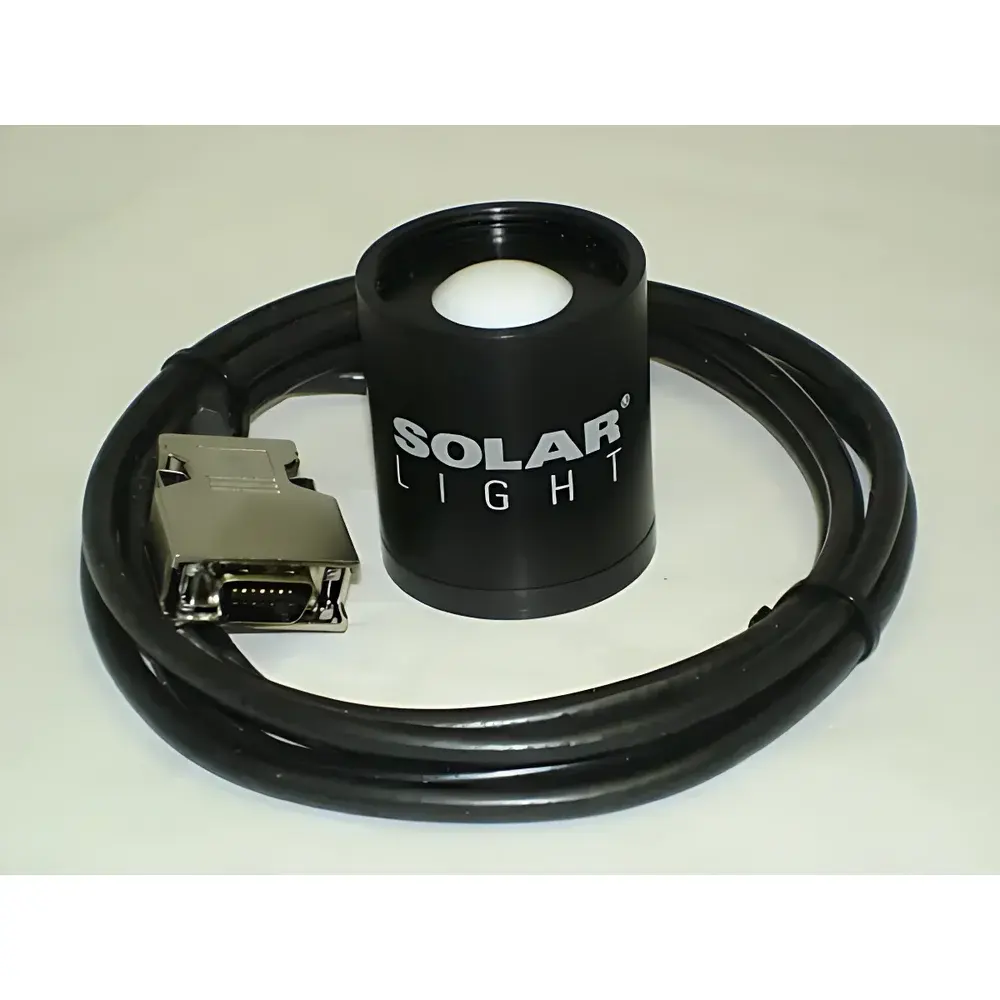
Solar Light PMA2106 Non-Weighted UVB Radiometer
| Brand | Solar Light |
|---|---|
| Origin | USA |
| Model | PMA2106 |
| Detection Principle | Broadband Non-Weighted UVB (280–320 nm) |
| Spectral Response | Flat, Unfiltered Silicon Photodiode with UVB-optimized optical filter |
| Angular Response | Lambertian (Cosine-corrected, ±5% up to 60° incidence) |
| Measurement Range | 0.001–200 mW/cm² (0.01–2000 W/m²) |
| Resolution | 0.001 mW/cm² / 0.01 W/m² |
| Operating Temperature | 0–50 °C (32–120 °F), non-condensing |
| Temperature Coefficient | ±1 %/°C (for solar UVB irradiance) |
| Cable | Retractable coaxial, 0.3–1.5 m |
| Dimensions | Ø40.6 mm × H45.8 mm |
| Weight | 200 g |
| Calibration | NIST-traceable, factory-calibrated for UVB irradiance (mW/cm² and W/m²) |
Overview
The Solar Light PMA2106 Non-Weighted UVB Radiometer is a precision broadband detector engineered for quantitative measurement of unweighted ultraviolet-B (UVB) spectral irradiance across the 280–320 nm range. Unlike biologically weighted instruments (e.g., erythemally weighted UV meters conforming to CIE action spectrum), the PMA2106 delivers spectrally flat, non-weighted radiometric output—essential for applications requiring absolute physical irradiance values rather than biological effect estimates. Its measurement principle relies on a temperature-stabilized silicon photodiode coupled with a hard-coated, interference-type optical filter that rejects UVA, visible, and infrared radiation while maintaining high transmission uniformity within the target UVB band. The detector’s optical architecture incorporates a precision-ground diffuser and cosine-corrected entrance optic, achieving Lambertian angular response with ≤±5% deviation up to 60° from normal incidence—critical for accurate characterization of diffuse sky radiation, large-area UV lamps, and collimated or divergent artificial sources.
Key Features
- True non-weighted UVB spectral response: optimized for physical irradiance quantification—not erythemal or vitamin-D-weighted metrics
- High dynamic range: 0.001–200 mW/cm² (1×10⁻⁶–2 W/m²), enabling low-intensity environmental monitoring and high-flux therapeutic lamp validation
- NIST-traceable calibration: each unit ships with individual calibration certificate referencing NIST Standard Reference Radiometers (SRRs), supporting ISO/IEC 17025-compliant laboratory workflows
- Thermally compensated design: integrated temperature sensor and algorithmic correction minimize drift; specified coefficient ±1 %/°C under solar-spectrum illumination
- Robust mechanical construction: anodized aluminum housing, IP54-rated front aperture, and retractable coaxial cable (0.3–1.5 m) for field and benchtop flexibility
- Dual-unit display capability: real-time readout simultaneously in mW/cm² and W/m², facilitating cross-standard reporting (e.g., ASTM E892, ISO 17166)
Sample Compatibility & Compliance
The PMA2106 is compatible with all Solar Light PMA-series meter bases (e.g., PMA2100, PMA2200) and third-party data loggers supporting 0–5 V analog output or RS-232 digital interface. It meets the geometric and spectral requirements for UVB irradiance measurement defined in ASTM G132–19 (Standard Practice for Calibration of Solar Simulation Equipment) and ISO 17166:2019 (Erythema reference action spectrum), though its non-weighted output serves distinct metrological purposes. For GLP/GMP-regulated environments—including phototherapy device qualification, polymer UV stability testing, and agricultural UV exposure trials—the instrument supports audit-ready documentation via calibrated serial-number traceability and calibration expiration tracking. It is not intended for personal dosimetry or human exposure compliance assessment (e.g., ICNIRP limits), as it lacks spectral weighting or time-integrated dose functionality.
Software & Data Management
When paired with Solar Light’s optional WinUV™ software (v5.2+), the PMA2106 enables automated data acquisition, timestamped irradiance logging, statistical analysis (min/max/avg/std dev), and export to CSV, Excel, or XML formats. The software enforces electronic calibration certificate association per sensor ID and maintains full audit trails—including user login, parameter changes, and data export events—to satisfy FDA 21 CFR Part 11 requirements where configured with digital signatures and system access controls. Raw voltage outputs are linearly proportional to irradiance (mV per mW/cm²), permitting integration into custom LabVIEW, Python (PySerial), or MATLAB control systems using documented scaling factors provided in the technical manual.
Applications
- Validation and routine monitoring of narrowband UVB phototherapy lamps (e.g., Philips TL-01, Waldmann UV311) in dermatology clinics and clinical research units
- Quantification of natural and augmented UVB flux in greenhouse and field-based agronomic studies assessing plant photomorphogenesis and flavonoid synthesis
- Accelerated weathering test chamber calibration per ASTM G154 and ISO 4892-3, ensuring consistent UVB irradiance profiles during polymer degradation experiments
- Environmental UV monitoring networks measuring stratospheric ozone-driven variability in ground-level UVB, referenced to WMO/GAW protocols
- Optical safety testing of UV-emitting devices (e.g., curing lamps, disinfection systems) against IEC 62471 thresholds for UV hazard classification
FAQ
Is the PMA2106 suitable for measuring UV index (UVI)?
No. The UV Index requires erythemally weighted irradiance (250–400 nm, CIE-defined action spectrum). The PMA2106 provides non-weighted physical irradiance only and cannot compute UVI without spectral reconstruction and weighting algorithms.
Can this detector be recalibrated after field use?
Yes. Solar Light offers accredited recalibration services traceable to NIST SRM 2201 and SRM 2202, including uncertainty budgets compliant with ISO/IEC 17025. Recalibration interval is recommended annually for critical applications or after mechanical shock or prolonged outdoor exposure.
Does the PMA2106 require warm-up time before stable readings?
No. The detector exhibits negligible zero drift and achieves full stability within 30 seconds of power-on, verified per ANSI/NCSL Z540.3-2006 thermal settling criteria.
What is the spectral out-of-band rejection ratio?
The optical filter provides >10⁴:1 rejection at 330 nm and >10⁵:1 rejection at λ > 360 nm, confirmed by spectral transmittance measurements using a double-monochromator UV-VIS spectrophotometer.





