
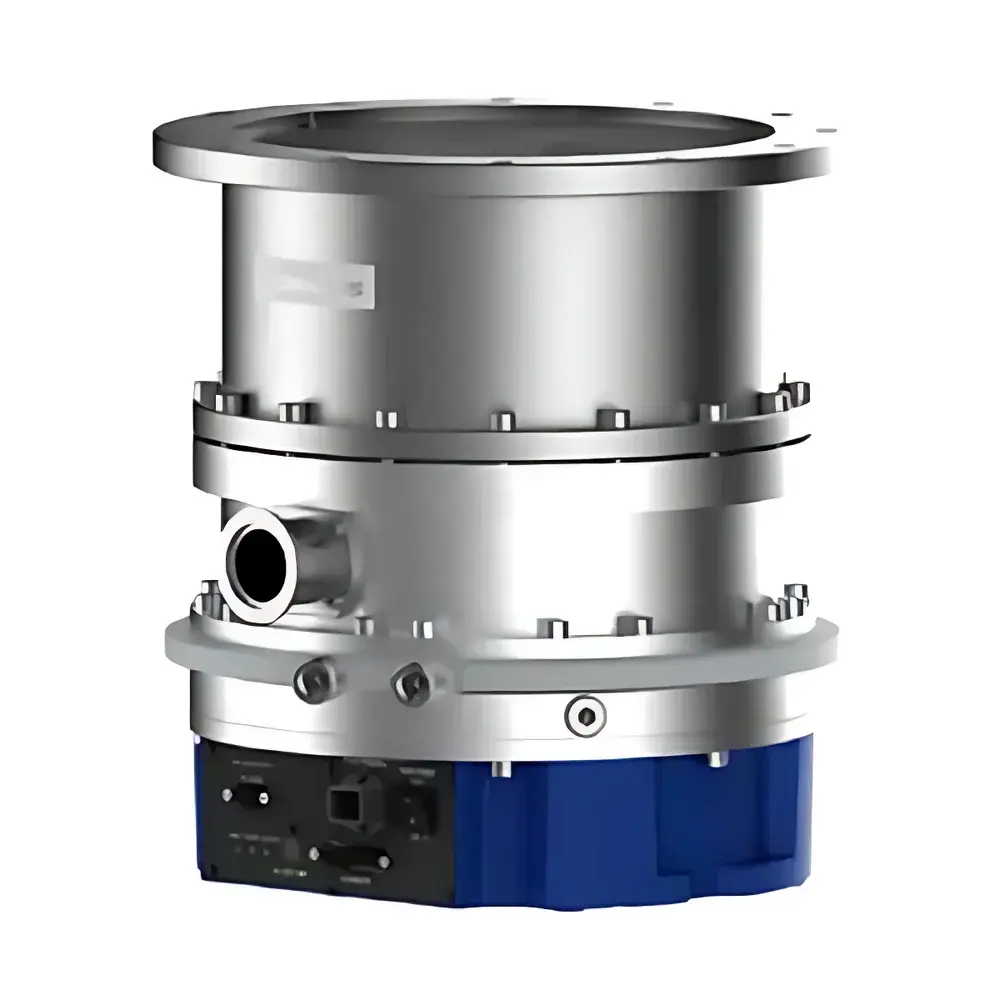
Edwards STP iS 2207 Full-Magnetic Levitation Turbo Molecular Pump
| Brand | Edwards Vacuum |
|---|---|
| Origin | Japan |
| Manufacturer Type | Authorized Distributor |
| Origin Category | Imported |
| Model | YT890Z040 |
| Pump Type | Turbo Molecular Pump |
| Oil-Free Operation | Yes |
| Pumping Speed (N₂) | 2200 L/s |
| Ultimate Pressure | 1×10⁻⁹ mbar |
| Weight | 38 kg |
| Flange | ISO-F 250 / CF 250 |
Overview
The Edwards STP iS 2207 is a high-performance, full-magnetic levitation turbo molecular pump engineered for ultra-high vacuum (UHV) and extreme high vacuum (XHV) applications in research laboratories, semiconductor process tools, analytical instrumentation (e.g., mass spectrometers, surface science systems), and advanced thin-film deposition chambers. Utilizing contact-free magnetic bearing technology across all rotor axes, the STP iS 2207 eliminates mechanical wear, vibration transmission, and hydrocarbon contamination associated with traditional ball-bearing or hybrid-bearing turbopumps. Its rotor spins at up to 90,000 rpm in vacuum, achieving stable, repeatable pumping performance with intrinsic rotational stability and minimal thermal drift. Designed for integration into clean, oil-free vacuum architectures, it operates without lubricants or backing pump oil carryover—ensuring compatibility with sensitive UHV environments where hydrocarbon outgassing or particulate generation must be strictly controlled.
Key Features
- Full active magnetic levitation system with digital PID control for all five degrees of freedom—enabling zero-contact suspension, sub-micron rotor centering accuracy, and dynamic load compensation during thermal expansion or external vibration.
- Integrated high-efficiency drive electronics with soft-start ramping, real-time speed monitoring, and automatic fault diagnostics—including bearing position deviation, over-temperature, power anomaly, and vacuum interlock status.
- ISO-F 250 (DN 250) and CF 250 flange options for direct mounting to vacuum chambers; compliant with ISO 16067-1 and ASTM F2579 standards for vacuum component interface geometry and leak integrity.
- Oil-free, dry operation certified per ISO 8573-1 Class 0 for compressed air purity—eliminating risk of hydrocarbon backstreaming and enabling seamless integration with cryo- or ion-pumped UHV systems.
- Rotor assembly constructed from high-strength titanium alloy with aerodynamically optimized blade geometry for nitrogen, argon, and helium—delivering balanced pumping speed across light and heavy gases (e.g., 2200 L/s for N₂, ~1900 L/s for Ar, ~1100 L/s for He).
- Compact footprint (Ø320 × H490 mm) and 38 kg mass optimized for vertical or horizontal installation in space-constrained tool platforms, including SEM/FIB columns and R&D sputtering systems.
Sample Compatibility & Compliance
The STP iS 2207 is compatible with inert, reactive, and corrosive gas environments when paired with appropriate foreline protection (e.g., dry scroll or diaphragm backing pumps). It is routinely deployed in systems requiring compliance with ISO 14644-1 Class 4 cleanroom specifications and meets electromagnetic compatibility requirements per EN 61326-1:2013 for laboratory instrumentation. The pump’s firmware architecture supports audit-ready operational logs and adheres to data integrity principles aligned with FDA 21 CFR Part 11 when integrated with validated control software. All materials in vacuum contact—including rotor blades, stator housings, and flange gasket surfaces—conform to ASTM B265 Grade 5 titanium and ISO 15730 ultraclean surface finish specifications (<0.2 µm Ra).
Software & Data Management
The pump interfaces via RS-485 (Modbus RTU) or optional Ethernet/IP protocol, enabling bidirectional communication with host vacuum controllers or SCADA systems. Edwards’ iQ Control Suite (v4.2+) provides real-time telemetry—including rotational speed, bearing current/voltage, motor temperature, vibration spectra (FFT-based), and cumulative runtime—with configurable alarm thresholds and event-triggered data export (CSV/JSON). Audit trails record all parameter changes, emergency stops, and maintenance alerts with timestamped user IDs—supporting GLP/GMP documentation workflows. Firmware updates are digitally signed and performed over secure HTTPS, maintaining traceability per IEC 62443-3-3 cybersecurity guidelines.
Applications
- Ultra-high vacuum chambers for X-ray photoelectron spectroscopy (XPS), Auger electron spectroscopy (AES), and low-energy electron diffraction (LEED)
- Ion implantation and plasma etch tools in semiconductor front-end fabrication
- Residual gas analysis (RGA) systems requiring base pressures below 1×10⁻⁹ mbar
- Cryogenic electron microscopy (cryo-EM) sample preparation vacuum lock systems
- Atomic layer deposition (ALD) and molecular beam epitaxy (MBE) reactors demanding ultra-clean, vibration-isolated pumping
- Gravitational wave detector vacuum systems where micro-vibration suppression is critical to optical path stability
FAQ
What forevacuum pressure range is required for safe startup?
The STP iS 2207 requires a pre-vacuum of ≤1×10⁻² mbar (measured at the pump inlet) prior to acceleration; this is typically achieved using a dry scroll pump or diaphragm pump meeting ISO 8573-1 Class 2 purity.
Is helium pumping speed specified, and how does it compare to nitrogen?
Yes—helium pumping speed is approximately 1100 L/s, reflecting its lower molecular mass and higher thermal velocity relative to nitrogen (2200 L/s); this ratio aligns with kinetic theory predictions for turbomolecular stage compression.
Can the pump operate continuously at ultimate pressure without load?
Yes—the STP iS 2207 is rated for continuous operation at 1×10⁻⁹ mbar under bake-out conditions (≤150 °C chamber temperature) and maintains long-term stability with <0.5% speed drift over 10,000 hours of cumulative runtime.
Does the magnetic bearing system require periodic recalibration?
No—bearing position sensors and control algorithms are factory-calibrated and self-compensating; no field recalibration is needed unless major hardware replacement occurs (e.g., stator coil or sensor module).
What is the recommended maintenance interval under typical lab use?
With no consumable bearings or lubricants, routine maintenance is limited to annual inspection of cooling fins, electrical connectors, and flange seal integrity; Edwards recommends full functional verification every 24 months per ISO/IEC 17025 calibration guidelines.



