
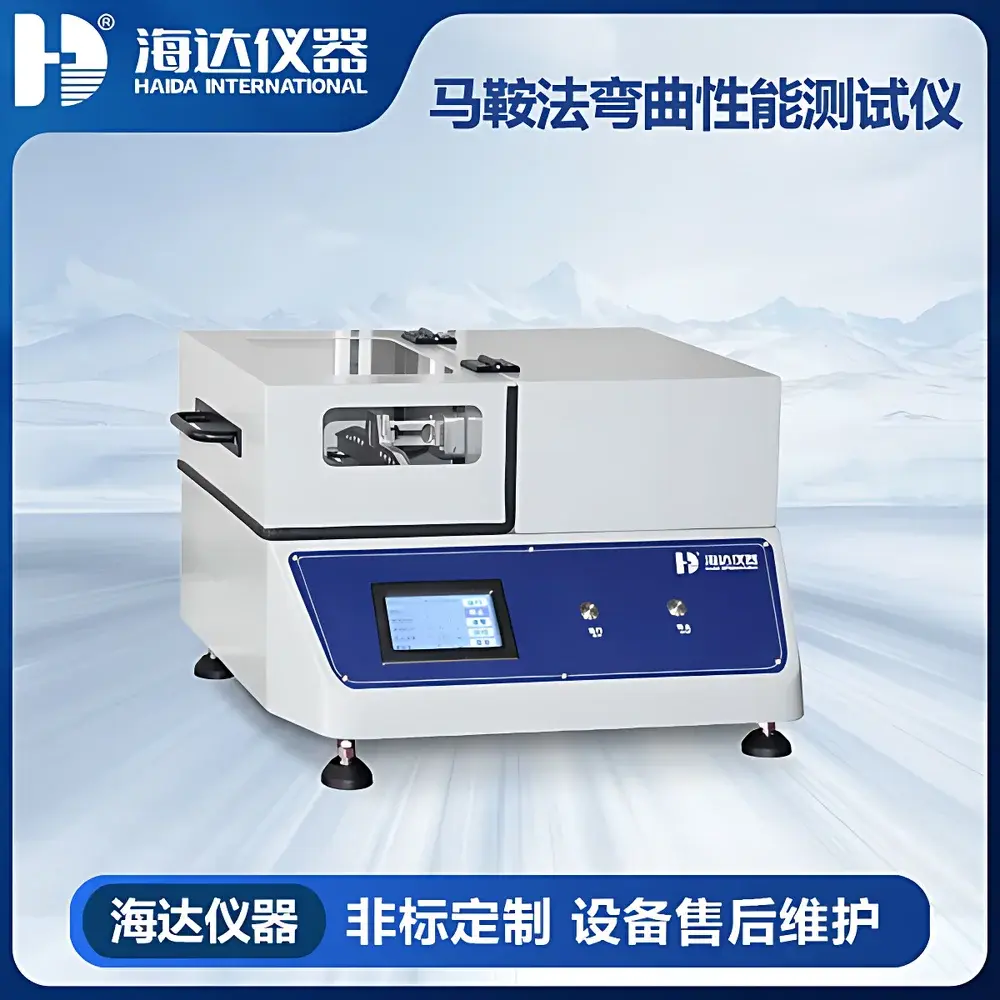
HAIDA HD-D013 Slot-Method Fabric Stiffness Tester
| Brand | HAIDA INTERNATIONAL |
|---|---|
| Origin | Guangdong, China |
| Manufacturer Type | Direct Manufacturer |
| Product Category | Domestic Instrumentation |
| Model | HAIDA HD-D013 Slot-Method Fabric Stiffness Tester |
| Pricing | Upon Request |
Overview
The HAIDA HD-D013 Slot-Method Fabric Stiffness Tester is an engineered precision instrument designed to quantify the bending rigidity and recovery behavior of textile fabrics in accordance with standardized mechanical testing principles. It operates on the slot (or slit) method—distinct from cantilever or saddle methods—where a fabric specimen is inserted into a calibrated vertical slot, and its protrusion length under controlled self-weight is measured to derive bending length and stiffness index. This principle is grounded in classical beam mechanics and directly correlates with fabric handle, drape, and end-use performance in apparel, home textiles, and technical fabrics. The instrument delivers repeatable, operator-independent measurements critical for QC laboratories, R&D departments, and third-party testing facilities requiring compliance with national and international textile mechanical property standards.
Key Features
- Micro-sensor–based digital measurement system with automatic detection and real-time signal processing, eliminating manual parallax errors and enhancing measurement reproducibility.
- Integrated high-precision optical displacement sensing and calibrated mechanical actuation, ensuring consistent force application and positional resolution across repeated test cycles.
- Compact, rigid aluminum alloy chassis with CNC-machined anodized aluminum test platform—non-corrosive, dimensionally stable, and optimized for long-term calibration retention.
- Front-panel human-machine interface featuring a 7-inch full-color capacitive touchscreen with intuitive icon-driven navigation, multilingual support (English/Chinese), and context-sensitive soft keys.
- Industrial-grade brushed aluminum front panel with sealed metal tactile buttons, rated for >500,000 actuations and resistant to laboratory environmental contaminants.
- Electrostatically applied powder-coated steel enclosure offering mechanical robustness, ESD-safe operation, and ease of decontamination in regulated environments.
- Onboard data logging with timestamped results, configurable test protocols, and direct USB export for traceable reporting.
Sample Compatibility & Compliance
The HD-D013 accommodates woven, knitted, nonwoven, and coated fabrics within standard specimen dimensions (25 mm × 250 mm) per GB/T 18318.6–2017. It supports both single-layer and laminated specimens up to 5 mm thickness without modification. The instrument meets essential metrological requirements for textile mechanical testing, including linearity (±0.5% FS), repeatability (CV ≤ 1.2%), and thermal drift stability (<0.02 mm/°C over 23 ± 2°C ambient). It is validated for conformance to GB/T 18318.6–2017 (equivalent to ISO 2411:2022 Annex B for slot-method bending resistance) and supports alignment with ASTM D1388 (for comparative stiffness evaluation) and ISO 9073-7 (for nonwovens). Calibration documentation complies with ISO/IEC 17025 traceability requirements when used with NIST-traceable reference standards.
Software & Data Management
The embedded firmware supports GLP-compliant data integrity through audit-trail-enabled operation logs, user-level access control (admin/operator modes), and immutable result storage. All test parameters—including specimen ID, date/time, operator ID, bending length (mm), stiffness index (mg·cm), and recovery ratio (%)—are automatically recorded. Data export is supported via USB mass storage in CSV and PDF formats, compatible with LIMS integration and statistical process control (SPC) software. Optional PC-based HAIDA TestSuite v3.2 provides advanced analysis tools: trend charting, batch comparison, outlier detection, and automated report generation compliant with FDA 21 CFR Part 11 (electronic signatures and record retention).
Applications
- Quality assurance of finished fabrics in spinning, weaving, dyeing, and finishing mills.
- R&D evaluation of fiber blends, finishing agents (e.g., starch, silicone, resin treatments), and nano-coating effects on fabric handle.
- Comparative benchmarking of sustainable materials (Tencel®, recycled polyester, organic cotton) against conventional benchmarks.
- Third-party certification testing for OEKO-TEX® Standard 100, GOTS, and bluesign® approved supply chains where mechanical performance is part of conformity assessment.
- Academic research in textile physics, particularly studies correlating bending modulus with sensory evaluation (e.g., KES-F, FAST protocols).
FAQ
What standard does the HD-D013 implement for fabric stiffness measurement?
It implements GB/T 18318.6–2017, which specifies the slot method for determining bending length and stiffness index, and is technically aligned with ISO 2411:2022 Annex B.
Can the instrument measure recovery after bending?
Yes—it calculates rebound ratio (%) by measuring initial bending length and residual deflection after a defined relaxation period (configurable from 1–60 seconds).
Is calibration verification supported with certified reference materials?
Yes—HAIDA supplies traceable stainless-steel reference blades (certified bending lengths: 50.0 ± 0.2 mm, 100.0 ± 0.3 mm) for routine performance verification.
Does the system support network connectivity or remote diagnostics?
Standard configuration includes USB host/device only; Ethernet and RS-232 options are available as factory-installed modules upon request.
What maintenance is required for long-term accuracy?
Annual verification of sensor linearity and mechanical alignment is recommended; no consumables or periodic recalibration of core transducers is required under normal lab conditions.



