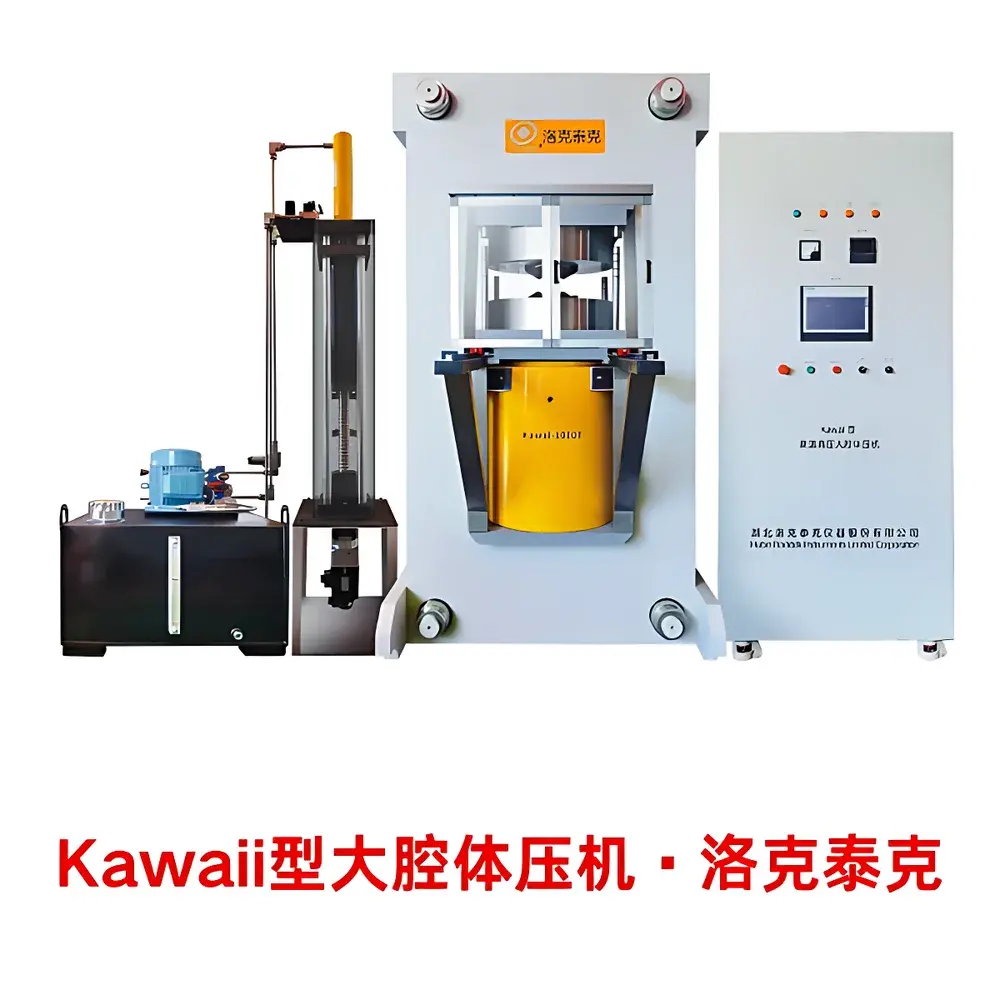
Rocktek Kawai-Type Multi-Anvil High-Pressure High-Temperature Press (6–8 Configuration)
| Brand | Rocktek |
|---|---|
| Origin | Wuhan, Hubei, China |
| Manufacturer | Hubei Rocktek Instrument Co., Ltd. |
| Configuration | Kawai-type 6–8 anvil assembly |
| Max. Load Capacity | 1000–2000 tons |
| Max. Sample Pressure | >20 GPa |
| Max. Sample Temperature | >2000 °C |
| Piston Stroke | 150 mm |
| Low-Pressure Drive | Hydraulic system |
| High-Pressure Regulation | Servo-motor-controlled with PLC |
| Pressure Control Accuracy | ±0.5 bar |
| Control Interface | Ethernet-enabled digital pressure sensor feedback loop |
| Compliance | Designed for GLP-compliant research environments |
| Software Integration | Real-time pressure/time profiling with event logging and remote monitoring capability |
Overview
The Rocktek Kawai-Type Multi-Anvil High-Pressure High-Temperature Press (6–8 Configuration) is a precision-engineered apparatus for static high-pressure synthesis and in situ property characterization under geophysically and materials-science-relevant conditions. Based on the classical Kawai geometry—where six hardened tungsten carbide (WC) anvils converge symmetrically onto an octahedral compression volume surrounded by eight backup anvils—the system enables stable, quasi-hydrostatic pressure generation exceeding 20 GPa at temperatures above 2000 °C. This configuration minimizes radial stress gradients and supports uniform thermal distribution across millimeter-scale sample volumes, making it suitable for diamond-anvil cell (DAC) calibration, phase transition studies, superconductivity screening, and synthesis of novel dense oxides, nitrides, and post-perovskite analogs. The press employs a hybrid actuation architecture: hydraulic drive for rapid low-pressure pre-compression (up to ~1 GPa), followed by fine-grained servo-motor-driven force application in the high-pressure regime—ensuring both operational efficiency and metrological fidelity.
Key Features
- Hybrid dual-stage actuation: Robust hydraulic system for initial piston advancement and high-speed low-pressure loading; closed-loop servo-motor + PLC control for sub-bar pressure regulation in the high-pressure domain.
- Digital pressure feedback: High-stability digital pressure transducers provide real-time measurement with ±0.5 bar accuracy; data transmitted via Ethernet to host PC for synchronized logging.
- Programmable multi-segment pressure–time profiles: User-defined ramp/hold/step sequences enable precise replication of thermobaric histories required for kinetic studies and metastable phase trapping.
- Open-frame mechanical design: Facilitates multi-probe integration—including electrical resistivity leads, thermocouple wiring, optical fibers, and X-ray transparent windows—for simultaneous in situ measurements during compression and heating.
- Low acoustic signature: Near-silent operation under servo-regulated high-pressure mode, critical for vibration-sensitive synchrotron or laser-heating experiments in shared laboratory facilities.
- Modular WC anvil assembly: Interchangeable tungsten carbide anvils with standardized 6–8 geometry support reproducible pressure-volume-temperature (P–V–T) calibration using internal standards (e.g., NaCl, Au, Pt).
Sample Compatibility & Compliance
The apparatus accommodates cylindrical sample assemblies up to 8 mm in diameter, compatible with common pressure media (e.g., MgO, NaCl, borosilicate glass) and furnace configurations (LaCrO₃, graphite, or W–Re wire heaters). All control firmware and data acquisition protocols adhere to principles aligned with ISO/IEC 17025 documentation requirements for calibration laboratories. Pressure and temperature logging includes time-stamped audit trails, supporting GLP compliance for academic and industrial R&D reporting. While not certified to FDA 21 CFR Part 11, the system’s deterministic control architecture and non-volatile parameter storage allow full traceability of experimental conditions—essential for peer-reviewed publication and inter-laboratory method validation.
Software & Data Management
The embedded control software provides a Windows-compatible GUI for configuring multi-step pressure programs, setting safety limits (e.g., max current, thermal cutoff), and visualizing live pressure vs. time curves. Raw sensor data—including pressure, motor position, heater voltage/current, and optional thermocouple inputs—are logged in CSV and HDF5 formats with microsecond timestamp resolution. Remote access is supported via TCP/IP, enabling centralized monitoring across institutional instrument networks. Exported datasets conform to FAIR principles (Findable, Accessible, Interoperable, Reusable), facilitating integration with Python-based analysis pipelines (e.g., Pynv, Thermobar) and metadata annotation tools such as NeXus.
Applications
- Earth and planetary interior simulation: Equation-of-state determination of mantle minerals (e.g., bridgmanite, ferropericlase) under lower-mantle P–T conditions.
- Materials discovery: Synthesis of high-entropy ceramics, ultra-incompressible borides, and high-Tc hydride superconductors.
- In situ transport property measurement: Four-probe resistivity, Seebeck coefficient, and Hall effect under simultaneous high pressure and high temperature.
- Phase diagram mapping: Solid–solid transitions, melting curves, and triple-point identification via multi-technique correlation (XRD, Raman, resistivity).
- Calibration reference: Generation of primary pressure standards for DAC and Paris–Edinburgh cell experiments.
FAQ
What is the maximum achievable pressure and temperature in standard configuration?
Standard operation achieves >20 GPa and >2000 °C using tungsten carbide anvils and graphite or LaCrO₃ furnaces; higher pressures (>25 GPa) are attainable with sintered diamond or nanopolycrystalline diamond anvils.
Is the system compatible with synchrotron X-ray diffraction?
Yes—the open-frame design permits direct beam access along axial and radial directions; custom collimator mounts and beryllium/titanium alloy components are available upon request.
Does the controller support third-party data acquisition hardware?
Yes—digital I/O ports and Modbus TCP interface allow synchronization with external DAQ systems (e.g., National Instruments, Keysight) for multi-sensor fusion.
What maintenance intervals are recommended for long-term stability?
Hydraulic fluid replacement every 24 months; WC anvil inspection after each 50 high-pressure cycles; servo-motor encoder recalibration annually or after mechanical shock events.
Can pressure calibration be performed in-house?
Yes—built-in routines support ruby fluorescence, NaCl equation-of-state, and gold melting point calibration; NIST-traceable reference standards are supplied with initial commissioning.