
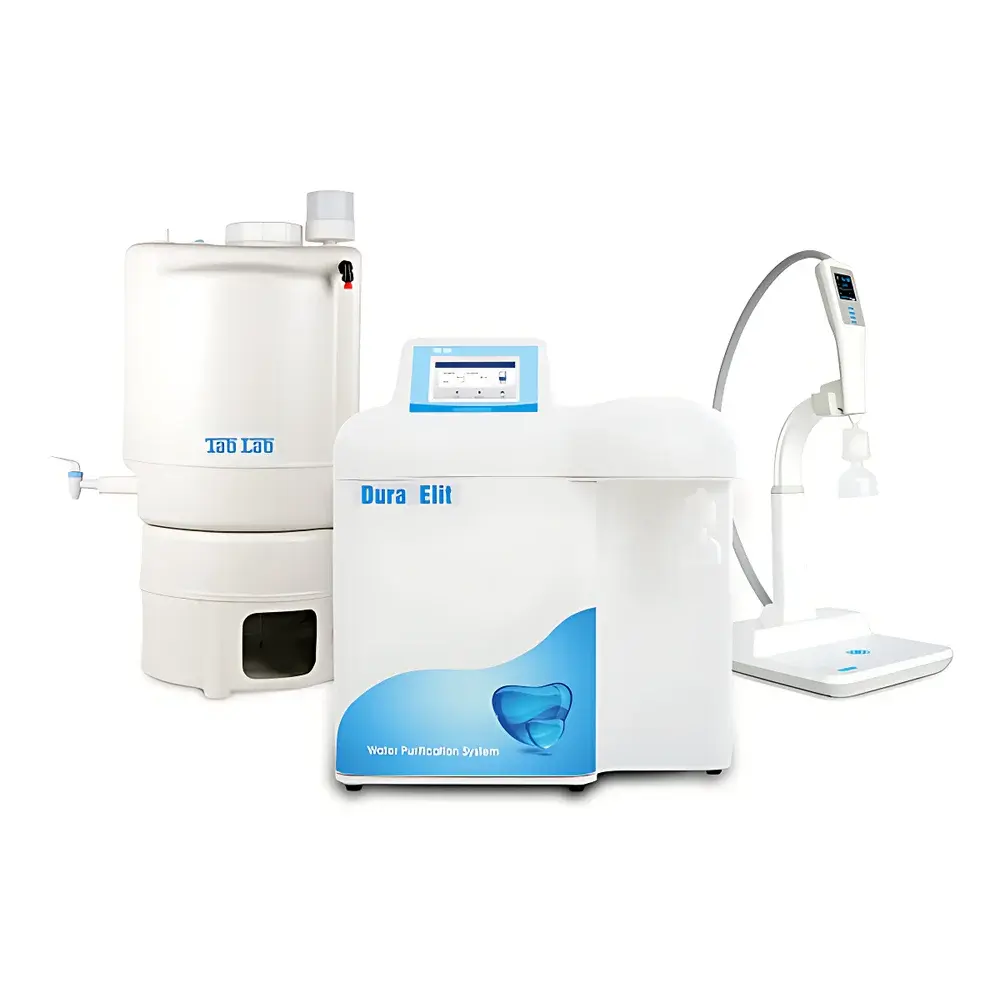
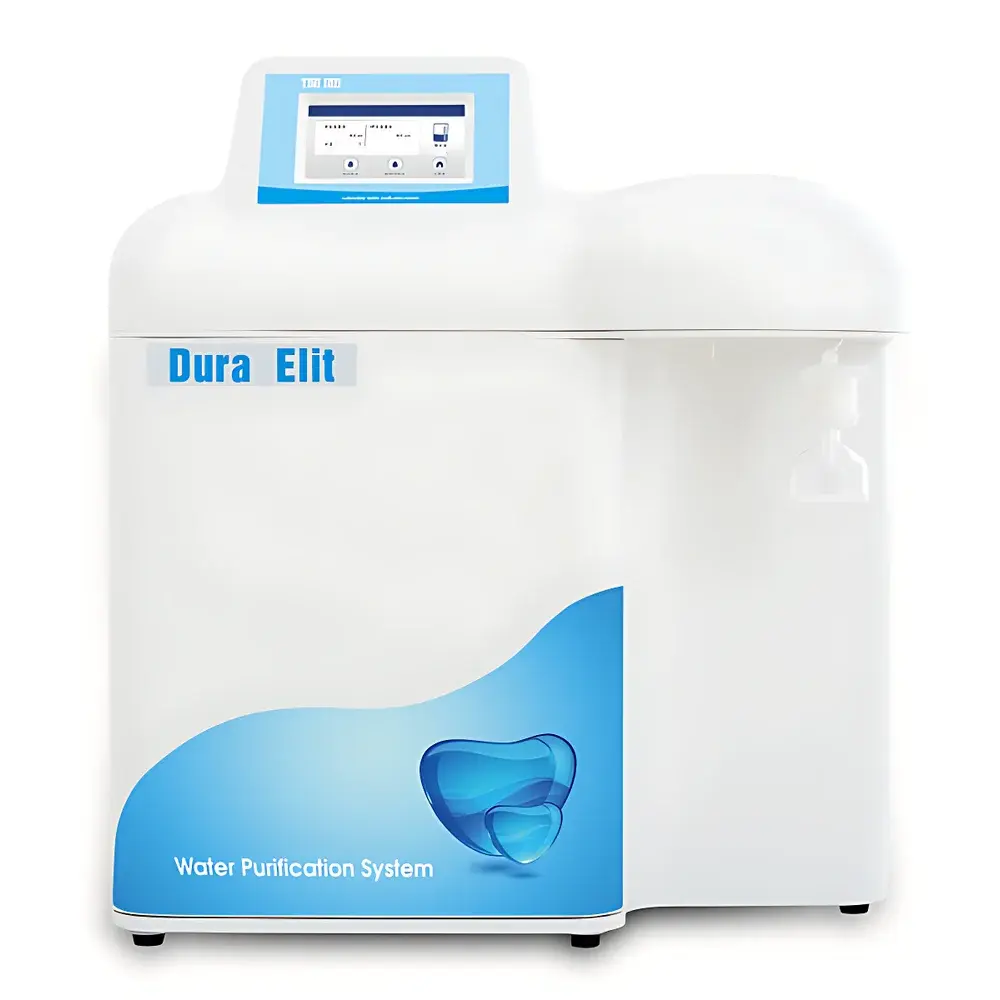
Zelab Dura Elit Series Full-Touchscreen Intelligent Ultra-Pure Water System
| Brand | Zelab / The Lab |
|---|---|
| Origin | Shanghai, China |
| Model | Dura Elit10 / 10F / 10V / 10FV / TOC10FV |
| Pure Water Grade | Type I (ASTM D1193-20) |
| Resistivity | 18.2 MΩ·cm @ 25 °C |
| Heavy Metals & Soluble Silica | <0.01 ppb |
| Total Organic Carbon (TOC) | <3 ppb |
| Microbial Count | <0.001 CFU/mL |
| Endotoxin | <0.001 EU/mL |
| Particles (>0.1 µm) | <1 particle/mL |
Overview
The Zelab Dura Elit Series is a fully integrated, touch-driven ultra-pure water system engineered for continuous production of Type I ultrapure water (UPW) and Type II pure water (PW) from municipal tap feedwater. It employs a validated dual-stage reverse osmosis (RO) pretreatment architecture coupled with Ionpure® electrodeionization (EDI) technology and a multi-stage polishing train—including dual-wavelength (254/185 nm) UV irradiation, ultrafiltration (UF), and dual-layer terminal filtration—to achieve consistent resistivity ≥18.2 MΩ·cm at 25 °C, TOC <3 ppb, endotoxin <0.001 EU/mL, and microbial load <0.001 CFU/mL. Designed for compliance with ISO 3696:1987, ASTM D1193-20, CLSI C3-A4, USP , EP 2.2.44, and GB/T 6682–2008 Class I specifications, the Dura Elit serves as a primary water source for critical applications including HPLC mobile phase preparation, ICP-MS calibration, cell culture media formulation, molecular biology reagent synthesis, and trace elemental analysis.
Key Features
- 5-inch full-color capacitive touchscreen interface with animated navigation menus, real-time system status visualization, and intuitive finger-operated control logic
- Dual-pump, dual-membrane RO architecture with intermediate storage tank—optimized to reduce energy consumption by up to 25% and wastewater generation by >40% versus conventional single-stage systems
- Integrated MiniTOC online analyzer with detection range 0.5–999.9 ppb and ±0.1 ppb accuracy; compliant with USP and EP 2.2.44 system suitability requirements
- Remote Digital Independent Station (R-DIS) with 2.0-inch graphical display: supports both volumetric (10–999,999 mL) and quality-triggered (0–18.25 MΩ·cm) dispensing; height-adjustable arm (0.3–0.9 m reach); detachable pipette-style handle for ergonomic operation
- 50 L conical-bottom PE reservoir with integrated CO₂-absorbing air filter and optional 254 nm UV sterilization module
- Full-loop recirculation system with programmable intermittent cycling to maintain bacterial counts <0.001 CFU/mL without continuous pump operation
- NSF-certified fluid path components (tubing, fittings, valves) minimizing extractables and ensuring low TOC contribution (<1 ppb baseline)
- Comprehensive consumables lifecycle management: configurable service intervals for PP (5 µm), KDF, activated carbon (coconut-shell), RO membranes (Dow FilmTec™), mixed-bed ion exchange resin (DuPont™ nuclear-grade), UV lamps, UF membrane (MWCO 5000 Da), and PES-based dual-stage final filters (0.45 + 0.1 µm)
Sample Compatibility & Compliance
The Dura Elit is validated for use with standard municipal tap water meeting WHO Guidelines for Drinking-water Quality (4th ed.) and local regulatory limits for hardness, chlorine, and turbidity. Its prefiltration stage—comprising transparent 5 µm PP, KDF-55 alloy, and acid-washed coconut-shell activated carbon—is designed to tolerate feedwater with ≤500 ppm total dissolved solids (TDS), ≤1 ppm free chlorine, and ≤1 NTU turbidity. All wetted materials comply with NSF/ANSI Standard 61 and USP Class VI biocompatibility testing. The system supports GLP/GMP audit readiness via time-stamped event logs, dual-level password protection (factory and user), and electronic record retention per FDA 21 CFR Part 11 requirements when paired with optional USB data export functionality.
Software & Data Management
Embedded firmware provides automated logging of operational parameters—including daily UPW volume, cumulative runtime, conductivity/TOC trends, alarm history, and consumable usage metrics—for a minimum of 12 months. Data are stored on an internal SD card and exportable via USB 2.0 in CSV format for integration into LIMS or QA documentation workflows. The interface supports configurable alert thresholds for feed pressure loss, RO rejection rate decline, DI breakthrough, UPW resistivity deviation, and tank level anomalies. Scheduled maintenance prompts include visual indicators and audible alerts synchronized with actual usage hours—not calendar time—ensuring precision in replacement timing.
Applications
- HPLC, UHPLC, and LC-MS mobile phase and blank preparation requiring sub-ppb organic and ionic contamination control
- ICP-OES and ICP-MS sample dilution and standard preparation where trace metal interference must be minimized
- Mammalian and stem cell culture media, transfection reagents, and IVF solutions demanding endotoxin-free, nuclease-free water
- PCR, qRT-PCR, NGS library prep, and CRISPR reagent formulation requiring DNase/RNase-free conditions
- Atomic absorption spectroscopy (AAS), GF-AAS, and graphite furnace calibration standards
- Electrophysiology buffer preparation and microelectrode filling solutions
FAQ
What feedwater quality is required for optimal Dura Elit performance?
Municipal tap water with TDS ≤500 ppm, free chlorine ≤1 ppm, and turbidity ≤1 NTU is recommended. Pre-treatment may be necessary for high-hardness or high-chlorine sources.
Does the system support remote monitoring via Ethernet or Wi-Fi?
No—remote access is limited to local USB data export and R-DIS wireless proximity communication (no network stack or cloud connectivity).
How often must the RO membrane be replaced under typical lab usage?
Based on 8-hour daily operation and average feedwater quality, RO membrane service life ranges from 24–36 months; the system calculates replacement timing dynamically using flux decay and salt rejection metrics.
Is the TOC analyzer certified for pharmacopeial compliance?
Yes—the integrated MiniTOC module meets USP oxidation efficiency and system suitability criteria, including 90% recovery for 500 ppb sucrose challenge and <±0.1 ppb repeatability.
Can the system be integrated into a building’s central water distribution network?
No—it is a point-of-use system only. The R-DIS station supports a maximum 3-meter tubing run from main unit to dispenser; extended distribution requires external recirculation loops not supplied by Zelab.



