
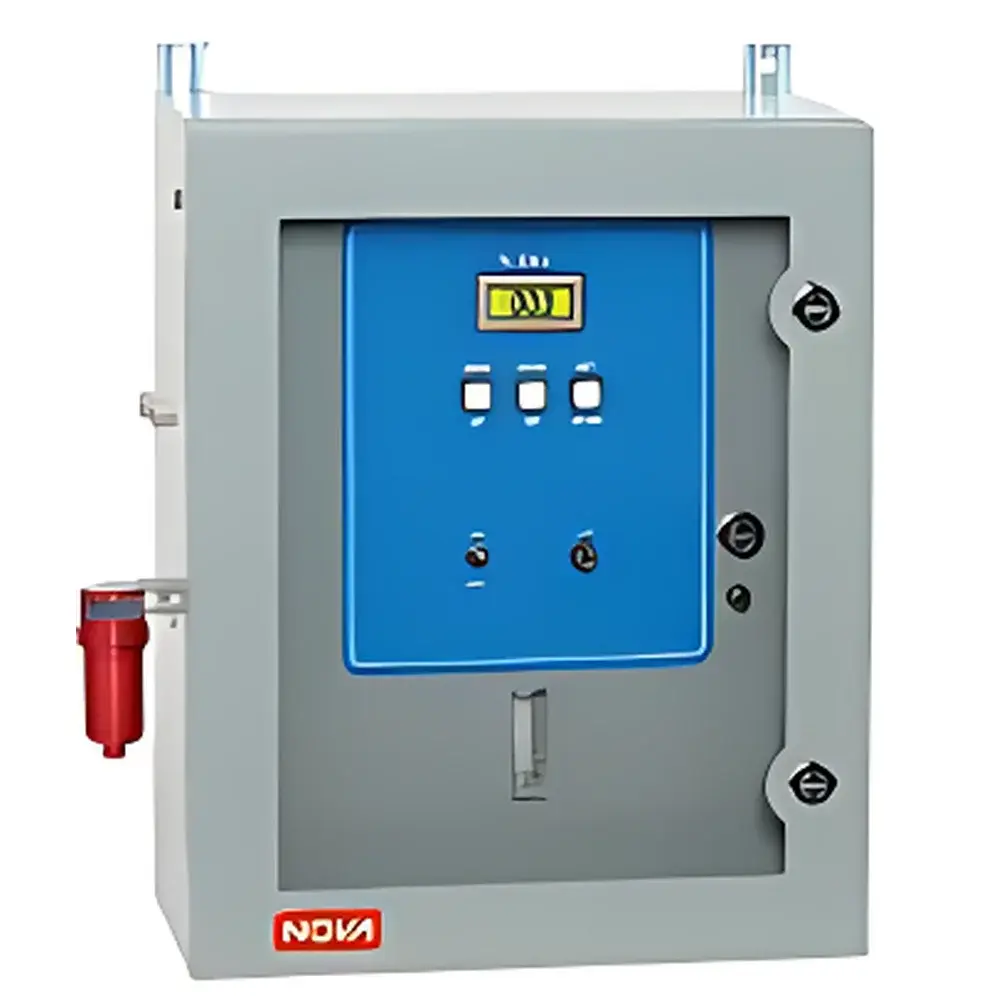
Nova 430 Series Hydrogen Analyzer
| Brand | Nova |
|---|---|
| Origin | Canada |
| Model | 430 |
| Detection Principle | Temperature-Controlled Thermal Conductivity Cell |
| Measurement Range | 0–2.0% H₂ and 0–100.0% H₂ |
| Resolution | 0.1% H₂ |
| Accuracy & Repeatability | ±1% of Full Scale |
| Drift | <1% of Full Scale per Month |
| Response Time (T90) | 10–15 s |
| Operating Ambient Temperature | 0–50°C (optional cold package for –20°C operation) |
| Sample Dew Point Requirement | At least 5°C below minimum sample temperature |
| Linearity | ±1% of Full Scale |
| Power Supply | 115 VAC, 60 Hz (220 VAC, 50 Hz optional) |
| Output Options | Isolated 4–20 mA (500 Ω), RS232, RS485, Modbus RTU/TCP, Ethernet |
| Alarm Outputs | SPDT relay contacts (5 A, 220 VAC), optional low-flow alarm |
| Enclosure Rating | Suitable for hazardous areas (ATEX/IECEx compliant cabinets available) |
| Sensor Lifetime | >10 years (no-flow thermal conductivity cell design) |
Overview
The Nova 430 Series Hydrogen Analyzer is a high-stability, continuous-duty thermal conductivity gas analyzer engineered for precise, real-time quantification of hydrogen (H₂) concentration in industrial process streams. Utilizing a temperature-stabilized, flow-independent thermal conductivity cell, the instrument delivers metrologically robust measurements without consumables or catalytic surfaces—eliminating risk of sensor poisoning, flameout, or drift from sample flow variations. Unlike electrochemical or semiconductor-based sensors, the 430’s dual-bridge thermal conductivity architecture operates on the fundamental physical property difference between H₂ (thermal conductivity ≈ 7x that of N₂) and common background gases (e.g., N₂, CO₂, Ar, CH₄), enabling selective detection even in complex, multi-component atmospheres. Designed for integration into safety-critical and regulatory-controlled environments—including hydrogen production units, electrolyzer off-gas monitoring, refinery purge streams, heat-treatment furnace atmospheres, and blast furnace top-gas recovery—the 430 meets functional safety expectations aligned with IEC 61508 SIL 2 system architecture requirements when configured with appropriate redundancy and diagnostics.
Key Features
- Temperature-regulated thermal conductivity cell with >10-year operational lifetime—no moving parts, no consumables, no sample flow dependency
- Two standard measurement ranges: 0–2.0% H₂ (for trace-level safety monitoring) and 0–100.0% H₂ (for pure stream verification)
- High-resolution digital display (0.1% H₂) with intuitive touchscreen LCD interface supporting multilingual menus and local configuration
- Rapid response performance: T90 ≤ 15 seconds across full scale, validated per ISO 14644-3 Annex B methodology for gas analyzers
- Modular mechanical design enabling field-replaceable modules—including pump assemblies, pressure regulators, and heated sample conditioning units
- Integrated sample handling: built-in diaphragm pump (optional pressure regulator) with configurable flow control and automatic low-flow diagnostic
- Environmental resilience: standard operation from 0–50°C ambient; cold-package variant certified for continuous operation down to –20°C
- Hazardous area compliance: available in ATEX Zone 1 / IECEx Ex d IIB T4 Gb and Class I Div 1 enclosures with intrinsically safe barrier options
Sample Compatibility & Compliance
The 430 Series accommodates a broad spectrum of industrial gas matrices, including but not limited to nitrogen-rich synthesis gas, steam-reformed reformate, electrolysis stack effluent, annealing atmospheres (N₂/H₂ blends), and metallurgical off-gases. It is insensitive to CO, CO₂, CH₄, O₂, and H₂O vapor at typical process concentrations—provided the sample dew point remains at least 5°C below the lowest expected operating temperature to prevent condensation-induced calibration shift. The analyzer complies with key international standards for emission and process monitoring instrumentation, including EN 14181 (QAL2/QAL3 validation framework), ISO 14644-3 (cleanroom gas purity verification), and ASTM D1946 (standard test method for analysis of reformed gas). Optional configurations support GLP/GMP data integrity requirements via audit-trail-enabled firmware and 21 CFR Part 11-compliant electronic signature functionality when paired with Nova’s certified Data Management Suite.
Software & Data Management
The embedded firmware supports comprehensive local operation via capacitive touchscreen interface, enabling zero-config startup, span/gain calibration, alarm threshold setting, and diagnostic logging without external PC tools. All configuration changes are timestamped and user-logged. For enterprise integration, the 430 provides native protocol support: isolated 4–20 mA analog output (500 Ω load), RS232 (ASCII command set), RS485 (Modbus RTU), and TCP/IP Ethernet (Modbus TCP). Optional cloud-ready firmware enables MQTT publishing to SCADA or IIoT platforms (e.g., Siemens MindSphere, PTC ThingWorx) with TLS 1.2 encryption and certificate-based authentication. Data export formats include CSV and XML; historical trend logs are retained onboard for ≥30 days (configurable) and synchronized to external NAS or historian systems via FTP/SFTP.
Applications
- Hydrogen production: real-time monitoring of PEM/alkaline electrolyzer outlet gas purity (≥99.99% H₂ verification)
- Refinery operations: H₂ concentration tracking in hydrotreater recycle loops and amine unit overheads
- Heat treatment: atmosphere composition control in bright annealing furnaces (e.g., 75% N₂ / 25% H₂ blends)
- Metallurgy: blast furnace top-gas H₂ content analysis for energy recovery optimization
- Safety interlock: rapid detection of H₂ accumulation in battery rooms, fuel cell test cells, and hydrogen storage enclosures
- Research & development: quantitative kinetic studies involving H₂ evolution/consumption in catalytic reactors
FAQ
What measurement principle does the Nova 430 use, and why is it suitable for high-purity hydrogen applications?
It employs a temperature-stabilized thermal conductivity cell—immune to catalyst deactivation, oxidation, or poisoning—making it ideal for long-term deployment in aggressive chemical environments where electrochemical or metal-oxide sensors degrade rapidly.
Can the 430 operate in explosive atmospheres?
Yes—when ordered with certified explosion-proof enclosures (ATEX Zone 1 / IECEx Ex d IIB T4 Gb or UL Class I Div 1), and installed with approved barriers per NEC Article 500.
Is automatic calibration supported?
Yes—fully automated zero/span calibration routines are programmable via touchscreen or remote command; certified calibration gases (N₂ balance, certified H₂ standards) are required per ISO 6142.
Does the analyzer require sample conditioning?
Minimal conditioning is needed—only particulate filtration and dew point control (via optional heated filter housing or chiller cabinet); no chemical scrubbers or catalytic converters are necessary due to inherent selectivity.
How is data integrity ensured for regulated industries?
With optional 21 CFR Part 11-compliant firmware, the device enforces role-based access control, electronic signatures, immutable audit trails, and secure data export—validated per FDA guidance for computerized systems in GxP environments.







