
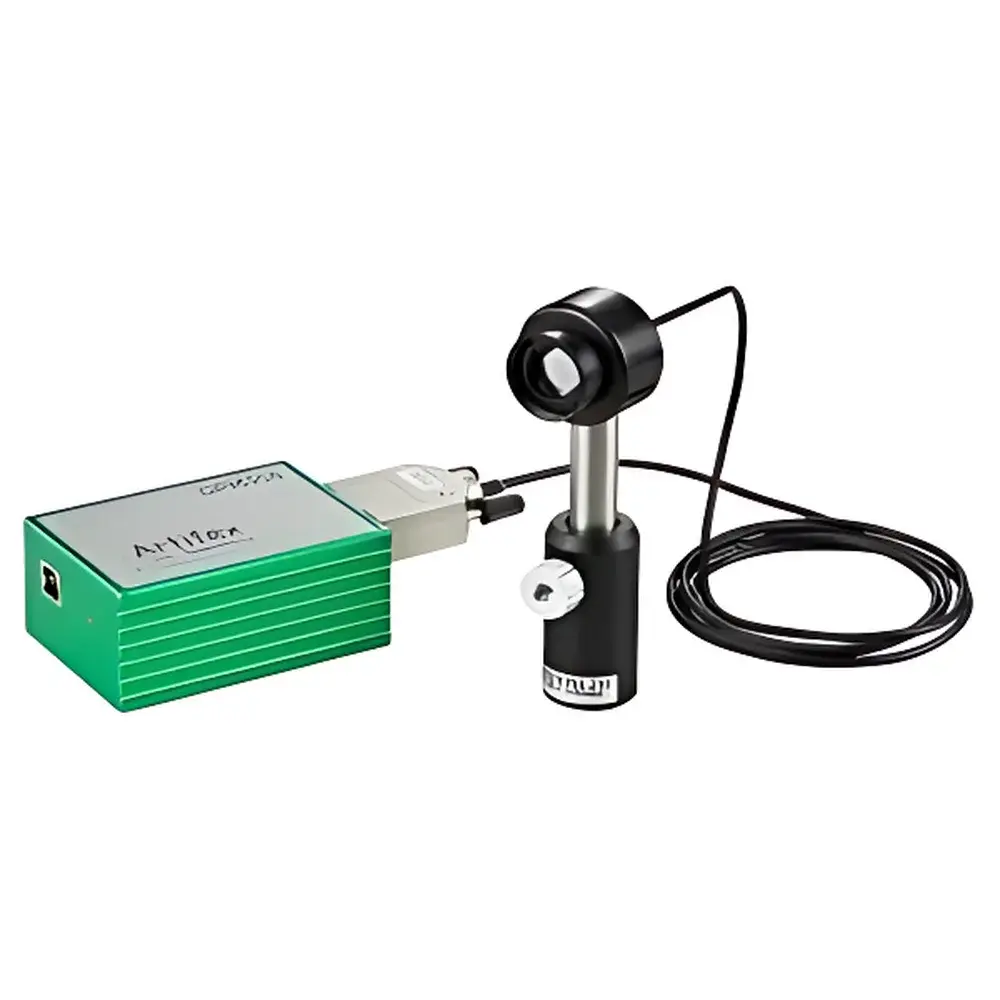
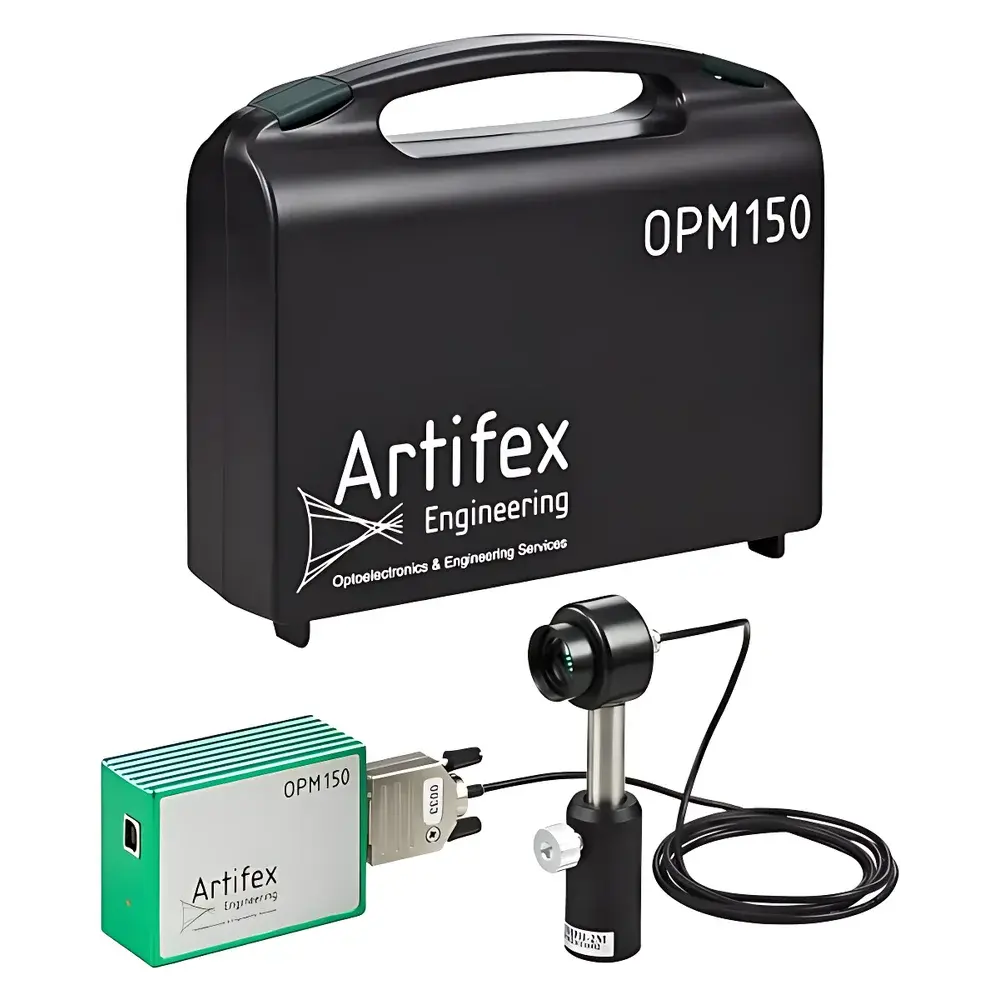
Artifex OPM150 Optical Power Meter
| Brand | Artifex |
|---|---|
| Origin | Germany |
| Model | OPM150 |
| Spectral Range | 190–2200 nm |
| Power Range | 1 nW – 20 W |
| Detector Type | Silicon, SiGe, InGaAs (multi-band) |
| Interface | USB (power + control), DB9, BNC |
| Bandwidth | 10 Hz – 100 kHz |
| Sampling Rate | 1500 S/s (direct readout), 30 S/s (GUI-controlled) |
| Gain Stages | 5 (1×, 10×, 100×, 1000×, 10000× V/mA) |
| Accuracy (Meter) | ±1% |
| Accuracy (Detector) | ±6% |
| Repeatability (Detector) | ±3% |
| Linearity (Detector) | ±0.2% |
| Response Time | 100 µs |
| Host Dimensions | 60 × 81 × 36 mm (W × L × H) |
| Detector Dimensions | Φ35 × 30 mm (D × L) |
| Calibration Data | Embedded in detector connector EEPROM |
| Software | GUI (VB.NET source included), LabVIEW® demo VI, virtual COM port command set |
| Compliance | CE, RoHS |
| Accessories | OD1–OD3 neutral density filters, SMA/FC fiber adapters, aperture reducers, lens mounts, detector heads |
Overview
The Artifex OPM150 Optical Power Meter is a high-speed, multi-spectral photodiode-based power measurement system engineered for precision, stability, and integration flexibility in research laboratories, laser manufacturing environments, and OEM instrumentation platforms. Unlike thermopile or pyroelectric sensors, the OPM150 employs calibrated semiconductor photodetectors—spanning UV-Si, SiGe, VIS-InGaAs, and extended-InGaAs variants—to deliver real-time optical power quantification across a broad spectral band (190–2200 nm). Its 100 µs response time enables dynamic monitoring of pulsed lasers, modulated sources, and transient beam profiles, while eliminating thermal drift artifacts inherent in thermal detectors. The instrument architecture separates signal conditioning (host unit) from wavelength-optimized detection (interchangeable detector heads), each with factory calibration data stored in onboard EEPROM—ensuring traceable, plug-and-play metrology without manual coefficient entry.
Key Features
- Five programmable gain stages (1× to 10⁴× V/mA) with automatic range selection and overload protection
- Dual-interface connectivity: USB (bus-powered, bidirectional command/data transfer) plus analog output via BNC and digital control via DB9
- Real-time sampling at up to 1500 samples per second (direct readout mode) and synchronized logging at 30 S/s under GUI control
- Modular detector design supporting six calibrated spectral configurations: UV-Si (190–1100 nm), VIS-InGaAs (800–1550 nm), dual InGaAs (400–1600 nm; 800–2000 nm; 1000–2200 nm)
- Embedded calibration coefficients stored in detector connector EEPROM—automatically loaded on hot-plug detection
- Compact host unit (60 × 81 × 36 mm) with industrial-grade aluminum housing and EMI-shielded circuitry
- Mechanical compatibility with standard optomechanical platforms: M6 and 8-32 threaded mounting holes, front-threaded interface for Qioptic components, and 35 mm outer diameter for cage system integration
Sample Compatibility & Compliance
The OPM150 accommodates free-space beams and fiber-coupled sources via optional SMA/FC adapters and adjustable aperture reducers. Detector heads feature 25 mm clear aperture (35 mm outer diameter), optimized for collimated or moderately focused beams. Each detector variant complies with ISO 11554 (laser beam parameter measurements) and supports traceable calibration against NIST-traceable reference standards. The system meets CE marking requirements for electromagnetic compatibility (EN 61326-1) and safety (EN 61010-1), and adheres to RoHS Directive 2011/65/EU. While not FDA 21 CFR Part 11 certified out-of-the-box, audit-ready data export (CSV, binary, timestamped logs) and full command-line control enable integration into GLP/GMP workflows when deployed with validated software protocols.
Software & Data Management
The bundled Windows-compatible GUI provides three real-time visualization modes: Logging (time-series trend), Scope (oscilloscope-style waveform), and Scroll (continuous buffer display). All modes support user-defined averaging windows, auto-scaling, and trigger-based capture. Data can be exported in CSV, TXT, or binary formats; graphical outputs include PNG, BMP, and SVG. The SDK includes VB.NET GUI source code, LabVIEW® demonstration VIs, and a comprehensive virtual COM port command reference—enabling seamless integration with MATLAB, Python (PySerial), or custom C/C++ applications. Firmware updates and detector configuration are performed over USB without external programmers.
Applications
- Laser diode characterization during R&D and production testing (threshold current, slope efficiency, power stability)
- Optical amplifier (EDFA, SOA) gain and noise figure verification
- Fiber optic component insertion loss measurement (isolators, couplers, WDMs)
- Pulsed laser energy validation (with appropriate averaging and peak-hold settings)
- UV curing system irradiance monitoring in industrial manufacturing
- Photobiomodulation and low-level light therapy (LLLT) dosimetry validation
- OEM integration into automated alignment stations, wafer inspection tools, or closed-loop power stabilization loops
FAQ
Does the OPM150 require external power or calibration software?
No—the host unit is bus-powered via USB and requires no external supply. Calibration data is embedded in each detector’s connector EEPROM; no software-based calibration upload is needed.
Can multiple detectors be used interchangeably with one host unit?
Yes—detector heads are hot-swappable and automatically identified by the host. Spectral range and calibration coefficients are loaded dynamically upon connection.
What is the maximum measurable pulse repetition rate?
With 100 µs response time and 1500 S/s sampling, the OPM150 reliably captures pulses down to ~100 µs width at repetition rates up to 1 kHz in direct-readout mode.
Is the software compatible with Linux or macOS?
The native GUI runs on Windows only; however, the virtual COM port command set allows cross-platform control via Python, MATLAB, or terminal utilities on Linux/macOS.
Are calibration certificates provided with each detector?
Yes—each detector ships with a manufacturer-issued calibration report referencing traceable standards, including uncertainty budgets per wavelength point and linearity verification data.





