
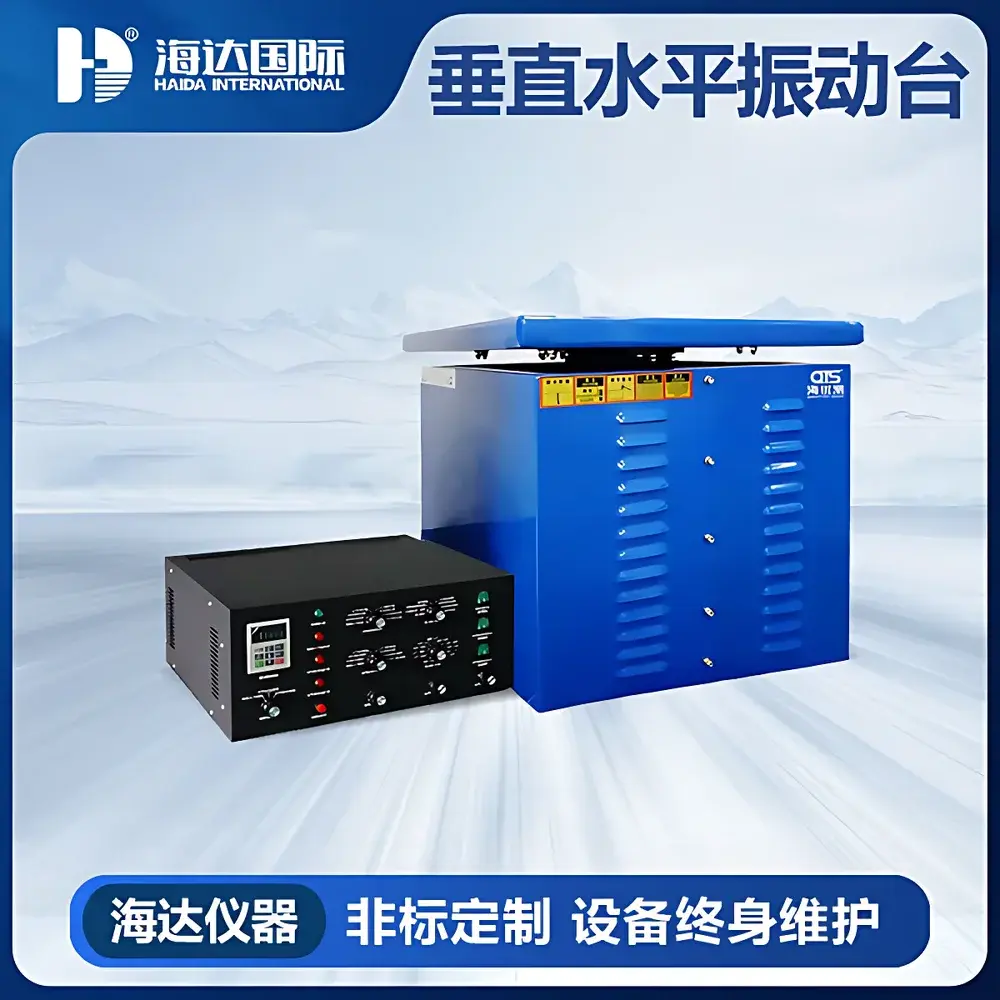
HAIDA HD-G809-2 Electromagnetic Vibration Shaker System
| Brand | HAIDA INTERNATIONAL |
|---|---|
| Origin | Guangdong, China |
| Manufacturer Type | Original Equipment Manufacturer (OEM) |
| Instrument Type | Electrodynamic Vibration Shaker |
| Rated Force | 120 kgf (1.176 kN) |
| Frequency Range | 2–3000 Hz |
| Maximum Payload | 120 kg |
| Table Dimensions (L×W×H) | 1200 mm × 790 mm × 840 mm (excluding extension platform) |
| Peak Acceleration | 100 g (980 m/s²) |
| Sine Force | 300 kgf peak (2.94 kN) |
| Random Force | 300 kgf rms (2.94 kN) |
| Shock Force | 600 kgf peak (5.88 kN) |
| Displacement | 25.4 mm p-p |
| Velocity | 1.8 m/s |
| Power Amplifier Output | 3 kVA, 100 V, 30 A, 116 kHz switching frequency, ≥90% efficiency, ≤70 dB noise |
| Vertical Extension Table | 500 × 500 mm, Al alloy with hard-anodized finish, 25 kg, usable up to 2000 Hz |
| Input Power | 3-phase AC 380 V / 50 Hz, 8 kVA |
| System Weight | ~1200 kg (excl. horizontal slip table) |
Overview
The HAIDA HD-G809-2 Electromagnetic Vibration Shaker System is a high-performance electrodynamic shaker engineered for precision mechanical shock and vibration testing across aerospace, defense, automotive, electronics, and consumer appliance industries. Based on Lorentz-force actuation principles, the system delivers controlled sinusoidal, random, and transient (shock) excitations to evaluate structural integrity, fatigue life, resonance behavior, and functional reliability of test specimens under simulated operational or environmental stress conditions. Its dual-magnetic-circuit exciter design ensures low magnetic leakage and uniform flux distribution—critical for achieving high linearity and repeatability across its full 2–3000 Hz bandwidth. The shaker meets fundamental requirements for modal analysis, qualification testing, and durability validation per MIL-STD-810H, ISO 10816, ISO 20283, and IEC 60068-2 series standards.
Key Features
- Robust electromagnetic exciter with dual-magnetic-path architecture and optimized thermal management: honeycomb airflow channels in the voice coil assembly and dual-stage divergent ducts in the center magnet improve heat dissipation efficiency by >35% over conventional designs.
- High-stiffness aluminum alloy vertical extension table (500 × 500 mm), hard-anodized for corrosion resistance and surface hardness ≥60 HV, rated for continuous operation up to 2000 Hz.
- Digital switching power amplifier delivering 3 kVA output at 100 V/30 A, featuring 116 kHz PWM frequency, ≥90% electrical-to-mechanical conversion efficiency, and acoustic noise <70 dB(A) at 1 m distance.
- Integrated safety interlock architecture including grid over/under-voltage detection, phase-loss monitoring, thermal cutoffs (coil & baseplate), displacement limit sensing, output current/voltage clamping, and emergency stop with hardware-level termination.
- Phosphated and automotive-grade baked enamel finish on main frame ensures long-term resistance to abrasion, humidity, and industrial contaminants—validated per ASTM D3359 and ISO 2360.
Sample Compatibility & Compliance
The HD-G809-2 accommodates test articles ranging from printed circuit assemblies (PCBAs) and avionics enclosures to full-scale automotive modules and military-grade electronic subsystems. With a maximum payload capacity of 120 kg and a large 1200 × 790 mm active table surface, it supports both direct-mount and fixture-based configurations. Optional horizontal oil-film slip tables extend multi-axis capability for combined vibration environments. The system complies with essential regulatory frameworks for laboratory-grade testing equipment, including ISO/IEC 17025 calibration traceability pathways, MIL-STD-810H Method 514.8 (vibration) and 516.7 (shock), and EU Machinery Directive 2006/42/EC. All control software logs include time-stamped audit trails compliant with GLP and GMP documentation practices.
Software & Data Management
Control and analysis are executed via a Windows-based digital vibration controller with real-time closed-loop feedback architecture. The application provides guided test setup wizards for sine sweep, resonant dwell, random PSD synthesis, classical shock pulse generation (half-sine, trapezoidal, sawtooth), and user-defined time-history playback. All test parameters—including acceleration spectra, transmissibility functions, and coherence metrics—are stored in IEEE 1558-compliant binary format. USB 2.0 and Ethernet interfaces enable seamless integration with external DAQ systems and LIMS platforms. Report generation conforms to ASTM E177 and ISO 10012 requirements, supporting automated PDF export with embedded metadata, signature fields, and revision-controlled templates.
Applications
- Aerospace: Qualification of satellite payload mounts, flight computer chassis, and UAV structural components per DO-160 Section 8.
- Automotive: NVH evaluation of infotainment modules, battery management systems (BMS), and ADAS sensor housings under road-simulation spectra.
- Electronics: PCB-level reliability screening for solder joint fatigue, connector retention, and component delamination using accelerated random vibration profiles.
- Defense: Environmental stress screening (ESS) of radar subsystems, communication terminals, and munition fuzing mechanisms per MIL-STD-883 Method 2007.
- Consumer Appliances: Durability verification of smart home controllers, HVAC control boards, and robotic vacuum motor assemblies.
FAQ
What is the maximum usable frequency when operating with the optional horizontal oil-film slip table?
The horizontal slip table maintains full performance up to 2000 Hz, preserving phase coherence and force fidelity within ±1.5 dB amplitude tolerance.
Does the system support real-time MIMO (multi-input multi-output) control?
Yes—the digital controller firmware supports up to four synchronized shaker channels with cross-channel coherence compensation and decoupled drive synthesis.
Is the vibration controller software validated for FDA 21 CFR Part 11 compliance?
The software includes configurable electronic signatures, audit trail logging, and role-based access control—fully configurable to meet Part 11 requirements when deployed in regulated environments.
Can the HD-G809-2 perform fatigue life prediction using time-domain waveform replication?
Yes—via time-history playback mode with 24-bit DAC resolution and sub-millisecond latency, enabling high-fidelity replication of field-collected vibration data for accelerated life testing.
What calibration documentation is supplied with the system?
Each unit ships with NIST-traceable calibration certificates for force, acceleration, and displacement sensors, valid for 12 months, plus a full uncertainty budget per ISO/IEC 17025 Annex A.



