
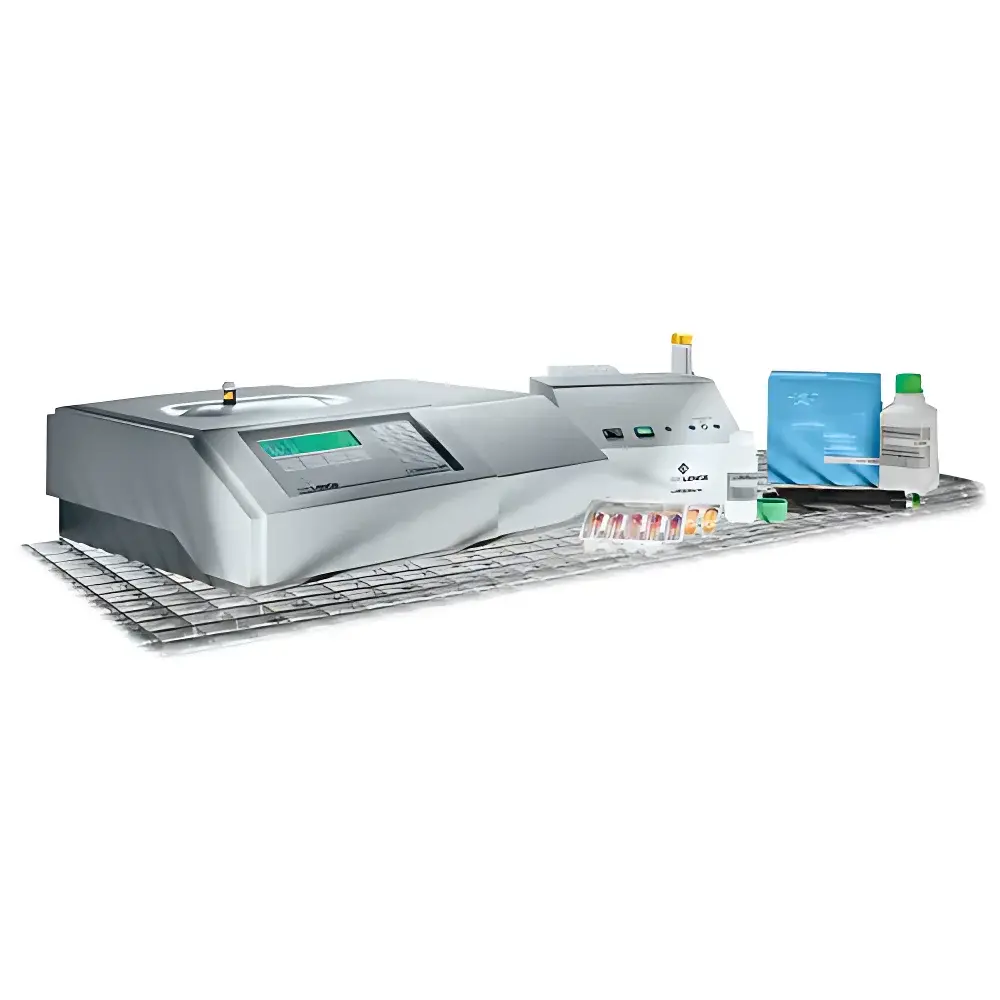
HACH LUMIStox300 Biotoxicity Analyzer
| Brand | HACH |
|---|---|
| Origin | Imported |
| Manufacturer Type | Original Equipment Manufacturer (OEM) |
| Model | LUMIStox300 |
| Instrument Type | Portable |
| Biological Indicator | *Aliivibrio fischeri* (formerly *Vibrio fischeri*) bioluminescent bacteria |
| Compliance | ISO 11348-3 (Water quality — Determination of the inhibitory effect of water samples on the light emission of *Vibrio fischeri* — Part 3: Method using freeze-dried bacteria) |
| Power Supply | 48 VA (230 V ±10%, 50 Hz) |
| Operating Environment | 16–29 °C, <80% RH, non-condensing |
| Weight | 7.75 kg |
| Optical Compensation | Automatic chromaticity and turbidity correction |
| Measurement Mode | Acute and chronic toxicity assessment via bioluminescence inhibition kinetics |
Overview
The HACH LUMIStox300 Biotoxicity Analyzer is a portable, standardized instrument engineered for rapid, quantitative assessment of acute and chronic aquatic toxicity based on the principle of bioluminescence inhibition. It utilizes freeze-dried *Aliivibrio fischeri*—a marine luminescent bacterium whose metabolic activity correlates directly with light emission intensity. When exposed to toxicants—including heavy metals, pesticides, phenols, surfactants, and complex industrial effluents—the bacteria experience respiratory chain disruption, resulting in measurable suppression of bioluminescence within minutes. This inhibition rate is quantitatively correlated to sample toxicity, expressed as EC50 (effective concentration reducing luminescence by 50%) or % inhibition relative to control. Unlike vertebrate- or crustacean-based bioassays (e.g., *Daphnia magna* or fish), the LUMIStox300 method eliminates ethical constraints, reduces assay time from days to 15–30 minutes, and delivers high reproducibility (inter-laboratory CV <15% per ISO 11348-3). Its design adheres to internationally accepted protocols for environmental screening, regulatory compliance support, and wastewater treatment optimization.
Key Features
- Integrated optical system with automatic chromaticity and turbidity compensation—eliminates need for reference measurements or sample pre-filtration in most routine applications.
- Real-time bioluminescence monitoring throughout the entire incubation period (up to 30 min), enabling kinetic analysis of inhibition onset, peak response, and recovery trends.
- Dual-mode operation: supports both acute toxicity screening (single-point measurement at 15 min) and chronic toxicity evaluation via growth-inhibition kinetics using integrated photometric detection.
- Self-contained, field-deployable architecture: battery-compatible operation (with optional external power supply), ruggedized housing (IP54-rated), and intuitive touchscreen interface calibrated for unattended use in mobile labs or on-site sampling campaigns.
- Pre-configured test protocols aligned with ISO 11348-3, DIN 38412-L33, and EPA 200.10 (draft)—ensuring data traceability and audit readiness under GLP and ISO/IEC 17025 frameworks.
Sample Compatibility & Compliance
The LUMIStox300 accepts raw or minimally processed aqueous matrices including surface water, groundwater, treated and untreated wastewater, leachates, and industrial process streams. Sample pH must be adjusted to 6.5–8.5 prior to testing; high-salinity samples (>20 g/L NaCl) require dilution or osmotic adjustment to maintain bacterial viability. The analyzer is validated for use with standardized lyophilized *A. fischeri* reagents supplied by HACH (catalog no. LUMI-300-KIT), which undergo lot-specific potency verification per ISO 11348-1. All toxicity results are generated in accordance with ISO/IEC 17025-accredited laboratory practices when operated within defined environmental and procedural controls. The system supports documentation integrity through timestamped result logs, user authentication, and exportable CSV reports compatible with LIMS integration.
Software & Data Management
The embedded firmware provides guided workflow navigation, automatic calibration verification, and real-time QC flagging (e.g., low signal-to-noise ratio, out-of-range blank response). Toxicity calculations apply the standard inhibition formula: % Inhibition = [(Icontrol − Isample) / Icontrol] × 100, where I denotes integrated light intensity. EC50 values are derived via four-parameter logistic regression (Hill equation) using onboard curve-fitting algorithms. Data export supports USB mass storage and Bluetooth 4.2 connectivity for secure transfer to desktop software (e.g., HACH TOX-Link v3.x), which enables batch reporting, statistical outlier detection, trend charting across sampling events, and alignment with regulatory submission templates (e.g., EU Water Framework Directive Annex V reporting fields). Audit trails include operator ID, instrument serial number, reagent lot code, ambient temperature/humidity logging, and firmware version—fully compliant with FDA 21 CFR Part 11 requirements when paired with appropriate electronic signature configuration.
Applications
- Rapid screening of influent/effluent toxicity in municipal and industrial wastewater treatment plants to identify shock loads or upstream contamination sources.
- Environmental impact assessment of landfill leachate, mining runoff, and agricultural drainage prior to discharge authorization.
- Verification of detoxification efficiency during advanced oxidation, activated carbon adsorption, or membrane filtration pilot studies.
- Regulatory compliance monitoring for industries subject to national or regional toxicity-based discharge limits (e.g., German LAWA criteria, Canadian Environmental Quality Guidelines).
- Research applications in ecotoxicology, including mixture toxicity modeling, QSAR validation, and comparative sensitivity profiling across chemical classes.
FAQ
What biological endpoint does the LUMIStox300 measure?
It measures the inhibition of bioluminescence emitted by metabolically active *Aliivibrio fischeri*, which serves as a proxy for cellular respiratory toxicity.
Can the LUMIStox300 distinguish between specific toxicants?
No—it provides a holistic, functional toxicity index; compound identification requires complementary analytical techniques such as GC-MS or ICP-MS.
Is sample pretreatment required before analysis?
Centrifugation or filtration may be necessary for highly turbid or particulate-laden samples exceeding 100 NTU; pH adjustment is mandatory for samples outside 6.5–8.5 range.
How frequently must the optical system be recalibrated?
Factory calibration is stable for 12 months under normal operating conditions; annual verification using HACH-certified luminance standards (LUMI-CAL-STD) is recommended.
Does the system support multi-user access with role-based permissions?
Yes—administrator, technician, and viewer profiles can be configured with password protection and session timeout enforcement.







