
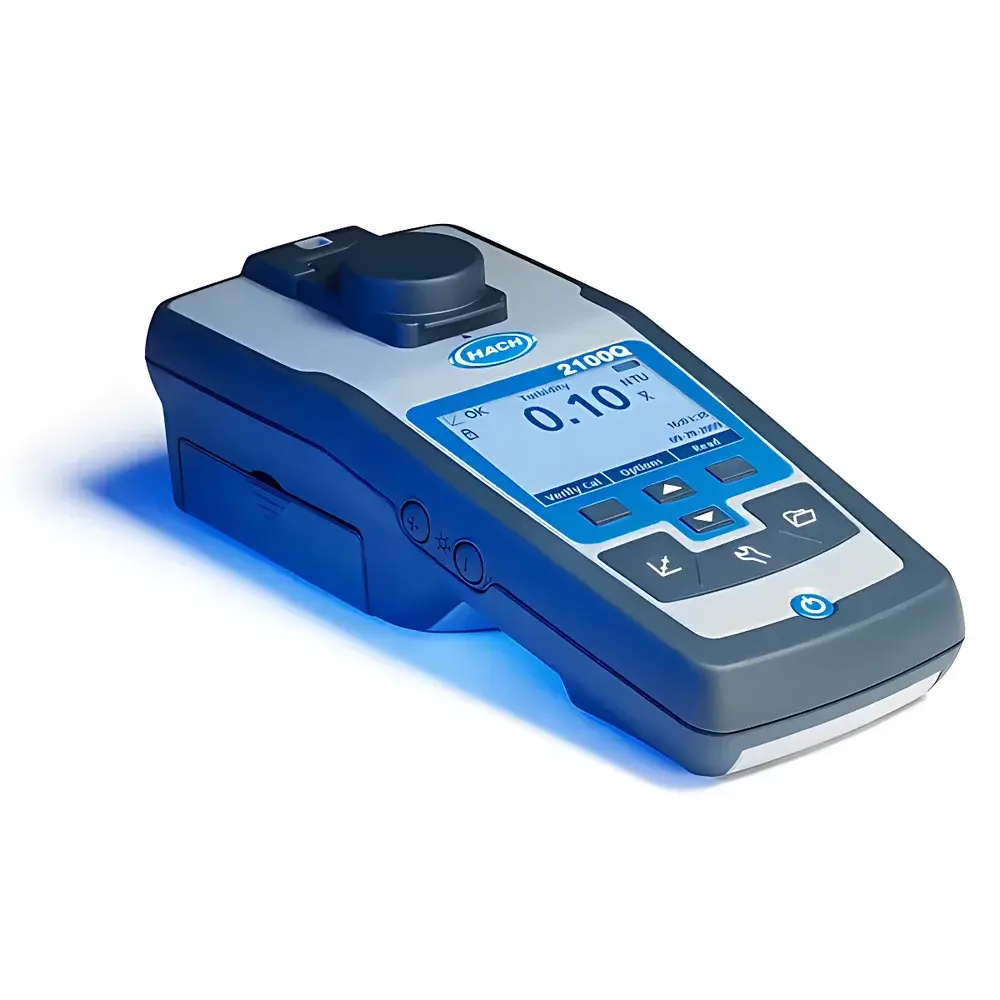
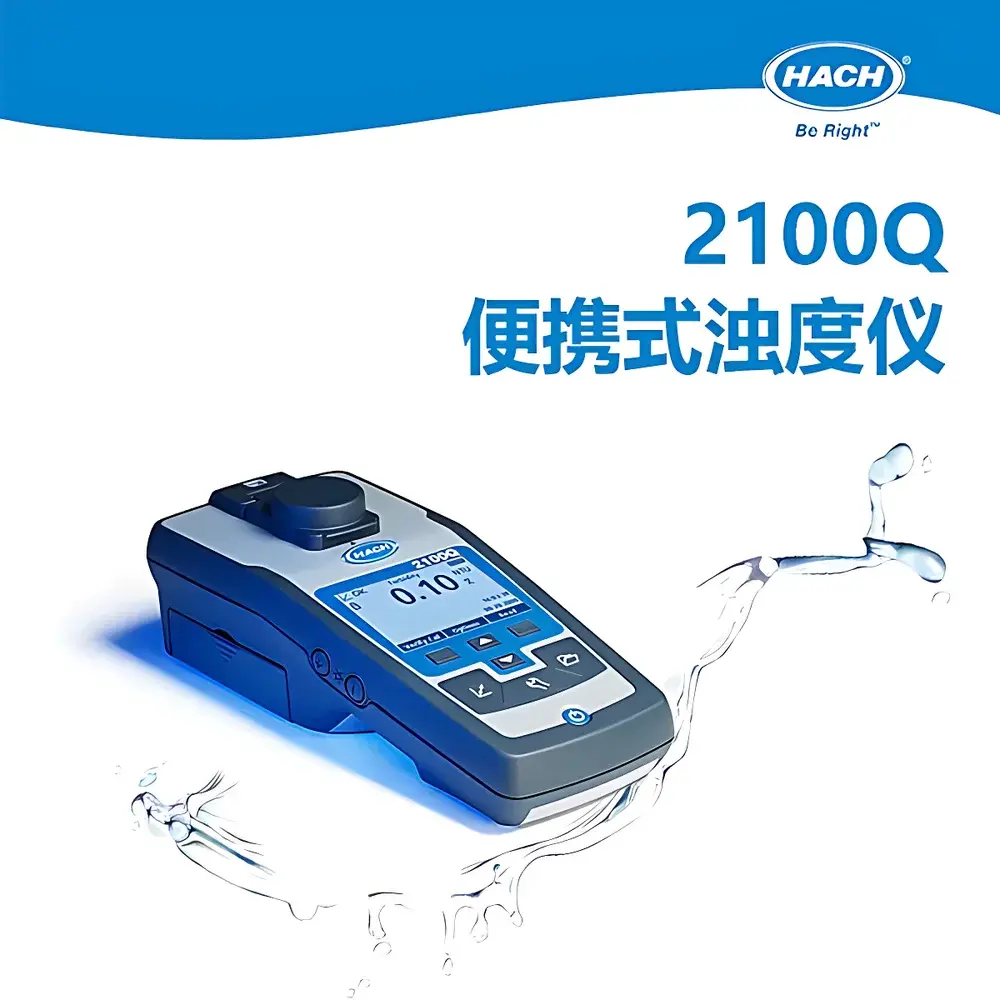
Hach 2100Q Portable Turbidimeter
| Brand | Hach |
|---|---|
| Origin | Imported |
| Manufacturer Type | Manufacturer |
| Model | 2100Q |
| Product Type | Portable |
| Measurement Range | 0–1000 NTU |
| Resolution | 0.01 NTU (at lowest range) |
| Operating Temperature | 0–50 °C |
| Accuracy | ±2% of reading plus stray light contribution |
| Stray Light | < 0.02 NTU (FNU) |
| Measurement Principle | Ratio method—90° scattered light and transmitted light detection |
| Regulatory Compliance | EPA Method 180.1 |
| Light Source | Tungsten lamp |
| Calibration Options | Single-point (0–40 NTU), full-range (0–1000 NTU), or turbidity-to-suspended solids (0–100 mg/L) |
| Calibration Memory | Last 25 successful calibrations |
| Data Storage | Up to 500 measurements with timestamp, operator ID, sample ID, mode, units, calibration status, and error logs |
| Signal Averaging | User-selectable On/Off |
| Reading Modes | Normal, Signal Averaging, Fast-Settling Turbidity |
| RST (Rapid Settling Turbidity) Algorithm | Yes |
| Interface | USB + power module (optional) for direct PC transfer without proprietary software |
Overview
The Hach 2100Q Portable Turbidimeter is an EPA Method 180.1-compliant field instrument engineered for high-fidelity turbidity measurement in demanding environmental, municipal, and industrial water quality applications. It employs a dual-detector ratio measurement principle—simultaneously quantifying 90° scattered light and transmitted light—to compensate for color interference, ambient light fluctuations, and stray light artifacts. This optical architecture, derived from Hach’s legacy 2100P platform and refined through decades of field validation, ensures laboratory-grade repeatability and stability even under variable lighting, temperature, or sample matrix conditions. Unlike single-angle scatter meters, the 2100Q’s ratio-based photometry minimizes bias from particle size distribution shifts and chromophore absorption, delivering robust NTU (Nephelometric Turbidity Unit) values traceable to formazin standards. Its tungsten lamp source provides broad-spectrum illumination suitable for compliance with U.S. regulatory frameworks governing drinking water, wastewater effluent, and surface water monitoring.
Key Features
- Dual-Detector Ratio Photometry: Compensates for sample color, lamp drift, and stray light (<0.02 NTU FNU), enabling reliable measurements across diverse matrices—from colored surface waters to chlorinated distribution system samples.
- Rapid Settling Turbidity (RST) Algorithm: Automatically acquires and processes a time-series of readings to compute a stabilized turbidity value for rapidly settling suspensions (e.g., flocculated coagulant residuals or sediment-laden runoff), eliminating manual estimation or repeated sampling.
- Three Calibration Pathways: Supports single-point RapidCal (0–40 NTU), full-range calibration (0–1000 NTU), and turbidity-to-suspended solids correlation (0–100 mg/L), each with on-screen guided prompts and automatic validation feedback.
- Embedded Calibration Audit Trail: Stores metadata for the most recent 25 calibrations—including date/time, operator ID, standard used, deviation, and pass/fail status—supporting GLP-aligned documentation requirements.
- Field-Optimized Ergonomics: IP67-rated housing, rubberized grip, and intuitive keypad enable one-handed operation in wet, dusty, or low-light environments; battery life exceeds 2,000 measurements per charge.
Sample Compatibility & Compliance
The 2100Q is validated for use with aqueous samples exhibiting turbidity values from 0 to 1000 NTU, including raw water, filtered effluent, process streams, and treated drinking water. Its optical design accommodates moderate coloration (up to 500 Pt-Co units) without requiring filtration or dilution. The instrument meets the performance criteria specified in U.S. Environmental Protection Agency Method 180.1 for nephelometric turbidity determination and is routinely deployed in facilities subject to Clean Water Act reporting and Safe Drinking Water Act compliance. While not ISO 7027-certified (a distinction reserved for the 2100Q IS variant with 860 nm LED source), its measurement uncertainty profile—±2% of reading plus stray light contribution—is consistent with routine field verification protocols outlined in ASTM D6508 and ISO 7027 Annex B for comparative assessment.
Software & Data Management
Data integrity and traceability are maintained via built-in non-volatile memory capable of storing up to 500 complete measurement records. Each entry includes timestamp (YYYY-MM-DD HH:MM), operator ID, sample ID, reading mode (Normal, Signal Average, or RST), units (NTU or FNU), calibration status flag, and any associated diagnostic codes. Optional USB + power module enables direct plug-and-play data export to Windows or macOS systems without installation of vendor-specific drivers or software suites—measurements appear as CSV-formatted text files readable in Excel or LIMS platforms. The absence of proprietary firmware dependencies ensures compatibility with 21 CFR Part 11–compliant audit trail configurations when integrated into validated laboratory information management systems (LIMS).
Applications
- Drinking water treatment: Monitoring filter performance, coagulation efficiency, and finished water clarity at intake, intermediate, and point-of-entry locations.
- Wastewater operations: Assessing clarifier effluent quality, evaluating membrane integrity, and verifying disinfection barrier efficacy prior to discharge.
- Environmental field surveys: Quantifying turbidity plumes in rivers, lakes, and estuaries during construction dewatering, dredging, or stormwater outfall assessments.
- Industrial process control: Tracking suspended solids in cooling tower make-up, boiler feedwater pretreatment, and pharmaceutical water-for-injection (WFI) polishing loops.
- Educational and research labs: Teaching fundamental principles of light scattering, validating new sensor designs, and cross-calibrating benchtop nephelometers against portable reference standards.
FAQ
Does the 2100Q require annual factory recalibration?
No—its optical path is sealed and drift-compensated via real-time ratio detection. Users perform field verification using primary standards (e.g., formazin or AMCO AEPA-1); only if verification fails beyond tolerance should service be requested.
Can the 2100Q measure samples with air bubbles or foam?
Bubbles introduce positive bias due to enhanced scattering; deaeration or settling is recommended prior to measurement. The RST mode may partially mitigate transient bubble effects but does not eliminate them.
Is the 2100Q compatible with Hach’s DR series spectrophotometers’ calibration standards?
Yes—formazin-based standards (e.g., 20 NTU, 100 NTU) and StablCal® vials are fully interoperable across Hach turbidimeters, ensuring method consistency across portable and benchtop platforms.
How does the instrument handle high-turbidity samples near 1000 NTU?
At upper range, signal averaging (≥3 sec) and proper cuvette wiping minimize noise; however, dilution with particle-free water followed by multiplication is preferred for optimal linearity and reduced stray light impact.
What documentation is provided for regulatory audits?
The device generates internal calibration logs and measurement history; users should retain printed or exported records alongside standard operating procedures (SOPs), standard lot certificates, and verification reports to satisfy EPA, ISO/IEC 17025, or GMP audit requirements.



