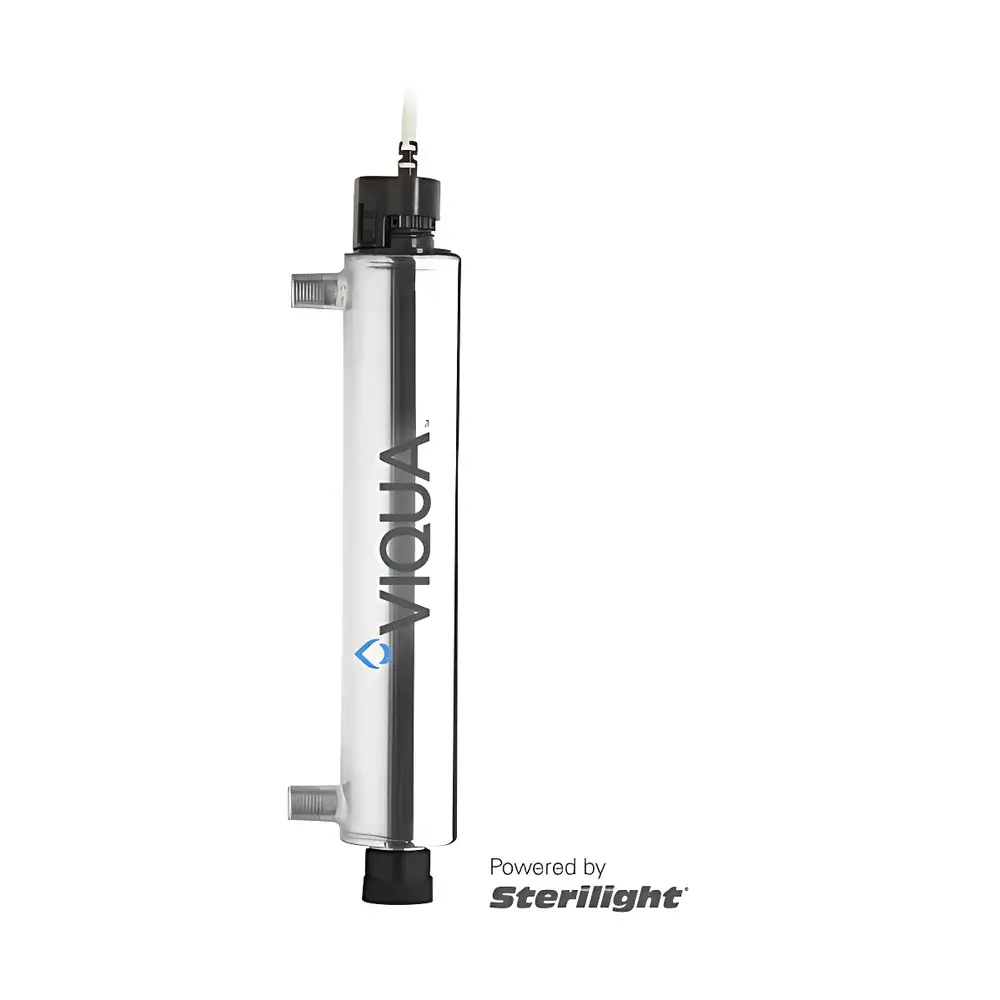
Viqua S2Q-PA Ultraviolet Water Disinfection System
| Brand | Viqua |
|---|---|
| Origin | Imported |
| Manufacturer Type | Authorized Distributor |
| Model | S2Q-PA |
| Pricing | Available Upon Request |
Overview
The Viqua S2Q-PA Ultraviolet Water Disinfection System is an NSF/ANSI 55 Class A certified, low-pressure, high-output UV disinfection unit engineered for continuous, chemical-free microbial inactivation in point-of-entry (POE) applications. Operating on the principle of ultraviolet germicidal irradiation (UVGI), the system delivers a validated minimum UV dose of 40 mJ/cm² at design flow rates—sufficient to achieve ≥4-log (99.99%) reduction of bacteria (e.g., E. coli, Legionella pneumophila), viruses (e.g., rotavirus, hepatitis A), and protozoan cysts (e.g., Cryptosporidium parvum, Giardia lamblia) without altering water chemistry, taste, odor, or pH. Designed for integration into potable water distribution systems, the S2Q-PA complies with U.S. EPA Guidance Manual for the UV Disinfection of Drinking Water and meets the performance requirements of NSF/ANSI Standard 55 for Class A systems, which mandate redundant safety features, real-time UV intensity monitoring, and automatic shut-off upon sensor failure or lamp deactivation.
Key Features
- High-efficiency, low-pressure amalgam UV lamp delivering stable output over extended service life (rated for ≥9,000 hours)
- Integrated UV intensity sensor with continuous real-time monitoring and digital LED display showing instantaneous UV dose (mJ/cm²) and lamp operational status
- Automatic solenoid valve interlock that cuts water flow if UV intensity falls below the validated threshold or power is interrupted
- Stainless steel 316 reaction chamber with polished internal surface to maximize UV reflectivity and minimize biofilm adhesion
- Compact, wall-mountable housing with IP65-rated electronics enclosure suitable for indoor installation in mechanical rooms, utility closets, or basement environments
- Compliance-ready design supporting audit trails: event logging (lamp start/stop, intensity alarms, valve actuation) stored internally for ≥30 days
Sample Compatibility & Compliance
The S2Q-PA is validated for use with municipally treated or privately sourced potable water meeting NSF/ANSI Standard 61 for material safety and exhibiting turbidity ≤1 NTU, total iron ≤0.3 mg/L, hardness ≤7 gpg, and UV transmittance (UVT) ≥75% at 254 nm. Pre-filtration (5 µm sediment filter + optional carbon polishing) is required where feed water exceeds these thresholds. The system is certified to NSF/ANSI 55 Class A (Standard 55-2022), conforms to CSA C22.2 No. 125 and UL 61010-1 for electrical safety, and supports documentation frameworks aligned with FDA 21 CFR Part 11 for electronic records and signatures when integrated with compatible data acquisition software. It is not intended for wastewater, seawater, or non-potable reuse applications.
Software & Data Management
While the S2Q-PA operates as a standalone, microprocessor-controlled unit without cloud connectivity, its embedded controller supports RS-485 Modbus RTU communication for integration into building management systems (BMS) or SCADA networks. Logged operational data—including cumulative lamp hours, total UV dose delivered, alarm history (e.g., low-intensity, flow fault, power loss), and valve actuation events—can be retrieved via serial interface using standard Modbus function codes (e.g., FC03, FC04). Optional Viqua UV Monitor software (Windows-based) enables local PC-based configuration, historical trend analysis, and PDF report generation compliant with GLP/GMP documentation requirements. All logs include timestamped UTC entries with millisecond resolution, supporting traceability during regulatory audits.
Applications
The S2Q-PA serves as a primary or secondary disinfection barrier across diverse institutional and commercial settings requiring reliable, maintenance-transparent pathogen control. Typical deployments include: municipal residential POE installations serving multi-family dwellings; foodservice operations (restaurants, cafeterias, beverage dispensers) requiring NSF/ANSI 136 compliance; healthcare facilities (clinics, outpatient centers) adhering to ASHRAE Guideline 12–2020 for Legionella risk management; educational campuses with centralized domestic water systems; hospitality venues (hotels, resorts) maintaining guest safety standards per CDC’s Environmental Health Services guidelines; and recreational facilities (indoor pools, water parks) where chlorine-resistant pathogens pose elevated public health risks. Its design excludes use in pharmaceutical-grade purified water (PW) or water-for-injection (WFI) systems, which require higher validation rigor per USP .
FAQ
What is the maximum recommended flow rate for the S2Q-PA?
The system is rated for continuous operation up to 22.7 L/min (6 GPM) while maintaining ≥40 mJ/cm² UV dose under specified water quality conditions.
Does the S2Q-PA require annual recalibration?
No—UV intensity sensors are factory-calibrated and do not require field recalibration; however, annual verification using a NIST-traceable handheld UV radiometer is recommended per manufacturer guidelines.
Can the unit be installed vertically or horizontally?
Installation must follow the orientation specified in the instruction manual: horizontal mounting only, with inlet/outlet ports aligned on the same horizontal plane to ensure laminar flow and uniform UV exposure.
Is replacement lamp programming required after installation?
Yes—the control module must be reset to initialize the new lamp’s operational counter; failure to do so will trigger false low-dose alarms after 9,000 hours.
Does the S2Q-PA meet requirements for LEED v4.1 Water Efficiency credits?
While UV disinfection itself does not directly contribute to LEED WE credits, its inclusion in a comprehensive water safety plan may support Innovation credits when documented alongside third-party risk assessment and monitoring protocols.