
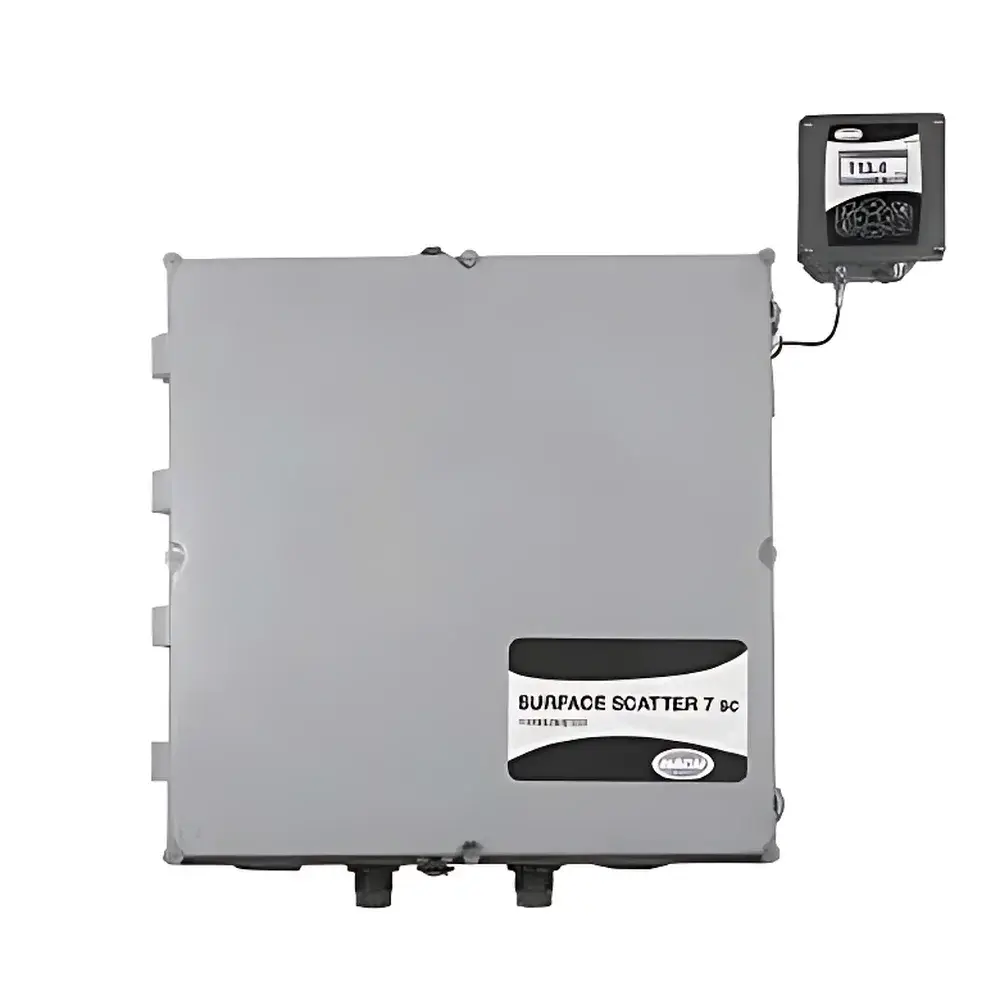
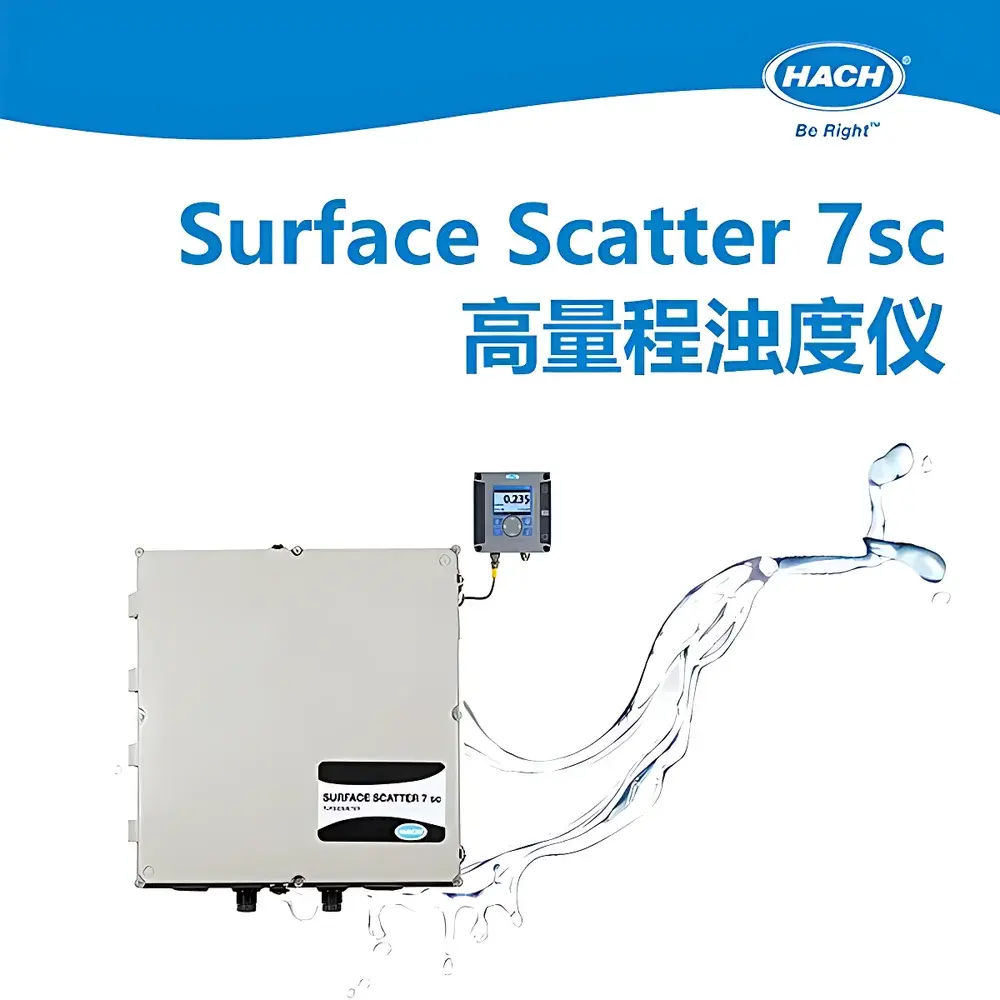
HACH Surface Scatter 7 sc High-Range Turbidimeter
| Brand | HACH |
|---|---|
| Origin | Imported |
| Manufacturer | HACH Company |
| Instrument Type | Benchtop/Laboratory |
| Measurement Range | 0.0001–1000 FNU (NTU) |
| Resolution | 0.0001–0.9999 / 1.000–9.999 / 10.00–99.99 / 100–1000 FNU (NTU) |
| Operating Temperature | 2–40 °C |
| Accuracy | ±0.008 FNU + ±1% of reading (0–10 FNU) |
| Sample Flow Rate | 1.0–2.0 L/min |
| Sample Temperature Range | 0–70 °C |
| Power Supply | 220 VAC, 50 Hz, 40 VA |
| Optical Principle | Surface Scatter (90° scattered light detection at air–liquid interface) |
| Compliance | Meets ISO 7027 and EPA Method 180.1 requirements for turbidity measurement |
| Output Interfaces | Compatible with HACH SC100 or SC1000 universal controllers (4–20 mA analog, Modbus RTU, relay alarms) |
Overview
The HACH Surface Scatter 7 sc is a high-range benchtop turbidimeter engineered for precision measurement of turbidity in water samples with exceptionally high suspended solids content—ranging from ultra-low clarity source waters to heavily loaded process effluents. Unlike conventional immersion or flow-cell turbidimeters that rely on transmission or in-situ scattering within the sample matrix, the Surface Scatter 7 sc employs a patented surface-scatter optical architecture. In this configuration, the sample flows continuously over a precisely angled, optically stable quartz surface, forming a laminar, planar meniscus at the instrument’s top edge. A collimated light beam is directed at a fixed angle onto this air–liquid interface; suspended particles near the surface scatter light predominantly at 90°, which is captured by a photodetector positioned above the surface. This geometry eliminates optical path-length variability, minimizes bubble interference, and ensures consistent illumination geometry—critical for reproducible measurements across the full 0.0001–1000 FNU range. The instrument complies with ISO 7027 (nephelometric principle using 860 nm LED) and is validated for use in accordance with U.S. EPA Method 180.1 for drinking water and wastewater applications.
Key Features
- Non-contact optical design: Light source and detector remain entirely isolated from the sample stream—eliminating fouling, reducing maintenance frequency, and extending calibration stability.
- Extended dynamic range: Capable of accurate quantification from sub-ppb-level clarity (0.0001 FNU) to highly turbid industrial slurries (up to 1000 FNU), with auto-ranging resolution switching across four decades.
- Surface-scatter geometry: Patented measurement zone at the air–liquid interface provides inherent insensitivity to color, absorbance, and refractive index variations—enhancing robustness in colored or chemically complex matrices.
- Corrosion-resistant wetted materials: Fluidic path constructed from PTFE, PVDF, and 316 stainless steel—suitable for aggressive media and elevated temperatures up to 70 °C sample inlet temperature.
- Integrated reference calibration check: Built-in ceramic reference plate enables rapid verification of optical system performance without external standards—supporting GLP-compliant operational qualification.
- Controller-agnostic architecture: Designed for seamless integration with HACH SC100 or SC1000 universal controllers, supporting 4–20 mA analog output, Modbus RTU digital communication, and configurable alarm relays.
Sample Compatibility & Compliance
The Surface Scatter 7 sc is validated for use with raw water, sedimentation basin effluents, filter backwash streams, activated sludge return lines, and industrial process waters containing high concentrations of silt, algae, precipitated metal hydroxides, or organic flocs. Its surface-scatter methodology maintains accuracy in samples exhibiting significant spectral absorption (e.g., humic-rich surface waters) or variable particle morphology—conditions where traditional 90° nephelometers may exhibit bias. The instrument meets ISO 7027:2016 requirements for instrument design, wavelength specification (860 ± 30 nm), and stray-light rejection. For regulated environments—including drinking water utilities subject to U.S. Safe Drinking Water Act (SDWA) monitoring and wastewater treatment plants under NPDES permit conditions—the device supports audit-ready data logging when paired with SC1000 controllers compliant with FDA 21 CFR Part 11 (electronic records/signatures) and GLP/GMP traceability requirements.
Software & Data Management
When interfaced with the HACH SC1000 controller, the Surface Scatter 7 sc supports time-stamped, high-resolution data acquisition at user-defined intervals (1 second to 24 hours). Raw FNU values, diagnostic flags (e.g., low signal, flow interruption), and calibration event logs are stored locally with optional export via USB or Ethernet to LIMS or SCADA systems. Firmware includes configurable averaging algorithms (moving average, median filtering) to suppress transient noise from entrained air or particulate surges. All calibration events—including zero, span, and reference checks—are digitally signed and timestamped, enabling full traceability for internal QA audits or regulatory inspections. The SC1000 platform also supports automated calibration scheduling, alarm escalation protocols, and secure remote access via TLS-encrypted web interface.
Applications
- Drinking water treatment: Real-time monitoring of coagulation efficiency, sedimentation performance, and final filter effluent quality—ensuring compliance with WHO and national turbidity limits (<0.1 NTU).
- Wastewater treatment: Quantification of mixed liquor suspended solids (MLSS) consistency, secondary clarifier overflow turbidity, and disinfection process validation prior to UV or chlorine contact.
- Industrial water recycling: Control of cooling tower blowdown, boiler feed pretreatment, and membrane filtration integrity testing in power, pharmaceutical, and semiconductor facilities.
- Environmental monitoring: Field-deployable lab verification of high-turbidity river inflows, stormwater runoff, and dredging plume dispersion studies.
- Research & method development: Reference-grade turbidity characterization in colloidal science, flocculation kinetics studies, and sensor validation protocols per ASTM D6708.
FAQ
How does the Surface Scatter 7 sc differ from conventional 90° nephelometers?
It measures scattered light exclusively at the air–liquid interface—not within the bulk sample—eliminating path-length dependency, bubble artifacts, and cuvette-related errors.
Can it be used for online continuous monitoring?
No—it is designed as a benchtop analytical instrument requiring controlled sample introduction via peristaltic or gravity-fed flow; for continuous process monitoring, consider the HACH System 1720E or TU5 series.
Is calibration traceable to NIST standards?
Yes—calibration is performed using HACH StablCal® standards traceable to NIST SRM 2102a, with documented uncertainty budgets available upon request.
What maintenance is required beyond routine calibration?
Only periodic inspection of the quartz meniscus surface and flow tubing; no optical cleaning or lamp replacement is needed during typical 5-year service life.
Does it support automatic temperature compensation?
Yes—integrated Pt1000 RTD sensor provides real-time compensation across 0–70 °C, applying ISO 7027-recommended correction coefficients for viscosity and scattering cross-section.





