
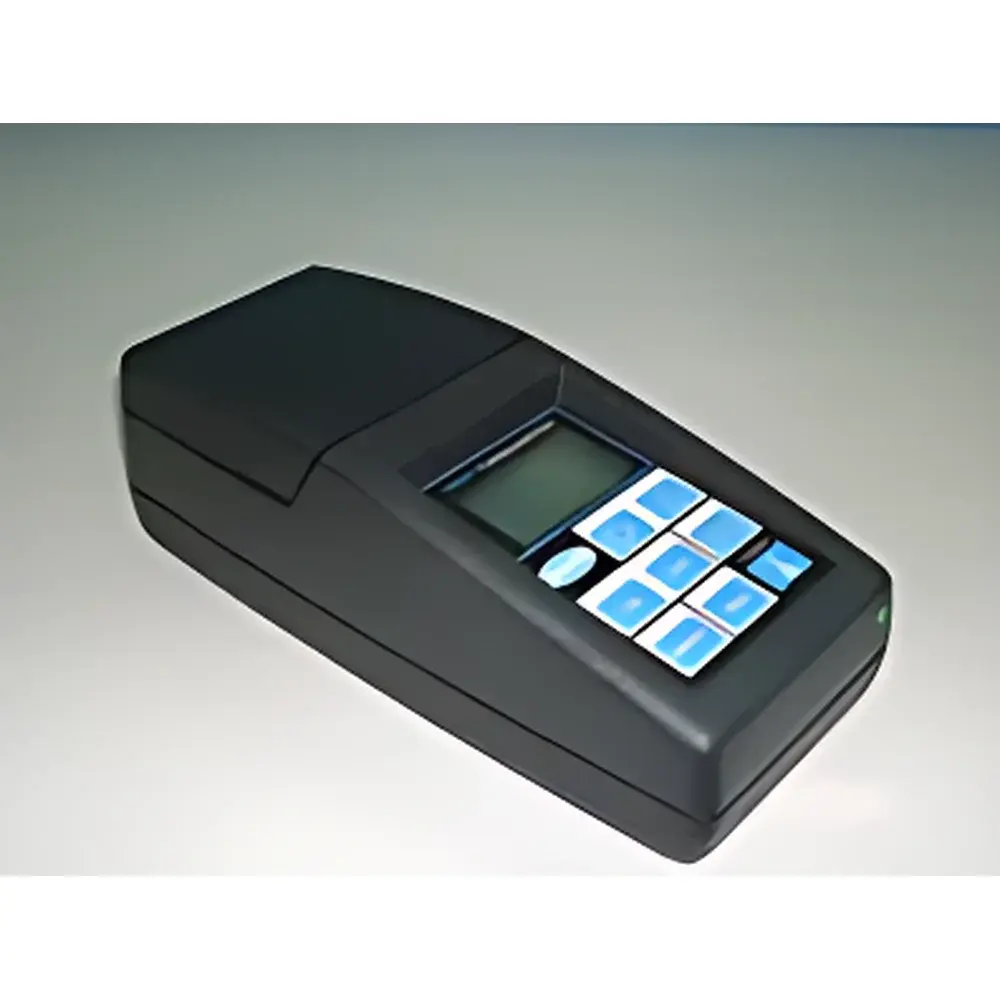
HACH 1900C Portable Turbidimeter
| Brand | HACH |
|---|---|
| Origin | Imported |
| Manufacturer Type | Manufacturer |
| Model | 1900C |
| Product Type | Portable |
| Measurement Range | 0–9.99 NTU, 0–99.9 NTU, or 0–1000 NTU (auto-ranging or manual range selection) |
| Resolution | 0.01 NTU (at lowest range) |
| Operating Temperature | 0–50 °C |
| Accuracy | ≤1% (0–1000 NTU) |
| Repeatability | ≤1% (0–1000 NTU) |
| Zero Drift | ±1.5% F.S. |
| Stability | ±1.5% F.S. |
| Linearity Error | 1% |
| Power Supply | 4 × AA alkaline batteries or optional AC adapter |
| Weight | 520 g |
| Compliance | EPA Method 180.1 |
Overview
The HACH 1900C Portable Turbidimeter is a field-deployable, microprocessor-controlled optical instrument engineered for precise and reliable turbidity measurement in diverse water matrices. It operates on the principle of nephelometric detection—measuring the intensity of light scattered at 90° from a collimated incident beam—as defined by U.S. Environmental Protection Agency (EPA) Method 180.1. Its dual-detector optical architecture employs HACH’s proprietary Ratio technology, which simultaneously monitors forward-scattered and 90°-scattered light to dynamically compensate for color interference, stray light, lamp intensity drift, and sample-related artifacts such as suspended particle migration during measurement. This ratio-based correction ensures high reproducibility and minimizes calibration dependency across variable sample conditions. Designed for operational robustness in both laboratory and uncontrolled field environments, the 1900C delivers laboratory-grade performance in a lightweight (520 g), battery-powered package suitable for routine monitoring, regulatory compliance verification, and rapid response applications.
Key Features
- Ratio optical system compliant with EPA Method 180.1, enabling accurate compensation for sample color, turbidity heterogeneity, and photometric instability
- Three manually selectable measurement ranges (0–9.99 NTU, 0–99.9 NTU, 0–1000 NTU) plus auto-ranging mode for adaptive resolution and dynamic span optimization
- High-resolution detection down to 0.01 NTU in the lowest range, supporting sensitive low-turbidity applications including purified water and pharmaceutical process water
- Integrated self-diagnostic routines that continuously monitor detector response, lamp output, and signal integrity—alerting users to potential hardware anomalies before data integrity is compromised
- Stable operation across an extended ambient temperature range (0–50 °C), validated for use in outdoor sampling, mobile laboratories, and industrial plant environments
- Low-power design powered by four standard AA alkaline batteries (typical life > 2,000 measurements), with optional AC adapter support for benchtop continuity
- CMC-certified for sale and use in China; meets metrological requirements for field-deployed environmental instrumentation under national verification protocols
Sample Compatibility & Compliance
The 1900C is validated for use with aqueous samples exhibiting low-to-moderate turbidity, including drinking water, wastewater effluents, process water in food & beverage production, aquaculture systems, swimming pool recirculation streams, and environmental surface waters. Its optical path geometry and cuvette-based sample handling minimize interference from bubbles, coating, or particulate settling. Instrument performance adheres to the precision and accuracy criteria specified in EPA Method 180.1 and aligns with ISO 7027:2016 principles for turbidimetric measurement. While not designed for compliance with FDA 21 CFR Part 11 out-of-the-box, audit-ready documentation—including calibration logs, operator identification fields (via optional PC interface), and timestamped measurement records—supports GLP and GMP-aligned quality systems when integrated into validated workflows.
Software & Data Management
The 1900C operates as a standalone instrument with embedded firmware; no onboard data storage or USB connectivity is provided. However, analog output (0–5 V DC) and optional RS-232 serial interface enable integration with external data loggers or LIMS platforms for automated record capture. HACH’s legacy LogPro software (Windows-compatible) supports configuration, firmware updates, and batch export of measurement sessions when connected via serial cable. All calibration and verification events—including zero and span checks using formazin or AMCO-AE standards—are traceable through printed or exported reports. The device maintains internal calibration constants with non-volatile memory retention, ensuring consistency across power cycles without recalibration.
Applications
- Routine turbidity screening at municipal water treatment plants, particularly for filter performance evaluation and distribution system integrity monitoring
- Regulatory compliance testing for discharge permits (e.g., NPDES), requiring adherence to EPA-defined turbidity thresholds
- Process control in beverage bottling facilities, where turbidity serves as an indicator of filtration efficiency and product clarity
- Environmental field surveys assessing sediment resuspension, stormwater runoff impact, and watershed health indicators
- Healthcare facility water safety plans (WSPs), including dialysis water monitoring and cooling tower surveillance per ASHRAE Guideline 12
- Educational laboratories conducting method validation exercises and comparative turbidity studies under controlled pedagogical protocols
FAQ
What turbidity standards are recommended for calibration?
Formazin suspension (primary standard per ISO 7027) or HACH AMCO-AE polymer standards are recommended; calibration should be performed at two points—one near zero and one within the expected sample range.
Can the 1900C measure samples with high color or fluorescence?
Yes—the Ratio optical system inherently corrects for absorbance-related attenuation, though extreme chromophore concentrations (>500 Pt-Co units) may require method validation against reference techniques.
Is the instrument suitable for continuous online monitoring?
No—it is a portable, grab-sample instrument; for continuous applications, consider HACH’s SC1000 platform with TU5 Series sensors.
How often should zero and span calibration be performed?
Daily zero verification is recommended for critical applications; full two-point calibration should occur before each analytical session or after exposure to extreme temperature shifts or physical shock.
Does the 1900C support traceable calibration certificates?
Calibration can be documented using HACH’s Certificate of Conformance templates; third-party NIST-traceable calibration services are available through authorized service centers.




