
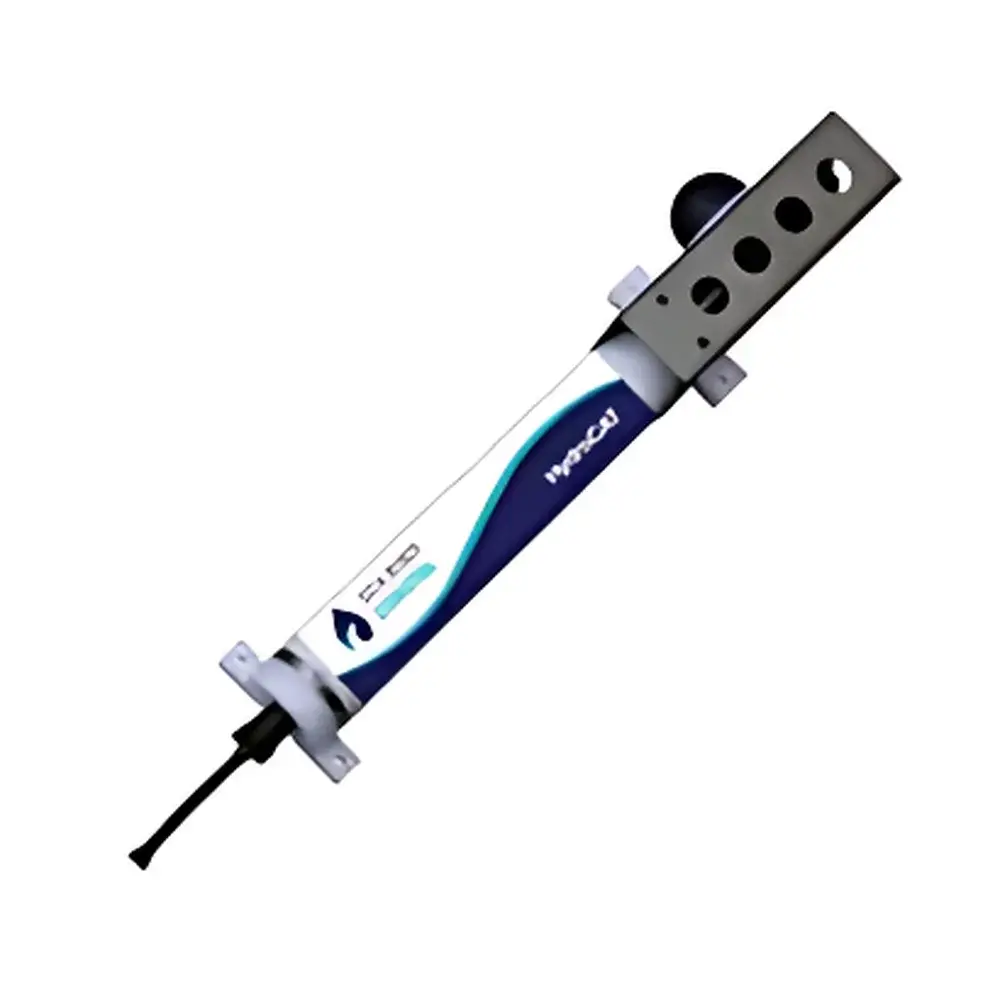
HACH Sea-Bird Scientific Hydrocat CTD Profiler
| Brand | Sea-Bird Scientific |
|---|---|
| Origin | Imported |
| Manufacturer Type | Authorized Distributor |
| Model | Hydrocat |
| Price | Upon Request |
| Temperature Range | −5 to 45 °C |
| Temp Resolution | 0.0001 °C |
| Temp Accuracy | ±0.002 °C |
| Conductivity Range | 0–70 mS/cm |
| Cond Resolution | 0.0001 mS/cm |
| Cond Accuracy | ±0.003 mS/cm |
| Pressure Range | 0–350 m (depth equivalent) |
| Pressure Resolution | 0.002% FS |
| Pressure Accuracy | ±0.1% FS |
| Dissolved Oxygen Range | 0–120% saturation |
| DO Resolution | 0.007 mg/L |
| DO Accuracy | ±0.1 mg/L or ±2% (whichever is greater) |
| Housing | Engineering-grade polymer |
| Weight (air/water) | 3.4 kg / 1.5 kg |
| Sampling Interval | 2.3–3.2 s per profile |
| Power Supply | 9–24 V DC, 0.25 A |
Overview
The HACH Sea-Bird Scientific Hydrocat CTD Profiler is a purpose-built, submersible oceanographic instrument engineered for high-fidelity, long-term in situ monitoring of core physical and biogeochemical parameters in coastal, estuarine, lacustrine, and riverine environments. Operating on the fundamental principles of precision thermistor-based temperature measurement, quartz-cell conductivity sensing via a three-electrode configuration, and piezoresistive pressure transduction, the Hydrocat delivers traceable, stable, and inter-calibrated data streams essential for time-series analysis, ecosystem modeling, and regulatory compliance. Its design emphasizes operational robustness over extended deployment cycles—up to 12 months on a single mooring—without requiring field recalibration, making it particularly suited for remote or logistically constrained sites where access is infrequent.
Key Features
- Integrated Flow-Controlled Measurement Architecture: A dedicated low-pulsation pump draws ambient water at a precisely regulated flow rate through an enclosed, light-tight internal plumbing path. This ensures all sensors—including temperature, conductivity, and dissolved oxygen—sample the same water parcel under identical hydrodynamic conditions, eliminating temporal misalignment and cross-sensor response lag.
- Quartz Conductivity Cell with Three-Electrode Design: Unlike inductive (toroidal) or conventional two-electrode cells, Sea-Bird’s proprietary quartz cell minimizes edge effects and polarization drift. The three-electrode configuration enables real-time compensation for electrode fouling and contact resistance, delivering stable conductivity measurements independent of nearby metallic structures or biofilm accumulation.
- EPA-Recognized Biofouling Mitigation System: Includes passive antifouling hardware compliant with U.S. Environmental Protection Agency guidance for long-term marine deployments. Combined with the dark, laminar-flow internal path and periodic flush cycles, this system significantly reduces biological growth on optical and electrochemical surfaces—preserving calibration integrity and signal stability across multi-month missions.
- Factory-Calibrated Traceability: Each unit undergoes full-scale characterization in a NIST-traceable, thermostatically controlled calibration bath with uncertainty 2–4× tighter than published sensor specifications. Calibration coefficients are embedded in firmware and applied in real time during data acquisition.
- Low-Power, Wide-Voltage Operation: Designed for integration into autonomous platforms (moorings, gliders, buoys), the Hydrocat operates continuously from 9–24 V DC at just 0.25 A, supporting solar- or battery-powered deployments without thermal loading or voltage regulation complexity.
Sample Compatibility & Compliance
The Hydrocat is validated for use in saline, brackish, and freshwater matrices—including turbid estuaries, eutrophic lakes, and dynamic tidal rivers. Its polymer housing meets ISO 14688-1 for submersible environmental instrumentation and complies with IEC 60529 IP68 ingress protection standards for continuous submersion to 350 m. Data output formats (including ASCII, binary .cnv, and NetCDF) support interoperability with NOAA IOOS, EuroGOOS, and national water quality monitoring frameworks. While not certified to FDA 21 CFR Part 11, its deterministic sampling interval, onboard timestamping, and immutable calibration metadata align with GLP/GMP-aligned QA/QC workflows for environmental data reporting under ISO/IEC 17025-accredited laboratories.
Software & Data Management
Data acquisition is managed via Sea-Bird’s SBE Data Processing software suite (v7.27+), which supports batch post-processing, alignment correction, salinity derivation (using UNESCO TEOS-10 algorithms), and dissolved oxygen saturation conversion (accounting for temperature, salinity, and atmospheric pressure). Raw sensor voltages, derived parameters, and diagnostic flags (e.g., pump status, thermal equilibrium alerts) are logged with microsecond-resolution timestamps. Export options include CSV, MATLAB .mat, and CF-compliant NetCDF—enabling direct ingestion into Python-based analysis pipelines (e.g., xarray, OceanSpy) or GIS-integrated monitoring dashboards. Firmware updates preserve backward compatibility and include configurable sampling schedules, burst modes, and alert-triggered event logging.
Applications
- Long-term moored observatories tracking seasonal variability in stratification, hypoxia onset, and nutrient fluxes
- Real-time validation of satellite-derived sea surface temperature (SST) and chlorophyll-a products
- Calibration and ground-truthing of autonomous underwater vehicles (AUVs) and profiling floats
- Regulatory compliance monitoring for TMDL implementation, shellfish bed classification, and wastewater outfall assessments
- Process studies of air–water gas exchange, sediment resuspension events, and storm-driven mixing dynamics
FAQ
What is the maximum recommended deployment duration without maintenance?
Typical unattended operation exceeds 12 months in low-to-moderate biofouling environments when using the EPA-recognized antifouling kit and standard pump duty cycle.
Does the Hydrocat support real-time telemetry via satellite or cellular modems?
Yes—the instrument outputs RS-232 or SDI-12 serial data compatible with common telemetry gateways (e.g., Campbell Scientific CR1000X, Satlantic Sea-Bird integrators); no proprietary protocol is required.
How is salinity calculated, and which algorithm is used?
Salinity is computed in real time using the TEOS-10 Gibbs SeaWater (GSW) Oceanographic Toolbox, incorporating simultaneous temperature, conductivity, and pressure inputs with full thermal expansion and compressibility corrections.
Can the Hydrocat be deployed in freshwater lakes with low conductivity?
Yes—its 0–70 mS/cm range covers ultrapure freshwater (≈0.05 mS/cm) through hypersaline lagoons (>60 mS/cm), with resolution and accuracy maintained across the full span.
Is pressure used solely for depth derivation, or does it contribute to other calculations?
Pressure input is integral to both depth reporting and TEOS-10 salinity computation; it also corrects dissolved oxygen saturation values for hydrostatic compression effects per Winkler-standard methodology.







