
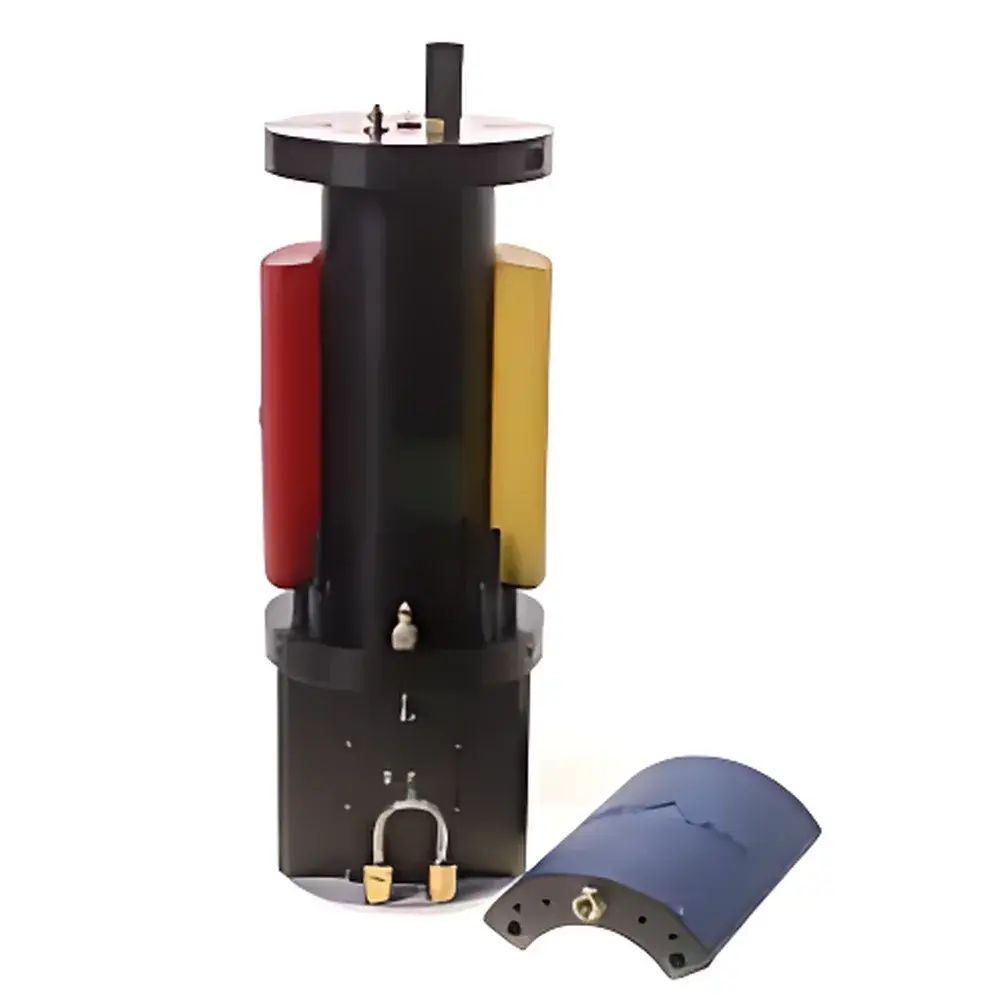
Hach Sea-Bird Coastal Cycle PO₄ In Situ Dissolved Orthophosphate Analyzer
| Brand | Sea-Bird Scientific |
|---|---|
| Origin | Imported |
| Model | Cycle PO₄ |
| Detection Principle | Colorimetric Microfluidic Analysis (EPA Method 365.3) |
| Detection Limit | ≤75 nM PO₄-P (3σ in 18 MΩ·cm water) |
| Quantitation Limit | ≤0.25 µM PO₄-P (10σ) |
| Typical Range | 0–10 µM PO₄-P (0–0.3 mg/L as PO₄-P) |
| Optical Path Length | 5 cm |
| LED Wavelength | 870 nm |
| Linearity | ≥95% R² |
| Operating Depth | Up to 200 m |
| Temperature Range | 1–35 °C |
| Power Input | 10–18 VDC |
| Average Current Draw | 125 mA |
| Sampling Frequency | Up to 2 samples/hour |
| Data Storage | 1 GB internal |
| Output Interfaces | RS-232, SDI-12 |
| Filter | Dual-stage (copper mesh + 10 µm stainless steel) |
| Calibration | Onboard NIST-traceable peak calibration with user-configurable schedule |
| Reagent Cartridge Life | >1000 analyses per cartridge (including QA/QC calibrations) |
| Housing Dimensions | 56 cm (H incl. handle) × 18 cm (W) × — cm (D) |
| Air Weight | 6.8 kg (with reagents) |
Overview
The Hach Sea-Bird Coastal Cycle PO₄ In Situ Dissolved Orthophosphate Analyzer is an autonomous, submersible nutrient sensor engineered for high-fidelity, long-term monitoring of dissolved orthophosphate (PO₄-P) in dynamic aquatic environments. It implements a microfluidic colorimetric assay based on the U.S. Environmental Protection Agency (EPA) Method 365.3—modified for field-deployable operation—where orthophosphate reacts with ammonium molybdate and ascorbic acid under controlled pH and temperature to form a phosphomolybdenum blue complex. Absorbance is measured at 870 nm using a stable LED light source and a 5 cm optical pathlength flow cell, minimizing interference from turbidity and particulate scattering. Designed for deployment in biologically active waters—including estuaries, rivers, reservoirs, and coastal zones—the Cycle PO₄ delivers nanomolar-level resolution and robust anti-fouling performance through dual-stage mechanical filtration (copper mesh + 10 µm stainless steel membrane). Its pressure-rated housing (200 m depth rating) and wide operational temperature range (1–35 °C) support year-round, unattended operation in variable environmental conditions.
Key Features
- Microfluidic colorimetric detection compliant with EPA Method 365.3, optimized for in situ application
- Dual-stage inlet filtration system: copper mesh pre-filter + 10 µm stainless steel membrane for extended deployment in high-biomass waters
- NIST-traceable onboard peak calibration using certified reference materials; user-definable calibration interval
- Modular, color-coded reagent cartridges with position-encoded installation—enabling rapid, error-resistant field replacement
- Low-power architecture: average current draw of 125 mA (max 2.0 A during analysis), supporting multi-month deployments on battery or solar-hybrid platforms
- Integrated 1 GB non-volatile memory with timestamped data logging; supports RS-232 and SDI-12 digital output protocols
- Optical design with 870 nm LED and 5 cm pathlength flow cell ensures high linearity (≥95% R²) and minimal turbidity-induced drift
Sample Compatibility & Compliance
The Cycle PO₄ is validated for direct measurement of dissolved orthophosphate in natural freshwater and brackish systems, including lakes, rivers, tidal creeks, and estuarine mixing zones. It meets the analytical performance criteria outlined in ASTM D515-18 (Standard Test Method for Phosphorus in Water) and aligns with ISO 15681-1:2018 (Water quality — Determination of orthophosphate — Part 1: Automated spectrophotometric method). While not a GLP-certified instrument per se, its onboard calibration traceability to NIST Standard Reference Materials (SRMs), audit-ready data logs (with full metadata: time, temperature, pressure, calibration status), and configurable QA/QC routines support compliance with EPA-approved monitoring programs and state-level TMDL reporting requirements. The system operates within defined uncertainty envelopes across its nominal range (0–10 µM PO₄-P); extended-range operation (e.g., 0–40 µM) is possible but falls outside published accuracy specifications.
Software & Data Management
Instrument configuration, diagnostic testing, and data retrieval are managed via Sea-Bird’s SBE Data Processing software suite and the LOBO Monitoring Platform web interface. The GUI provides intuitive access to all operational parameters—including sampling interval, calibration trigger logic, memory management, and real-time status indicators (e.g., reagent level, filter clog warning, voltage stability). Raw absorbance values, calculated concentrations, and calibration coefficients are stored with full metadata and exported in CSV or NetCDF format. Time-series visualization tools enable trend analysis, event flagging (e.g., nutrient pulses following storm events), and integration with co-located sensors (e.g., SUNA nitrate, CTD, fluorometers) within the LOBO ecosystem. All data files retain embedded provenance information required for regulatory data submission under EPA Region-specific QA Project Plans.
Applications
- Long-term tracking of point-source and non-point-source phosphorus loading in watershed monitoring networks
- Real-time detection of orthophosphate anomalies associated with agricultural runoff, wastewater effluent, or algal bloom initiation
- High-frequency nutrient dynamics studies in eutrophic lakes and reservoirs under varying hydrological regimes
- Estuarine mixing zone characterization to quantify benthic fluxes and internal recycling processes
- Supporting adaptive management decisions for Total Maximum Daily Load (TMDL) implementation and nutrient reduction strategies
- Integration into autonomous platforms—including moorings, gliders, and riverine telemetry nodes—for spatially distributed sensing
FAQ
What is the recommended calibration frequency for routine monitoring?
Calibration intervals are application-dependent; typical deployments use weekly or biweekly peak calibrations. Field validation against discrete bottle samples is advised at least once per deployment cycle.
Can the Cycle PO₄ operate in full seawater without modification?
Yes—the instrument is rated for 200 m depth and fully compatible with salinities up to 35 PSU. No hardware or firmware adjustments are required for marine use.
How is reagent consumption managed over extended deployments?
Each cartridge supports >1000 analyses, including scheduled calibrations and blanks. Remaining reagent volume is monitored internally and reported in status logs.
Is the optical system susceptible to biofouling on the flow cell windows?
The 870 nm wavelength and short optical path minimize scattering artifacts; however, periodic visual inspection of the flow cell is recommended after recovery. Optional antifouling coatings are available upon request.
Does the system comply with FDA 21 CFR Part 11 or similar electronic record requirements?
While not formally 21 CFR Part 11-certified, the Cycle PO₄ generates immutable, timestamped, and metadata-rich data files suitable for regulated environmental reporting when deployed under documented SOPs and QA/QC protocols.
Related Products







