
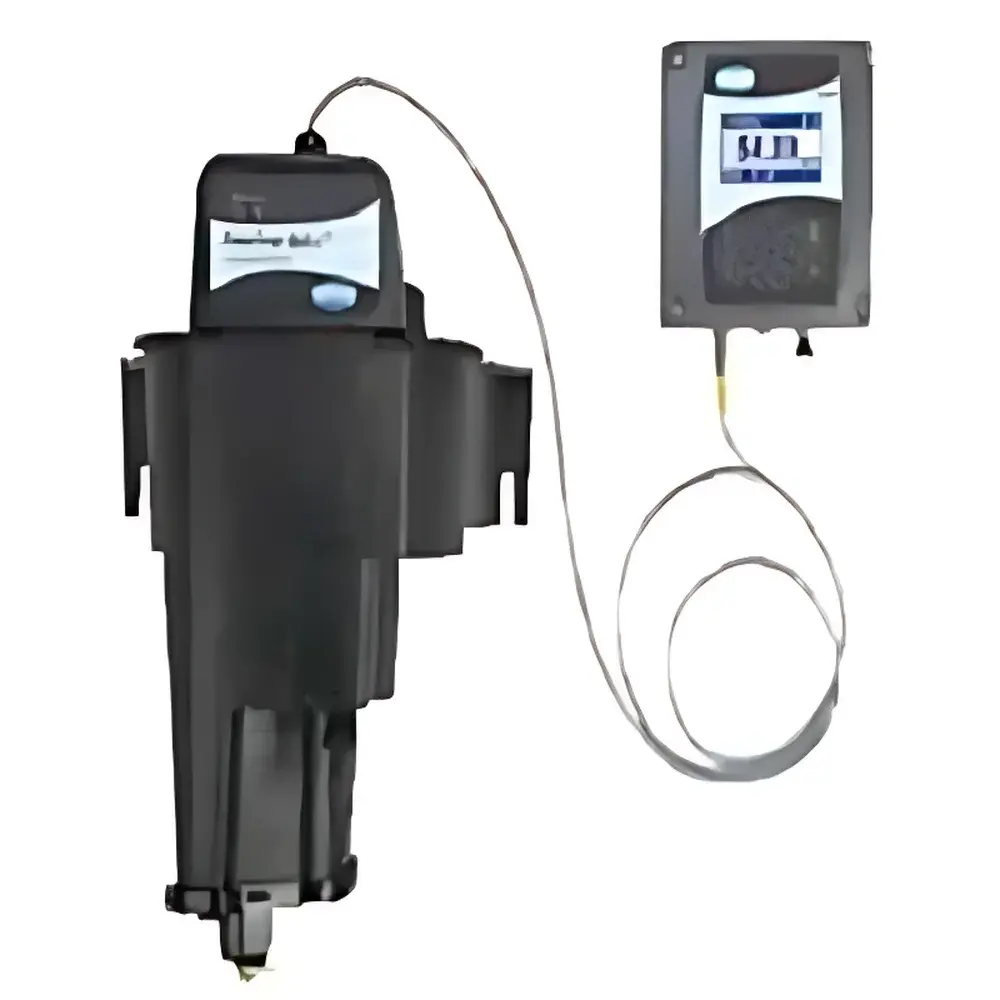
HACH FilterTrak 660 sc Ultra-Low-Range Online Turbidimeter
| Brand | HACH |
|---|---|
| Origin | Imported |
| Manufacturer Type | Original Equipment Manufacturer (OEM) |
| Model | FT660sc |
| Installation Type | Online |
| Measurement Range | 0.000–5000 mNTU |
| Light Source | 660 nm Laser Diode (35 mW) |
| Accuracy | ±2% of reading or ±5 mNTU (whichever is greater) for 0–1000 mNTU |
| Resolution | 0.001 mNTU |
| Repeatability | ±3.6% at 30 mNTU, ±1.7% at 800 mNTU |
| Sample Flow Rate | 100–750 mL/min |
| Operating Ambient Temperature | 0–40 °C |
| Sample Temperature Range | 0–50 °C |
| Analog Outputs | Dual 4–20 mA (configurable across full range) |
| Alarm Outputs | Two SPDT relays (5 A / 230 VAC) |
| Standard Compliance | EPA Method 10133 |
| Controller Compatibility | HACH sc100 / sc1000 universal controllers |
| Integrated De-bubbling System | Patented in-line air removal |
| Calibration Standards | HACH-certified 200 mNTU and 800 mNTU formazin equivalents |
Overview
The HACH FilterTrak 660 sc is an ultra-low-range online turbidimeter engineered for continuous, high-fidelity monitoring of water clarity in critical treatment and distribution applications. It operates on the principle of 90° side-scatter detection using a stabilized 660 nm laser diode, eliminating spectral interference and stray light artifacts common in LED-based systems. Unlike conventional nephelometers relying on broad-spectrum illumination, the FT660 sc employs a collimated, monochromatic 35 mW laser beam—optically filtered and precisely aligned—to ensure consistent photon interaction with suspended particulates. Scattered photons are collected via fiber-optic coupling to a photodetector positioned at a strict 90° angle relative to the incident beam path, conforming to the foundational geometry specified in EPA Method 10133. This configuration delivers exceptional signal-to-noise ratio and enables reliable quantification down to 0.001 mNTU—making it uniquely suited for detecting subtle membrane breaches, early-stage filter breakthrough, or post-treatment polishing performance where sub-0.1 NTU resolution is non-negotiable.
Key Features
- Ultra-high sensitivity: 150× greater detection capability than standard turbidimeters, validated for stable operation below 0.1 NTU—essential for membrane integrity verification and advanced oxidation process (AOP) effluent monitoring.
- Patented in-line de-bubbling system: Integrated pneumatic and hydrodynamic bubble removal ensures gas-phase interference is eliminated prior to measurement chamber entry—critical for low-turbidity samples where microbubbles mimic particle scatter.
- EPA-compliant optical architecture: Fully aligned with USEPA Method 10133 requirements for calibration traceability, angular geometry, and source stability—supporting regulatory reporting in drinking water utilities subject to SDWA compliance.
- Laser-based illumination: 660 nm diode laser provides narrow spectral bandwidth (10,000 hours MTBF), and negligible thermal drift—eliminating recalibration frequency associated with tungsten or LED sources.
- Universal controller integration: Seamless interoperability with HACH sc100 and sc1000 platforms enables centralized data logging, alarm management, and multi-parameter trending without proprietary gateways or protocol translation.
Sample Compatibility & Compliance
The FT660 sc is designed for continuous flow-through analysis of potable water, filtered process streams, and membrane permeate. Its sample interface accepts nominal ¼” or 6 mm tubing connections and supports flow rates from 100 to 750 mL/min—optimized to maintain laminar flow within the measurement cell while minimizing residence time-induced sedimentation. The instrument complies with ANSI/AWWA B100-2021 for turbidimeter performance specifications and meets the optical validation criteria outlined in ISO 7027-1:2016 for nephelometric turbidity measurement. All factory calibrations are traceable to NIST-traceable formazin standards (200 mNTU and 800 mNTU), and field verification protocols align with GLP documentation requirements for audit-ready calibration records.
Software & Data Management
When deployed with the sc1000 controller, the FT660 sc supports full 21 CFR Part 11-compliant data handling—including electronic signatures, audit trails, and user-access-level permissions. Raw analog outputs (dual 4–20 mA) are independently scalable across the entire 0–5000 mNTU range and support HART communication for remote configuration. Trend logs capture up to 12 months of 1-minute interval data with timestamped calibration events, alarm triggers, and sensor diagnostics. Export formats include CSV and PDF reports compatible with LIMS integration and SCADA historian ingestion via Modbus TCP or Ethernet/IP protocols.
Applications
- Real-time monitoring of ultrafiltration (UF) and nanofiltration (NF) membrane integrity in municipal and industrial water reuse facilities.
- Final effluent verification in direct potable reuse (DPR) and indirect potable reuse (IPR) systems requiring sub-0.05 NTU compliance.
- Continuous surveillance of finished water at municipal distribution points—particularly in chloraminated systems where low-level biofilm shedding may occur.
- Process control feedback for coagulation optimization and dissolved air flotation (DAF) performance assessment.
- Validation of UV disinfection system upstream clarity—ensuring UVT consistency and dose delivery fidelity.
FAQ
What regulatory methods does the FT660 sc comply with?
The instrument is validated per USEPA Method 10133 and conforms to ISO 7027-1:2016 for optical design, calibration methodology, and performance reporting.
Can the FT660 sc be calibrated in the field without lab-grade standards?
Yes—it supports two-point field calibration using HACH-certified 200 mNTU and 800 mNTU formazin reference standards, with built-in validation routines to confirm optical path integrity.
Is the laser source serviceable or replaceable by end users?
The 660 nm laser module is sealed and factory-aligned; replacement requires certified HACH field service personnel to maintain optical calibration certification.
How does the de-bubbling system function without moving parts?
It utilizes a combination of laminar flow channel geometry, controlled pressure differentials, and surface tension modulation—no valves, pumps, or consumables are involved.
Does the FT660 sc support Modbus RTU over RS-485?
Yes—when connected to an sc1000 controller with optional communication module, full Modbus RTU register mapping is available for third-party SCADA integration.




