
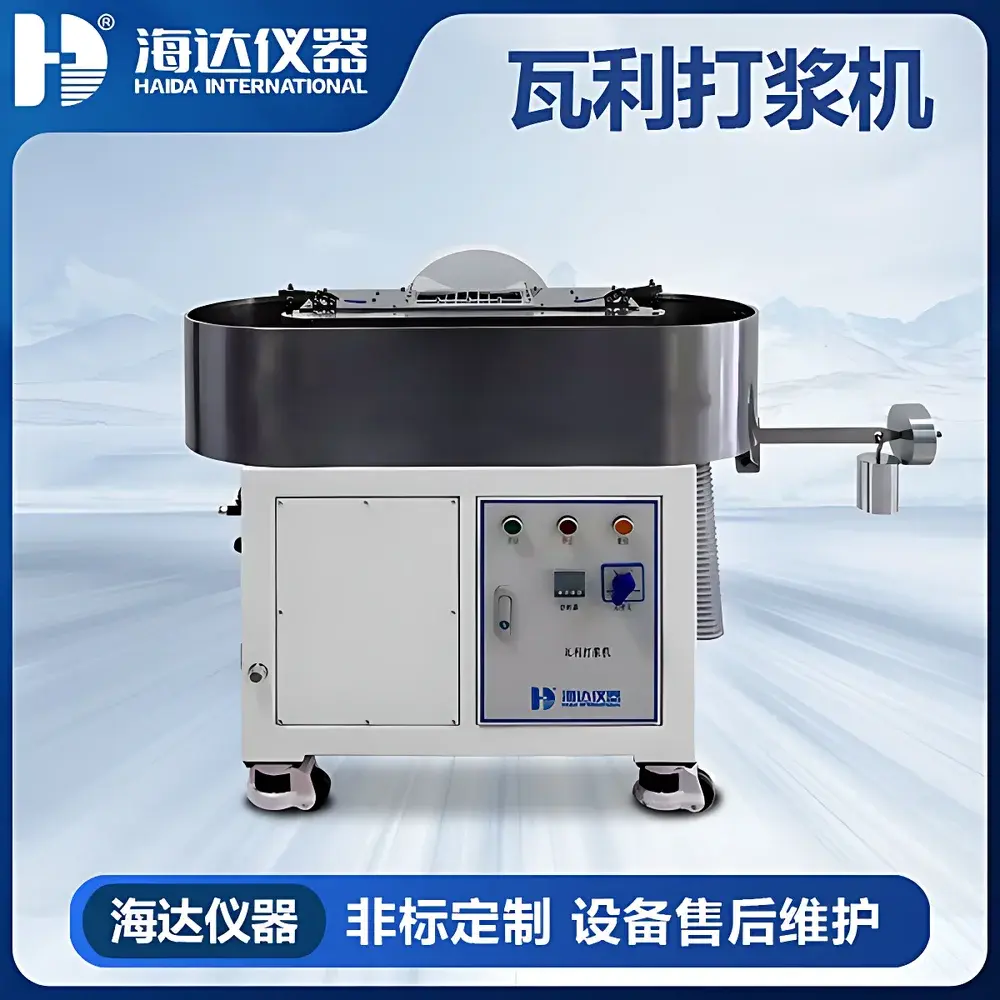
HAIDA HD-P002 Valley Beater
| Brand | HAIDA INTERNATIONAL |
|---|---|
| Origin | Guangdong, China |
| Manufacturer Type | Direct Manufacturer |
| Product Origin | Domestic (China) |
| Model | HAIDA HD-P002 Valley Beater |
| Quotation | Upon Request |
| Standard Pulping Capacity | 23 L |
| Slurry Tank Volume | 45 L |
| Dry Fiber Mass Range | 200–700 g (at 23 L capacity) |
| Fly Knife Roller Dimensions | Ø194 mm × 155 mm |
| Rotational Speed | 8.3 ± 0.2 r/s (500 ± 10 rpm), optional VFD speed control |
| Power Supply | 1200 W / 220 V AC |
| Water Supply | Compatible with intermittent or continuous flow |
| Automatic Cleaning Function | Yes |
| Net Weight | 210 kg |
| Gross Weight | 280 kg |
| Frame Designation | AT-WL10 |
| Lever Load Force | 54 ± 1 N (adjustable via calibrated weights) |
| Beating Duration Range | 1–999 min (user-selectable time units: seconds, minutes, hours) |
| Compliance | ISO 5264-1, TAPPI T 200 sp-07, GB/T 24325–2009 |
Overview
The HAIDA HD-P002 Valley Beater is a precision-engineered laboratory-scale pulping device designed in strict accordance with internationally recognized standard methods for fiber refining and beating evaluation. Based on the classical Valley beater principle—where controlled mechanical action between a rotating fly knife roll and a stationary bed knife induces fiber cutting, fibrillation, cell wall deformation, and internal swelling—the HD-P002 enables reproducible simulation of industrial refining conditions. Its operation adheres to the hydrodynamic shear and compressive loading mechanisms defined in ISO 5264-1 (Pulps — Laboratory beating — Part 1: Valley beater method), TAPPI T 200 sp-07 (Standard Mechanical Beating of Pulp), and GB/T 24325–2009 (Laboratory beating of pulp — Valley beater method). The instrument is engineered for high repeatability across diverse fiber systems—including hardwood/softwood kraft, recycled fiber, synthetic fibers (e.g., aramid, polyester), carbon fiber suspensions, and glass fiber dispersions—making it essential for pulp development, paper physics research, process optimization, and QC/QA validation in both academic and industrial settings.
Key Features
- Stainless-steel wet-end components—including slurry tank, fly knife roll, and bed knife—resist corrosion from acidic, alkaline, or oxidizing pulping media, ensuring long-term dimensional stability and minimal metal ion leaching.
- Adjustable lever loading system with calibrated counterweights delivers precise, traceable applied force (54 ± 1 N nominal), enabling systematic variation of refining intensity per ISO 5264-1 requirements.
- Programmable digital timer supports user-defined beating durations from 1 second to 999 minutes, with selectable time-unit display (s/min/h) and automatic motor cutoff upon completion.
- Dual-capacity design: standardized 23 L beating volume (for ISO/TAPPI-compliant trials) and extended 45 L tank volume for high-volume screening or low-consistency trials—dry fiber mass range: 200–700 g at 23 L; scalable for higher loads.
- Integrated automatic cleaning interface accepts pressurized water or compressed air, facilitating rapid residue removal from knife surfaces and tank interior without disassembly—reducing cross-contamination risk and downtime.
- Ergonomic safety layout: all electrical controls mounted above splash zone; removable splash guard for unobstructed access during maintenance; VFD-compatible drive for speed verification and low-speed diagnostics.
Sample Compatibility & Compliance
The HD-P002 accommodates a broad spectrum of fibrous suspensions, including but not limited to: chemical pulps (kraft, sulfite), mechanical pulps (TMP, CTMP), deinked recycled fiber, nanocellulose dispersions, chopped synthetic fibers (polyester, nylon), and inorganic reinforcements (glass, carbon, basalt fibers). All operational parameters—including rotational speed tolerance (±0.2 r/s), load force accuracy (±1 N), and timing resolution (<1 s)—are validated against metrological requirements of ISO/IEC 17025-accredited calibration protocols. The unit satisfies regulatory documentation needs for GLP-compliant laboratories, supporting audit-ready records when paired with external data loggers or HAIDA’s optional PC-based control module (not included).
Software & Data Management
While the base HD-P002 operates via standalone electromechanical controls, it features RS-485 serial output and dry-contact I/O terminals for integration into centralized lab automation systems. Optional HAIDA LabLink™ software (sold separately) provides time-stamped event logging, parameter archiving (load, duration, speed), and CSV export compatible with LIMS platforms. All electronic modules comply with IEC 61000-4 electromagnetic immunity standards and support 21 CFR Part 11–ready audit trails when deployed with role-based user authentication and electronic signature modules.
Applications
- Correlation of beating energy input with pulp freeness (CSF or Schopper-Riegler), tensile strength, tear index, and burst factor per ISO 5267-1 and TAPPI T 227.
- Refining response profiling of novel fibers (e.g., agricultural residues, bacterial cellulose) under standardized mechanical stress conditions.
- Validation of pilot-scale refiner performance by matching lab-scale Valley beater energy profiles to industrial disk refiner specific edge load (SEL) equivalents.
- Teaching curricula in pulp & paper engineering programs—demonstrating fiber morphology evolution via SEM imaging pre/post-beating.
- Quality assurance of incoming pulp lots against supplier specifications using repeatable, inter-laboratory comparable protocols.
FAQ
Does the HD-P002 meet TAPPI T 200 sp-07 requirements for fly knife geometry and clearance?
Yes. The fly knife roll (Ø194 mm × 155 mm) and bed knife assembly are manufactured to TAPPI-specified dimensions and surface finish tolerances, with adjustable knife gap maintained within ±0.05 mm during operation.
Can the machine operate continuously for extended durations (e.g., >300 min)?
Yes. Thermal management includes forced-air cooling of the motor housing and duty-cycle-rated insulation class F windings, permitting uninterrupted operation up to 999 minutes as specified.
Is third-party calibration certification available?
HAIDA provides factory calibration reports traceable to CNAS-accredited national standards. Optional on-site calibration by ISO/IEC 17025-certified service partners is available upon request.
What maintenance intervals are recommended for the knife assembly?
Knife sharpening is advised after every 200 operating hours or upon measurable decline in SR value reproducibility; replacement kits include certified hardness-tested HRC 60+ tool steel inserts.
Does the automatic cleaning function use detergent or only water/air?
The system is designed for aqueous or pneumatic flush only; chemical additives require external dosing and are not integrated into the cleaning cycle.



