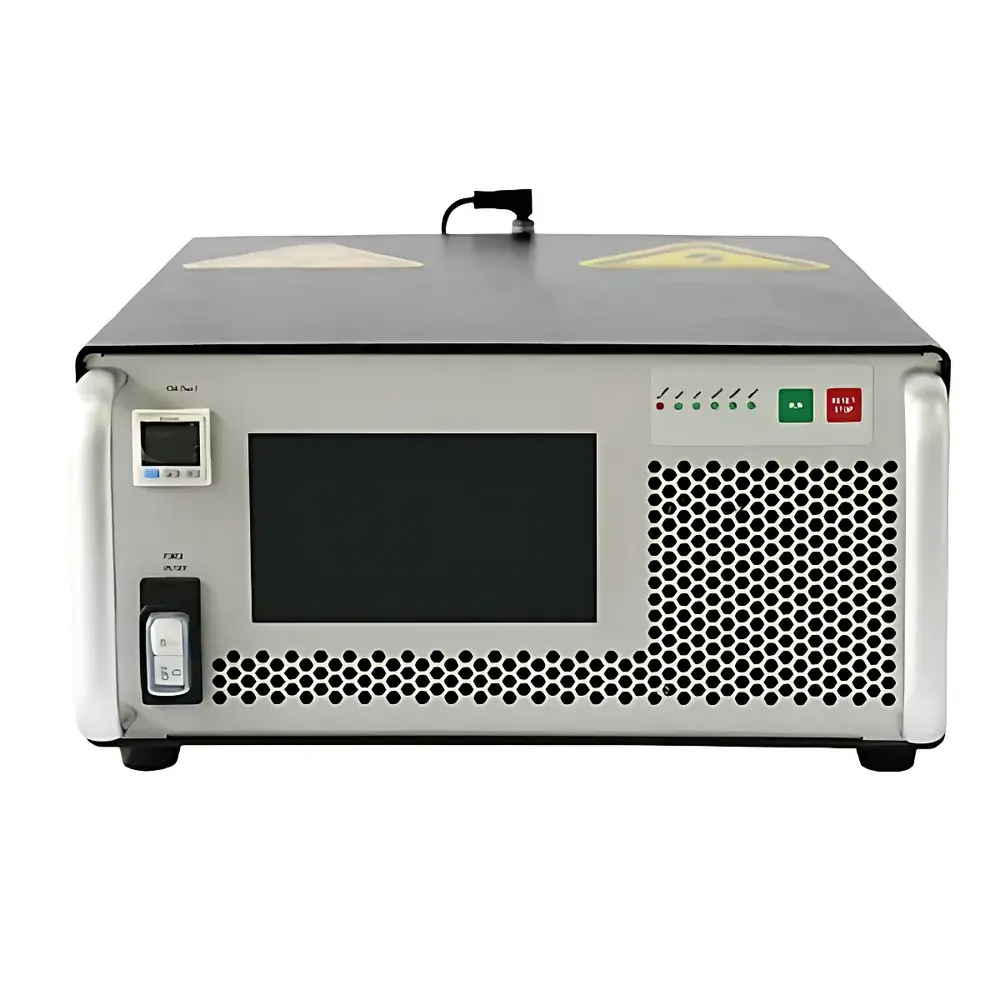
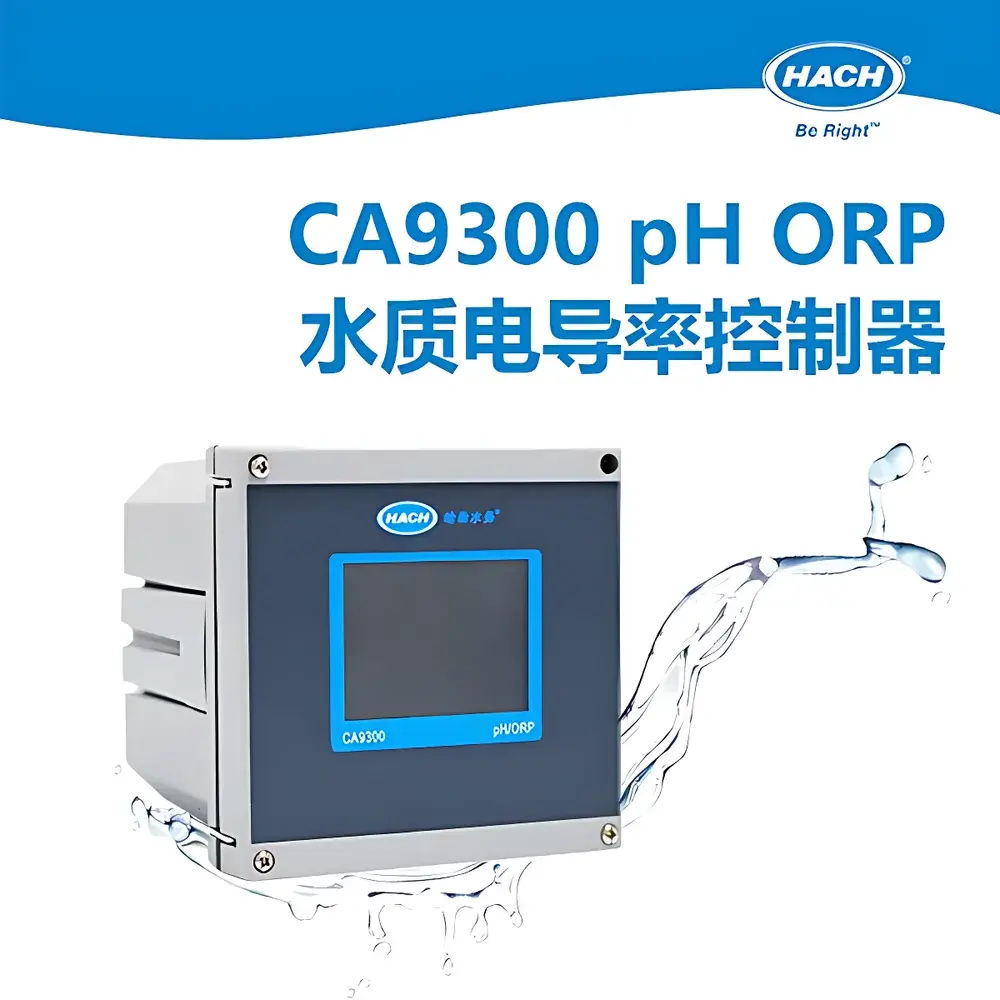
HACH CA9300 Analog Single-Channel pH/ORP and Conductivity Controller
| Brand | HACH |
|---|---|
| Origin | Imported |
| Manufacturer Type | Manufacturer |
| Model Numbers | CA9300.0100 (pH/ORP), CA9300.0200 (Conductivity) |
| Power Supply | 100–240 VAC, 50/60 Hz ±10% |
| Enclosure Rating | IP65 |
| Display | 3.5-inch color LCD (Chinese UI) |
| Outputs | Dual 4–20 mA analog outputs, 1 × MODBUS RTU over RS-485 |
| Relay Outputs | 2 configurable SPDT relays |
| Mounting Options | Panel mount, wall mount, pipe clamp |
| Compliance | Designed for industrial process environments per IEC 61000-6-2/-6-4 EMC standards |
Overview
The HACH CA9300 is an analog single-channel process controller engineered for reliable, cost-effective monitoring and control of pH/ORP (CA9300.0100) or conductivity (CA9300.0200) in continuous industrial water and wastewater applications. Unlike digital smart transmitters with embedded microprocessors and full protocol stacks, the CA9300 operates on a dedicated analog signal architecture—accepting millivolt or current inputs from compatible HACH analog sensors (e.g., SC1000-compatible pH electrodes, CLM253 conductivity cells) and delivering linearized, temperature-compensated measurements via industry-standard 4–20 mA loops. Its design prioritizes operational robustness and integration simplicity in legacy or budget-constrained control infrastructures where Modbus RTU communication and discrete relay actuation are required—but advanced diagnostics, multi-parameter fusion, or cloud connectivity are not. The controller does not perform digital signal processing or adaptive calibration; instead, it applies fixed-temperature compensation algorithms (e.g., NIST or DIN for pH; linear or pure-water models for conductivity) configured via front-panel navigation.
Key Features
- Industrial-grade aluminum housing rated IP65—resistant to dust ingress and low-pressure water jets, suitable for mounting in non-hazardous indoor/outdoor enclosures or process skids.
- 3.5-inch high-contrast color LCD with intuitive Chinese-language menu structure—designed for rapid operator orientation without training overhead in regional deployment contexts.
- Dual independent 4–20 mA analog outputs: one assigned to primary measurement (e.g., pH), the second configurable for secondary parameter (e.g., temperature) or derived value (e.g., % saturation, TDS).
- Two programmable SPDT relays supporting fail-safe logic—configurable as high/low alarms, pump start/stop, or dosing valve control with adjustable hysteresis and delay timers.
- Modbus RTU over RS-485 interface compliant with EIA-485 electrical specifications—enables read-only access to real-time measurement values, relay status, and basic diagnostic flags (e.g., sensor fault, out-of-range) by PLCs or SCADA systems.
- No internal data logging or SD card storage—measurements remain transient unless captured externally via DCS historian or connected HMI.
Sample Compatibility & Compliance
The CA9300 interfaces exclusively with HACH’s analog electrode family—including but not limited to the PHC101, PHC735, ORP101, and CLM253 series—requiring no software pairing or digital handshake. It supports standard two-wire or three-wire analog configurations with built-in cold-junction compensation for Pt1000 or thermistor-based temperature inputs. While not certified to SIL 2 or ATEX/IECEx standards, its construction and electromagnetic immunity align with IEC 61000-6-2 (immunity) and IEC 61000-6-4 (emissions) for industrial environments. It meets no specific FDA 21 CFR Part 11 requirements due to absence of electronic records or signature functionality; however, audit-ready relay event timestamps (with resolution ≥1 s) and output trend logs (when captured externally) support GLP-aligned process documentation in municipal and industrial QA/QC workflows.
Software & Data Management
The CA9300 contains no embedded firmware update capability or PC configuration software. All setup—including measurement range scaling, temperature compensation selection, relay setpoints, and Modbus slave ID—is performed locally via the front-panel keypad and LCD. No proprietary drivers, USB interfaces, or cloud portals are involved. Data integrity relies entirely on the stability of the analog signal path and proper shielding of 4–20 mA wiring per ISA RP12.06 guidelines. For regulatory traceability, users must implement external data acquisition systems that timestamp and archive Modbus register reads—enabling reconstruction of historical alarm states and measurement trends during GMP or ISO 9001 audits.
Applications
The CA9300 serves as a deterministic, low-maintenance control node across diverse aqueous process streams: potable water pH stabilization pre- and post-chlorination; neutralization control in chemical manufacturing effluent treatment; conductivity-based concentration monitoring in sugar beet diffusion juice or boiler blowdown; and rinse bath management in semiconductor wet benches. Its dual-relay architecture enables simple cascade logic—for example, initiating acid dosing when pH exceeds 8.2 and halting it at 7.4—without requiring PLC programming. It is routinely deployed in Class III industrial zones (per ISA S84) where functional safety is managed upstream, and where long-term uptime (>5 years mean time between failures) outweighs feature density.
FAQ
Does the CA9300 support automatic temperature compensation (ATC)?
Yes—via integrated Pt1000 or thermistor input; compensation curves follow NIST (pH) or linear/DIN 38404-5 (conductivity) standards.
Can it be used with non-HACH analog sensors?
Not recommended—output linearity, impedance matching, and reference voltage assumptions are calibrated specifically for HACH electrode families.
Is firmware upgrade possible?
No—the device contains no flash memory or bootloader; functionality is fixed at manufacture.
What is the maximum cable length for 4–20 mA output wiring?
Up to 600 m using shielded twisted-pair cable (AWG 18) with proper grounding at the controller end only.
Does it meet UL or CE marking requirements?
CE marked per EMC Directive 2014/30/EU and Low Voltage Directive 2014/35/EU; UL listing is not held.
Related Products