
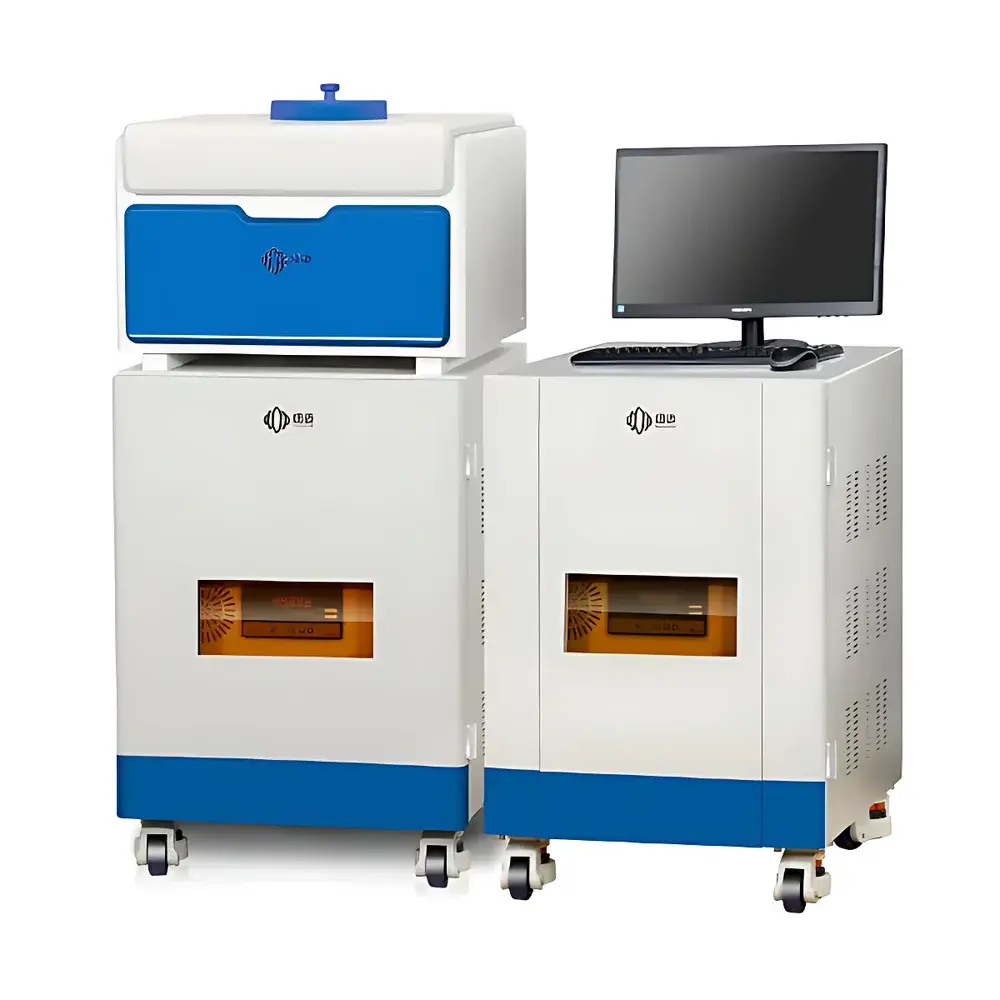
NIUMAG VTMR20-010V-I Low-Field Nuclear Magnetic Resonance Crosslink Density Analyzer
| Brand | NIUMAG |
|---|---|
| Origin | Jiangsu, China |
| Instrument Type | Low-Field NMR Analyzer |
| Model | VTMR20-010V-I |
| Magnet Type | Permanent Magnet |
| Static Field Strength | 0.5 ± 0.05 T |
| Sample Temperature Range | 25–130 °C (standard) |
| Sample Form Compatibility | Solid, liquid, gel, particulate, and solid–liquid hybrid systems |
| Measurement Time per Sample | ≤ 2 min |
| Optional Features | NMR Imaging (MRI), Real-Time In Situ Monitoring Module, GLP-Compliant Data Audit Trail |
Overview
The NIUMAG VTMR20-010V-I Low-Field Nuclear Magnetic Resonance Crosslink Density Analyzer is an engineered solution for quantitative, non-invasive characterization of polymer network architecture in industrial R&D and quality control laboratories. Based on time-domain nuclear magnetic resonance (TD-NMR) principles—specifically transverse relaxation (T₂) decay analysis—the instrument measures molecular mobility differences between crosslinked and mobile chain segments in elastomers, thermosets, hydrogels, and composite materials. Unlike destructive chemical methods (e.g., equilibrium swelling or titration), this system provides rapid, repeatable, and sample-preserving assessment of crosslink density (ρc) through calibration against reference standards traceable to ISO 10147 and ASTM D6247. The 0.5 T permanent magnet delivers stable field homogeneity (< 10 ppm over 20 mm DSV), enabling high reproducibility across batch-to-batch testing without cryogen dependency or RF shielding requirements.
Key Features
- Non-destructive, solvent-free analysis: No sample preparation, no reagents, no post-test disposal—ideal for regulated environments and iterative formulation development.
- High-throughput capability: Full T₂ distribution acquisition and crosslink density calculation completed in ≤ 120 seconds per sample under standard conditions.
- Multi-state sample compatibility: Designed for direct measurement of solids (vulcanized rubber, cured resins), gels (hydrogels, organogels), slurries, emulsions, and heterogeneous composites without phase separation or dilution.
- Thermal control flexibility: Standard temperature range from ambient to 130 °C supports accelerated aging, vulcanization kinetics, and thermal transition studies; optional extended-range module covers –100 to 200 °C for low-Tg polymers and high-temperature curing processes.
- Modular expandability: Optional NMR imaging (MRI) capability enables spatial mapping of crosslink heterogeneity, filler dispersion, moisture ingress, or defect localization with sub-millimeter resolution.
- Robust architecture: Industrial-grade console, vibration-damped magnet housing, and EMI-hardened RF probe ensure stable operation in production-floor or shared lab environments.
Sample Compatibility & Compliance
The VTMR20-010V-I accommodates cylindrical samples up to Ø25 mm × H50 mm, including raw elastomer compounds, extruded profiles, molded parts, powder-coated substrates, and lyophilized biomaterials. It complies with IEC 61000-6-3 (EMC emissions) and meets mechanical safety requirements per ISO 13857. For regulated applications, the system supports 21 CFR Part 11-compliant audit trails when paired with NIUMAG’s NMIQ software (version 4.2+), including electronic signatures, user-level access control, and immutable raw data archiving. Method validation documentation aligns with ISO/IEC 17025:2017 requirements for testing laboratories, and crosslink density protocols are referenced in ASTM D8144–22 (Standard Guide for NMR Characterization of Elastomeric Networks).
Software & Data Management
NMIQ v4.2 analytical software provides integrated workflows for T₂ inversion (using NNLS or SVD algorithms), multi-exponential fitting, crosslink density derivation via Flory–Rehner or Guth–Gold equation parameterization, and statistical batch comparison. All raw FID data are stored in vendor-neutral HDF5 format. The platform supports automated report generation (PDF/Excel), trend charting across time-series experiments (e.g., cure monitoring), and export to LIMS via ASTM E1394-compliant interfaces. Optional cloud synchronization enables secure remote data review and collaborative method sharing across global R&D sites—fully auditable under GLP/GMP frameworks.
Applications
- Crosslink quantification: Determination of ρc (mol/m³), bound rubber content, hard/soft segment ratio in block copolymers, and fluorine concentration in fluoroelastomers.
- Process analytics: Real-time tracking of sulfur vulcanization, epoxy curing, silicone condensation, and UV-initiated polymerization kinetics.
- Material stability assessment: Oxidative aging, thermal degradation, plasticizer migration, and solvent absorption/desorption dynamics.
- Morphological evaluation: Phase separation in blends, filler dispersion uniformity, pore size distribution in porous polymers, and water distribution in hydrophilic matrices.
- Regulatory support: Stability-indicating assays for medical device polymers (ISO 10993-12), automotive sealant qualification (SAE J2236), and pharmaceutical excipient characterization (USP ).
FAQ
What physical parameter does this instrument measure to derive crosslink density?
It measures the transverse relaxation time (T₂) distribution of hydrogen nuclei (¹H) in polymer chains. Reduced molecular mobility due to covalent or physical crosslinks shortens T₂; quantitative ρc is calculated using established polymer physics models calibrated against mechanical or swelling reference data.
Can it analyze powdered or irregularly shaped samples?
Yes—no geometric constraints beyond maximum dimensions. Powders, granules, and cut pieces are analyzed directly in standard 10 mm or 15 mm glass tubes with minimal packing density adjustment.
Is MRI functionality included by default?
No—NMR imaging is an optional hardware and software upgrade requiring additional gradient coils, shim set, and pulse sequence license. Base configuration supports only single-point and CPMG-based T₂ analysis.
How is temperature accuracy validated during variable-temperature experiments?
Each temperature setpoint is verified using a traceable Pt100 sensor embedded in the sample holder; calibration certificates are provided annually per ISO/IEC 17025-accredited procedures.
Does the system support custom pulse sequences?
Yes—advanced users may import custom CPMG, IR-CPMG, or diffusion-weighted sequences via MATLAB-compatible API; full sequence documentation and safety interlock compliance verification are required prior to deployment.





