
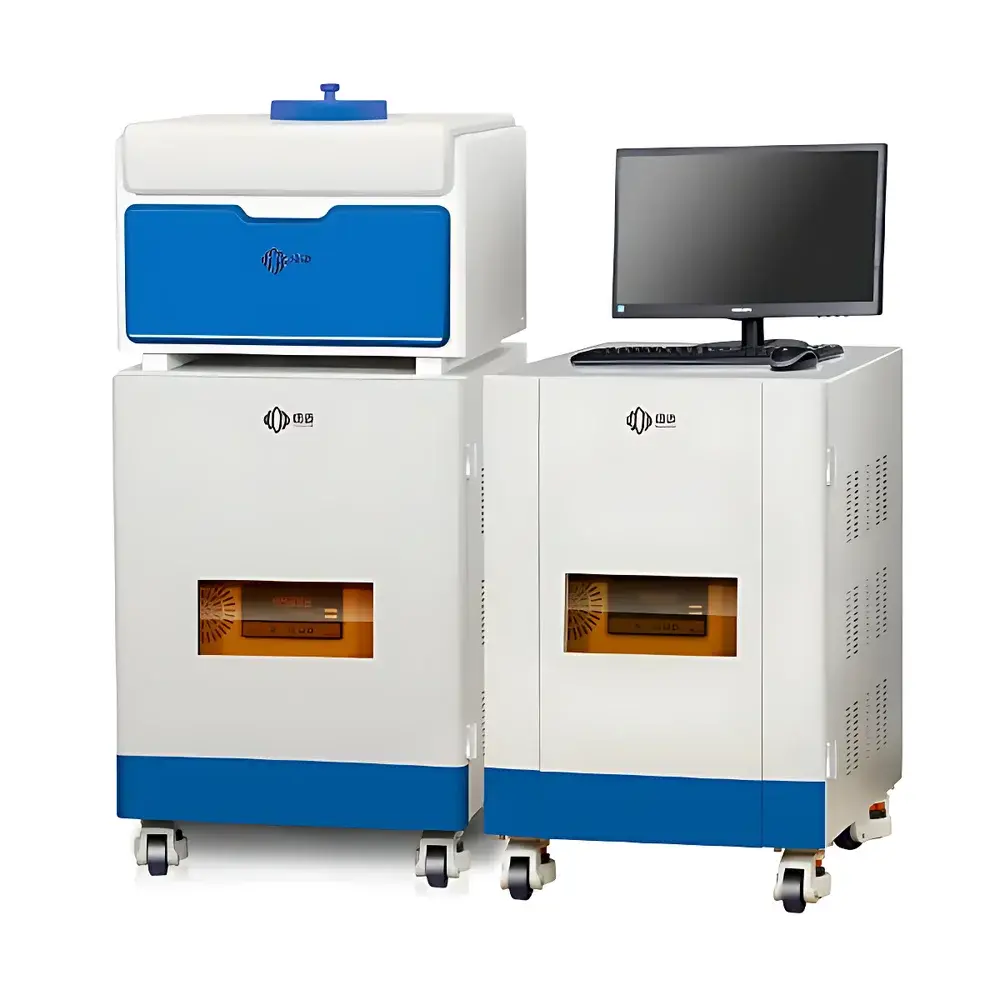
NIUMAG VTMR20-010V Series Low-Field Nuclear Magnetic Resonance Analyzer for Adhesive Cohesion and Adhesion Assessment
| Brand | NIUMAG |
|---|---|
| Model | VTMR20-010V / VTMR20-010V-I |
| Magnet Type | Permanent Magnet |
| Field Strength | 0.5 ± 0.05 T |
| Temperature Control Range | Ambient to 130 °C (standard) |
| Sample Compatibility | Solid–Liquid Hybrid Systems |
| Core Techniques | T₁/T₂ Relaxometry, MRI (optional), FLAT Pulse Sequence for Short-T₂ Signal Acquisition |
| Measurement Time | ≤2 min per sample |
| Application Domain | Crosslink Density Quantification, Hard/Soft Segment Ratio Analysis, Curing Kinetics Monitoring, Aging Evaluation, Interface Interaction Studies |
Overview
The NIUMAG VTMR20-010V Series Low-Field Nuclear Magnetic Resonance (LF-NMR) Analyzer is an engineered solution for non-destructive, quantitative assessment of adhesive cohesion and adhesion—two interdependent mechanical properties governing structural integrity and interfacial performance in pressure-sensitive adhesives, structural bonding agents, and elastomeric sealants. Unlike conventional mechanical testing methods (e.g., peel, shear, or lap-shear tests), which require destructive sampling, standardized geometries, and lengthy conditioning protocols, this instrument leverages time-domain NMR physics to probe molecular mobility at the hydrogen-proton level. In polymer-based adhesives, segmental dynamics—governed by local chain confinement, crosslink density, and phase separation—directly correlate with macroscopic performance: restricted proton motion in rigid domains reflects high cohesive strength, while enhanced mobility in amorphous soft segments underpins interfacial wetting and adhesion energy. The VTMR20-010V system measures transverse (T₂) and longitudinal (T₁) spin–lattice relaxation times, enabling discrimination among hard segments (short T₂, 10 ms), thereby providing a physicochemical basis for cohesion/adhesion prediction without empirical calibration.
Key Features
- Integrated dual-mode operation: simultaneous T₁/T₂ relaxometry and optional magnetic resonance imaging (MRI) for spatial mapping of heterogeneity in cured films or bonded interfaces.
- FLAT (Fast Low-Angle Turn) pulse sequence optimized for detection of short-T₂ signals (<0.1 ms), critical for highly crosslinked or filled adhesive systems where conventional CPMG sequences suffer from signal decay truncation.
- Precision temperature control: standard ambient-to-130 °C range supports real-time monitoring of thermal curing; optional cryo-heating module (–100 °C to 200 °C) enables glass transition profiling, cold-flow analysis, and accelerated aging studies.
- Non-invasive, re-usable sample interrogation: no solvent extraction, sectioning, or surface preparation required—enabling repeated measurements on the same specimen across time points (e.g., during post-cure evolution or environmental exposure).
- Modular hardware architecture: scalable RF coil options (diameter 10–50 mm), programmable gradient sets (for diffusion-weighted analysis), and lock-channel capability for field stabilization during long-term kinetic experiments.
Sample Compatibility & Compliance
The VTMR20-010V accommodates heterogeneous adhesive formulations—including solvent-based, hot-melt, UV-curable, and water-dispersed systems—as well as composite substrates (e.g., metal foil–polymer laminates, fiber-reinforced composites). Its solid–liquid hybrid sample handling design permits direct analysis of uncured pastes, gels, and partially cured films without drying or compression artifacts. From a regulatory standpoint, the system supports GLP-compliant workflows through audit-trail-enabled software (ISO/IEC 17025-aligned data logging), electronic signatures, and secure user-role management. While not FDA 21 CFR Part 11 certified out-of-the-box, the platform’s raw data export (ASCII, CSV, HDF5) and metadata-rich acquisition logs facilitate integration into validated QA/QC environments requiring traceability for ASTM D6984 (adhesive peel strength), ISO 4618 (coating cure monitoring), or internal material release specifications.
Software & Data Management
Control and analysis are performed via NIUMAG’s proprietary MesoMR Studio v4.x software suite, featuring a modular GUI with dedicated modules for relaxation spectrum deconvolution (using NNLS or CONTIN algorithms), multi-exponential fitting, diffusion–relaxation correlation (D–T₂ maps), and MRI reconstruction (filtered backprojection or iterative SENSE). All acquisitions include embedded metadata: timestamp, temperature setpoint, RF power, pulse width, number of scans, and coil tuning status. Data files comply with FAIR principles (Findable, Accessible, Interoperable, Reusable) and support batch processing for statistical comparison across formulation variants or aging conditions. Export formats include PNG/SVG for publication-ready figures, MATLAB .mat for advanced modeling, and LIMS-compatible XML schemas for enterprise integration.
Applications
- Quantitative crosslink density mapping via T₂ distribution shifts during thermal or UV curing—correlating with tensile modulus and creep resistance.
- Hard/soft segment ratio determination in block copolymer adhesives (e.g., SIS, SEBS), directly informing cohesive–adhesive balance optimization.
- In situ monitoring of solvent evaporation kinetics and plasticizer migration in PSA tapes using time-resolved T₁ρ dispersion analysis.
- Detection of interfacial delamination precursors in bonded joints via MRI-based void fraction quantification and T₂-weighted edge contrast enhancement.
- Accelerated aging simulation: tracking proton mobility changes under thermal–oxidative stress to predict shelf-life and service durability.
- Competitive adsorption studies at filler–polymer interfaces (e.g., silica–acrylic systems) using selective saturation transfer techniques.
FAQ
Can this instrument replace ASTM D1002 lap-shear testing for quality control?
No—it does not measure absolute force values. However, it provides rapid, mechanistic proxies (e.g., T₂-weighted mobility indices) that correlate strongly with shear strength across homologous formulations, enabling 100% inline screening where destructive testing is impractical.
Is sample preparation required for opaque or conductive substrates?
None beyond geometry matching to coil diameter. LF-NMR is insensitive to optical opacity, electrical conductivity, or surface roughness—unlike optical or eddy-current methods.
How is reproducibility ensured across laboratories?
Through standardized pulse sequences, temperature calibration routines traceable to NIST SRM 1474, and inter-laboratory round-robin validation packages available upon request.
Does the system support automated throughput for production environments?
Yes—integrated robotic sample changers (up to 24 positions) and PLC-triggered acquisition scripts enable unattended operation synchronized with manufacturing line cycles.
What validation documentation is provided for regulated industries?
IQ/OQ protocols, factory calibration certificates, and traceable uncertainty budgets for T₂ measurement (k = 2, ≤±3.2% at 25 °C) are included with each delivery.
Related Products




