
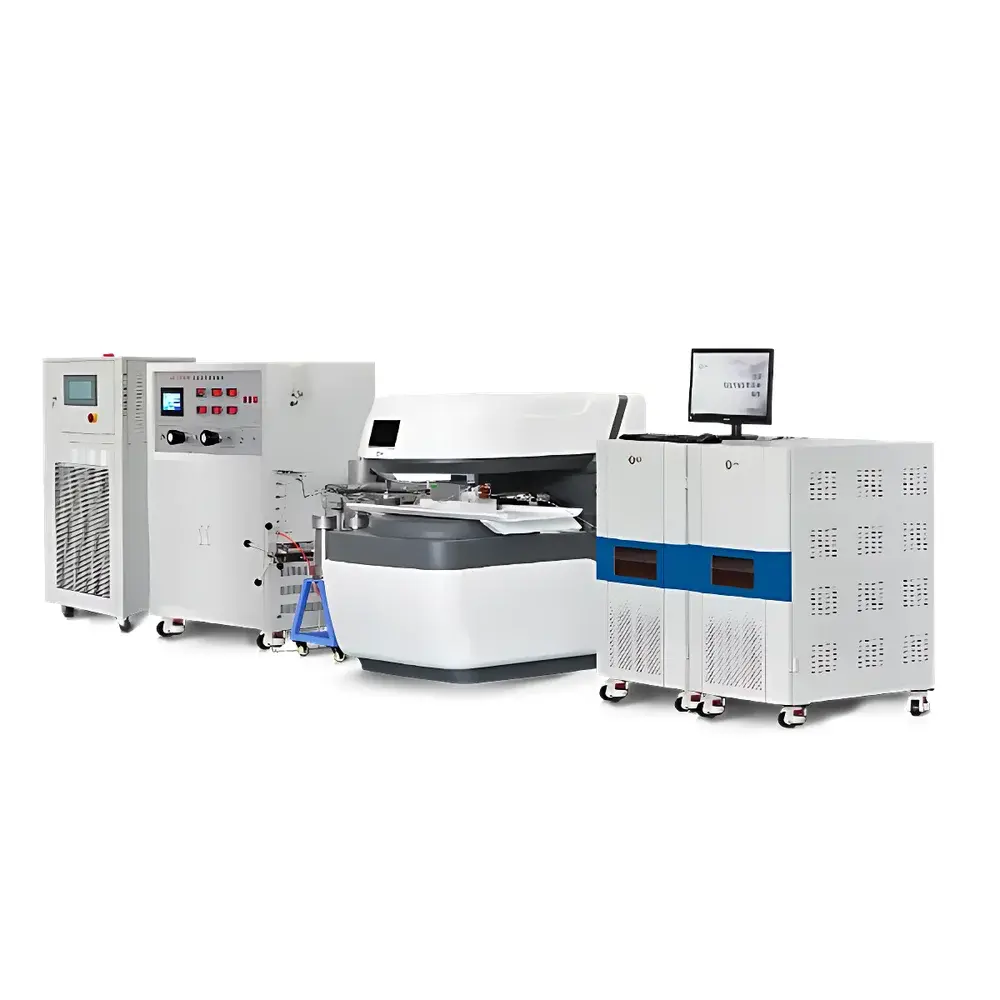
NIUMAG MacroMR12-150H-I Online Low-Field NMR Triaxial Testing System
| Brand | NIUMAG |
|---|---|
| Origin | Jiangsu, China |
| Manufacturer Type | Authorized Distributor |
| Product Category | Domestic |
| Model | MacroMR12-150H-I |
| Instrument Type | Low-Field NMR Analyzer |
| Sample Type | Solid-Liquid Coupled |
Overview
The NIUMAG MacroMR12-150H-I Online Low-Field NMR Triaxial Testing System is an integrated geomechanical–NMR platform engineered for in situ, non-invasive, and time-resolved characterization of porous media under controlled mechanical, thermal, and fluidic conditions. It combines a permanent-magnet-based low-field nuclear magnetic resonance (LF-NMR) spectrometer (0.3 T ± 0.03 T, C-shaped open configuration) with a fully programmable triaxial stress apparatus, enabling concurrent application of confining pressure (up to 40 MPa), pore pressure, axial load, and optional temperature control (–20 °C to +80 °C with add-on modules). Unlike conventional ex situ or destructive testing methods, this system captures dynamic evolution of water distribution, pore structure, and microfracture propagation in real time via quantitative T1/T2 relaxation spectroscopy and proton-density-weighted imaging—without sample extraction or structural perturbation. Its transverse (horizontal) sample insertion design ensures mechanical stability during high-stress loading while maintaining consistent RF coil coupling and field homogeneity (≤50 ppm over 60 mm DSV).
Key Features
- Integrated triaxial cell with custom-designed NMR-compatible pressure vessel and titanium alloy end caps, rated for sustained operation at ≥40 MPa confining pressure and ≥20 MPa pore pressure
- Dual-mode NMR acquisition: Fast T2 CPMG decay analysis (10 µs–3 s echo train) and inversion-recovery T1 mapping (50 ms–10 s recovery delay), both calibrated against ASTM D8292-21 reference standards for porous media quantification
- Modular environmental coupling: Optional cryogenic cooling stage, high-temperature heating jacket, and peristaltic flow controller for simultaneous stress–temperature–fluid (STF) multi-field experiments
- Open-access RF probe: 1H-tuned, broadband (1–30 MHz), with adjustable Q-factor and active shielding to minimize eddy-current interference from metallic pressure components
- Rack-mounted industrial enclosure with vibration-damped optical table base, IP54-rated electronics, and fail-safe pressure interlock circuitry compliant with ISO 13849-1 Category 3 PLd safety requirements
Sample Compatibility & Compliance
The system accommodates cylindrical rock cores (25–50 mm diameter × 50–100 mm length), unconsolidated sediments, cementitious composites, and coal samples—both saturated and partially saturated—with no requirement for chemical labeling or contrast agents. All hardware interfaces meet IEC 61000-6-2/6-4 electromagnetic compatibility standards. Data acquisition and storage comply with GLP principles: full audit trail (user ID, timestamp, parameter set, raw FID export), electronic signature support, and optional 21 CFR Part 11–compliant software module for regulated laboratories. Mechanical loading protocols align with ASTM D7012 (Standard Test Method for Compressive Strength and Elastic Moduli of Intact Rock Core Specimens), while NMR-derived porosity and saturation calculations follow ISO 17892-12 (Geotechnical Investigation and Testing — Laboratory Testing of Soil — Part 12: Determination of Water Content, Density, and Porosity).
Software & Data Management
Control and analysis are performed via NIUMAG’s proprietary MesoMR v5.2 software suite, built on Qt/C++ with Python API extension capability. The interface provides synchronized timeline-based experiment sequencing: pressure ramping, temperature stabilization, fluid injection, and NMR data acquisition are all programmable within a single workflow. Raw FID data are stored in HDF5 format with embedded metadata (field strength, gradient calibration, coil Q-factor, temperature log). Quantitative outputs include T2 distributions converted to pore-size spectra using the Coates–Denoo model, capillary pressure curves derived from mercury intrusion analogs, and spatially resolved saturation maps co-registered with axial displacement sensors. Export options include CSV, MATLAB .mat, and DICOM-compliant NIfTI for third-party image processing (e.g., Avizo, ImageJ). All datasets support batch reprocessing with version-controlled parameter templates.
Applications
- Reservoir Rock Characterization: In-situ porosity, movable/immobile fluid saturation, wettability index, and permeability estimation under reservoir-relevant stress paths
- Enhanced Oil Recovery Monitoring: Real-time visualization of polymer flood front progression, surfactant-induced wettability alteration, and CO2-EOR phase behavior in transparent core holders
- Geomechanical Damage Analysis: Correlation of acoustic emission events, axial strain, and localized T2 shortening during brittle failure—enabling microcrack nucleation mapping
- Unconventional Resource Evaluation: Isothermal methane/CO2 adsorption–desorption kinetics in shale matrix, hydrate formation/dissociation dynamics, and supercritical CO2 fracturing efficiency assessment
- Coupled THMC Processes: Freeze–thaw cycle effects on clay swelling, solute transport in fractured media, and coupled thermal–hydraulic–mechanical response of geothermal reservoir analogs
FAQ
What is the maximum operating pressure for the triaxial cell?
The standard MacroMR12-150H-I configuration supports up to 40 MPa confining pressure and 20 MPa pore pressure. Custom high-pressure variants (e.g., MacroMR12-150H-HTHP) extend confinement to 60 MPa.
Can the system perform true 2D/3D NMR imaging under load?
Yes—gradient-enabled spin-echo sequences (e.g., SGP, SPRITE) allow slice-selective imaging with ≤1 mm in-plane resolution. Full 3D reconstruction requires ≥4 hours per dataset due to signal-to-noise constraints at 0.3 T.
Is the NMR magnet shielded from mechanical vibration during loading?
The C-shaped permanent magnet is mounted on a granite optical table integrated into the cabinet frame, with pneumatic isolation feet and active damping tuned to suppress frequencies below 10 Hz.
How is temperature controlled during NMR acquisition?
A dual-zone Peltier system regulates sample chamber temperature (±0.1 °C accuracy) independent of pressure lines; thermocouple feedback is logged synchronously with FID acquisition.
Does the system support automated long-term creep or relaxation tests?
Yes—software-defined hold periods (up to 30 days) enable continuous NMR monitoring at fixed stress states, with adaptive sampling intervals to balance temporal resolution and data volume.



