
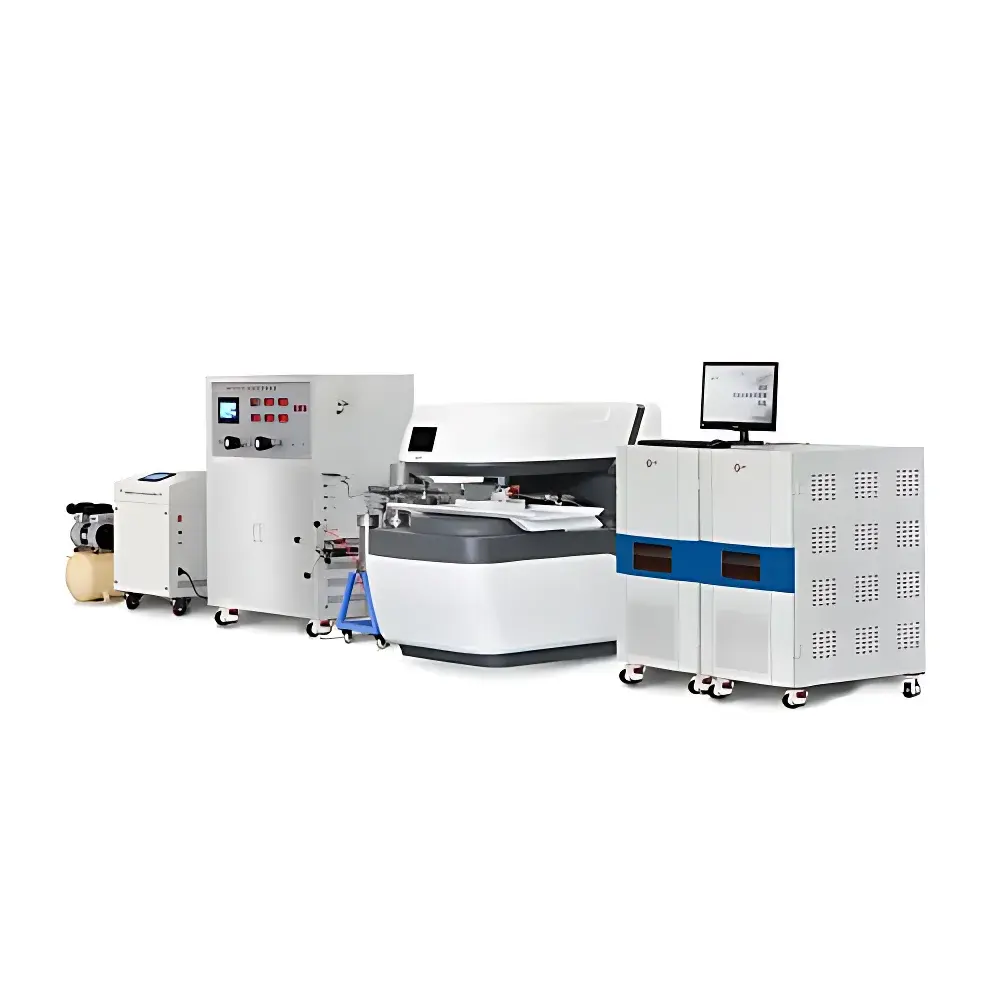
NIUMAG MacroMR Large-Bore Low-Field Nuclear Magnetic Resonance Analyzer and Imaging System
| Brand | NIUMAG |
|---|---|
| Origin | Jiangsu, China |
| Model | MacroMR |
| Instrument Type | Low-Field NMR Analyzer |
| Sample Type | Solid-Liquid Dual-Phase |
| Operating Frequency | 21 MHz |
| Operation Mode | Pulsed NMR |
| Magnet Type | Permanent Magnet (NdFeB) |
| Magnetic Field Strength | 0.3 ± 0.05 T |
| Uniformity Region | Accommodates Multiple Probe Configurations |
| Bore Geometry | C-Type Semi-Open Structure |
| Sample Access | Horizontal Push-Pull Loading |
Overview
The NIUMAG MacroMR is a large-bore, low-field nuclear magnetic resonance (NMR) analyzer and imaging system engineered for quantitative characterization of porous media—particularly intact rock cores, soils, catalysts, polymers, and energy materials. Operating at a fundamental Larmor frequency of 21 MHz (corresponding to a static magnetic field of 0.3 ± 0.05 T), the system leverages pulsed NMR principles to measure spin–lattice (T₁) and spin–spin (T₂) relaxation times, diffusion coefficients, and multi-dimensional correlation spectra. Its C-type semi-open permanent magnet architecture—constructed from high-coercivity neodymium–iron–boron (NdFeB) material—provides stable, drift-free field homogeneity over extended acquisition periods. Unlike high-field superconducting systems, the MacroMR delivers robust, maintenance-free operation with no cryogen consumption, making it ideal for routine laboratory use in geoscience labs, petroleum engineering departments, and materials R&D facilities where long-term reproducibility and operational simplicity are critical.
Key Features
- C-type large-bore magnet design (≥120 mm clear bore diameter) enables rapid, non-destructive insertion of full-diameter cylindrical rock cores up to 100 mm in length and 100 mm in diameter—eliminating sample sectioning and preserving spatial integrity.
- Push-pull horizontal sample loading mechanism minimizes operator handling time and mechanical stress on fragile or saturated samples.
- Modular probe interface supports interchangeable configurations: standard room-temperature solenoid probes, high-precision thermostatted probes (±0.1 °C stability), and optional high-pressure/low-temperature cells for in situ process simulation.
- Next-generation fully digital NMR spectrometer with real-time pulse sequence execution, 16-bit ADC resolution, and FPGA-based signal processing ensures high signal-to-noise ratio (SNR) and temporal fidelity across relaxation decay acquisitions.
- Integrated shimming system maintains field uniformity across the active volume without manual adjustment, enabling consistent T₂ distribution quantification even for heterogeneous geological samples.
Sample Compatibility & Compliance
The MacroMR accommodates solid–liquid composite samples—including water-saturated sandstones, oil-bearing carbonates, shale matrix plugs, polymer gels, and hydrate-bearing sediments—without requiring vacuum drying or chemical pretreatment. Its open geometry allows direct integration with external environmental control units (ECUs) for dynamic testing under simulated reservoir conditions. The system complies with core instrumentation standards for analytical laboratories, including ISO/IEC 17025:2017 requirements for measurement traceability and uncertainty estimation. Data acquisition protocols align with ASTM D7264 (flexural properties of composites) and ASTM D570 (water absorption of plastics) where applicable; raw FID and echo train data are stored in vendor-neutral formats (e.g., Bruker-compatible fid files) to support third-party analysis and regulatory audit trails per GLP and GMP frameworks.
Software & Data Management
Control and analysis are performed via NIUMAG’s proprietary NMI-Studio software suite, which provides a validated, password-protected environment supporting user role management, electronic signatures, and full audit trail logging compliant with FDA 21 CFR Part 11. The platform includes pre-configured workflows for porosity calculation (via bulk volume calibration), T₂ cutoff determination (using SDR or Timur-Coates models), capillary pressure curve derivation, and multi-exponential inversion using non-negative least squares (NNLS) algorithms. All processed results—including pore-size distributions, saturation maps, and permeability estimates—are exportable as CSV, PNG, or HDF5 files. Optional modules enable T₁–T₂ correlation mapping, diffusion–relaxation (D–T₂) joint encoding, and real-time monitoring of imbibition/drainage dynamics during core flooding experiments.
Applications
- Quantitative evaluation of formation porosity, movable/immovable fluid saturation, and irreducible water saturation in reservoir rock cores.
- Non-invasive assessment of pore structure heterogeneity, pore throat size distribution, and wettability classification via T₂ spectra and saturation contrast imaging.
- In situ monitoring of fluid redistribution during spontaneous imbibition, forced displacement, and surfactant flooding—critical for enhanced oil recovery (EOR) mechanism studies.
- Gas hydrate nucleation, growth, and dissociation kinetics under sub-zero, high-pressure conditions using the optional cryogenic–high-pressure module.
- Methane adsorption–desorption isotherms in coal and shale matrices at elevated temperatures (up to 120 °C) and pressures (up to 20 MPa).
- Microstructural evolution tracking in cementitious materials, battery electrodes, and food matrices during hydration, drying, or thermal cycling.
FAQ
What sample sizes can the MacroMR accommodate?
Standard configuration accepts cylindrical samples up to 100 mm in diameter and 100 mm in length; custom probe inserts support smaller geometries down to 10 mm diameter.
Is the system compatible with third-party data analysis tools?
Yes—raw time-domain data (FID/echo trains) are saved in standard binary formats with metadata headers, enabling import into MATLAB, Python (NumPy/SciPy), or commercial NMR processing platforms.
Does the MacroMR support quantitative T₁–T₂ correlation measurements?
Yes, when equipped with the optional multi-dimensional NMR module, the system executes synchronized T₁ preparation and T₂ encoding sequences with user-defined delay increments and phase cycling schemes.
Can the system be integrated into automated core analysis workflows?
Absolutely—the instrument supports RS-232, Ethernet, and Modbus TCP interfaces for seamless communication with LIMS, PLC-controlled core holders, and environmental chambers.
What is the typical measurement repeatability for porosity and T₂ distribution?
Under controlled temperature and sample positioning, porosity precision is ≤±0.3 vol% (1σ); T₂ distribution centroid reproducibility is ≤±2% across repeated acquisitions on identical samples.
Related Products





