
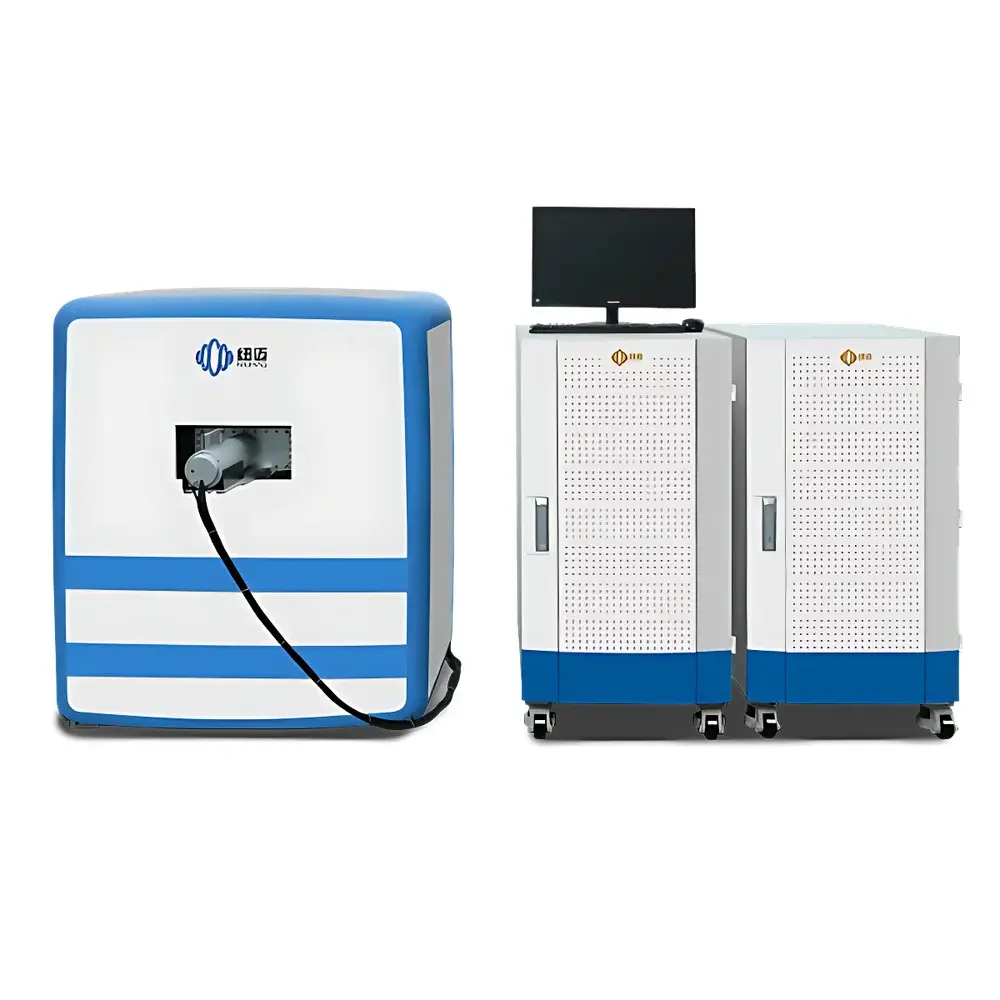
NIUMAG NM42-060H-1 Low-Field Nuclear Magnetic Resonance Imaging Analyzer for Fructose-Induced Hyperuricemia Models
| Brand | NIUMAG |
|---|---|
| Origin | Jiangsu, China |
| Model | NM42-060H-1 |
| Instrument Type | Low-Field NMR Spectrometer |
| Sample Compatibility | Solid-Liquid Hybrid (ex vivo tissues & live rodents, 1–350 g) |
| Magnet Type | Permanent Magnet |
| Field Strength | 1 T ± 0.05 T |
| Homogeneity | ≤30 ppm over DSV |
| Imaging Modes | T1-weighted, T2-weighted, Proton Density-weighted, Water-Fat Suppressed Imaging |
| Application Domain | Preclinical Metabolic Disease Research |
Overview
The NIUMAG NM42-060H-1 is a purpose-engineered low-field nuclear magnetic resonance (LF-NMR) imaging analyzer designed specifically for longitudinal, non-invasive investigation of fructose-induced hyperuricemia models in preclinical research. Unlike high-field clinical MRI systems, this instrument operates at a stable 1 T permanent magnetic field—optimized to balance signal-to-noise ratio, spatial resolution, and operational simplicity for small-animal metabolic phenotyping. Its core functionality rests on the physical principles of spin relaxation (T1 and T2), proton density mapping, and chemical shift-based water-fat discrimination—enabling quantitative assessment of tissue composition, crystal deposition, and dynamic metabolic changes without ionizing radiation or surgical intervention. The system is calibrated to detect subtle alterations in relaxation times associated with urate crystal accumulation in renal parenchyma, synovial spaces, and vascular tissues—key pathological hallmarks of hyperuricemia and gout progression.
Key Features
- Permanent magnet architecture requiring no cryogens, RF shielding rooms, or external cooling infrastructure—reducing total cost of ownership and facility footprint.
- High-field stability (±0.05 T) and homogeneity (≤30 ppm over 60 mm DSV) ensuring reproducible quantitative relaxation time measurements across repeated scans.
- Multi-contrast imaging capability including T1-weighted, T2-weighted, proton density-weighted, and water-fat suppressed sequences—supporting differential characterization of edema, fibrosis, lipid infiltration, and crystalline deposits.
- Dedicated rodent-compatible RF coil suite optimized for 1–350 g specimens, enabling simultaneous in vivo imaging of mice and rats as well as ex vivo tissue sections.
- Integrated gradient system supporting diffusion-weighted imaging (DWI) and apparent diffusion coefficient (ADC) mapping—valuable for assessing microstructural integrity in kidney tubules and joint capsules.
Sample Compatibility & Compliance
The NM42-060H-1 accommodates both in vivo and ex vivo samples: live rodents under controlled anesthesia protocols, isolated kidneys, joint tissues, and adipose biopsies. It supports solid–liquid hybrid analysis through dual-mode acquisition—allowing concurrent structural imaging and relaxometry-based metabolite profiling (e.g., choline, creatine, lactate via spectral editing). The platform complies with ISO/IEC 17025 requirements for measurement traceability in preclinical instrumentation and is compatible with GLP-aligned study workflows. Data acquisition parameters adhere to ASTM E2918-22 guidelines for small-animal MRI validation, and raw DICOM output enables integration into FDA 21 CFR Part 11–compliant LIMS environments when paired with audit-trail-enabled software modules.
Software & Data Management
The proprietary NMIQ Suite provides full control over pulse sequence design, real-time image reconstruction, and parametric mapping (T1/T2 maps, ADC maps, fat fraction quantification). All imaging data are stored in DICOM 3.0 format with embedded metadata (scan parameters, animal ID, timepoint, protocol version). Batch processing pipelines support automated segmentation of renal cortex/medulla, synovial volume, and crystal-laden regions using intensity-thresholding and morphological filtering. Export options include NIfTI for third-party analysis in FSL, SPM, or AFNI; CSV tables for statistical correlation with serum uric acid, xanthine oxidase activity, and histopathology scores. Audit logs record user actions, parameter modifications, and calibration events—meeting ALCOA+ (Attributable, Legible, Contemporaneous, Original, Accurate, Complete, Consistent, Enduring, Available) data integrity standards.
Applications
- Longitudinal monitoring of urate crystal deposition dynamics in kidneys and joints during fructose feeding regimens.
- Quantitative evaluation of nephrotoxicity and tubulointerstitial fibrosis progression in hyperuricemic models.
- In vivo assessment of therapeutic efficacy for uricosuric agents (e.g., benzbromarone), xanthine oxidase inhibitors (e.g., febuxostat), and novel anti-inflammatory biologics.
- Relaxivity characterization of iron oxide–based contrast agents targeting urate-laden macrophages in synovium.
- Correlative imaging–histology studies linking T2* shortening to iron–urate co-localization in chronic tophaceous gout models.
- Metabolic phenotyping via localized spectroscopy (PRESS, STEAM) in liver and muscle to assess fructose-driven de novo lipogenesis and mitochondrial dysfunction.
FAQ
What sample types can be imaged with the NM42-060H-1?
Live anesthetized rodents (mice, rats), excised organs (kidneys, spleens, joints), and fixed tissue slices up to 350 g total mass.
Is the system compatible with standard preclinical contrast agents?
Yes—it supports T1- and T2-enhancing agents including Gd-DTPA, iron oxide nanoparticles, and manganese-based probes; relaxivity measurements are fully supported.
Can the system perform quantitative T1/T2 mapping?
Yes—multi-echo spin echo and inversion recovery sequences generate voxel-wise T1 and T2 maps with sub-second temporal resolution per slice.
Does the instrument meet regulatory requirements for GLP-compliant studies?
Raw data export, audit trails, user authentication, and electronic signature support align with OECD GLP Principles and FDA guidance for nonclinical laboratory studies.
What maintenance is required for the permanent magnet?
No routine cryogen refills or shimming adjustments; annual field homogeneity verification and RF coil performance calibration are recommended.





