
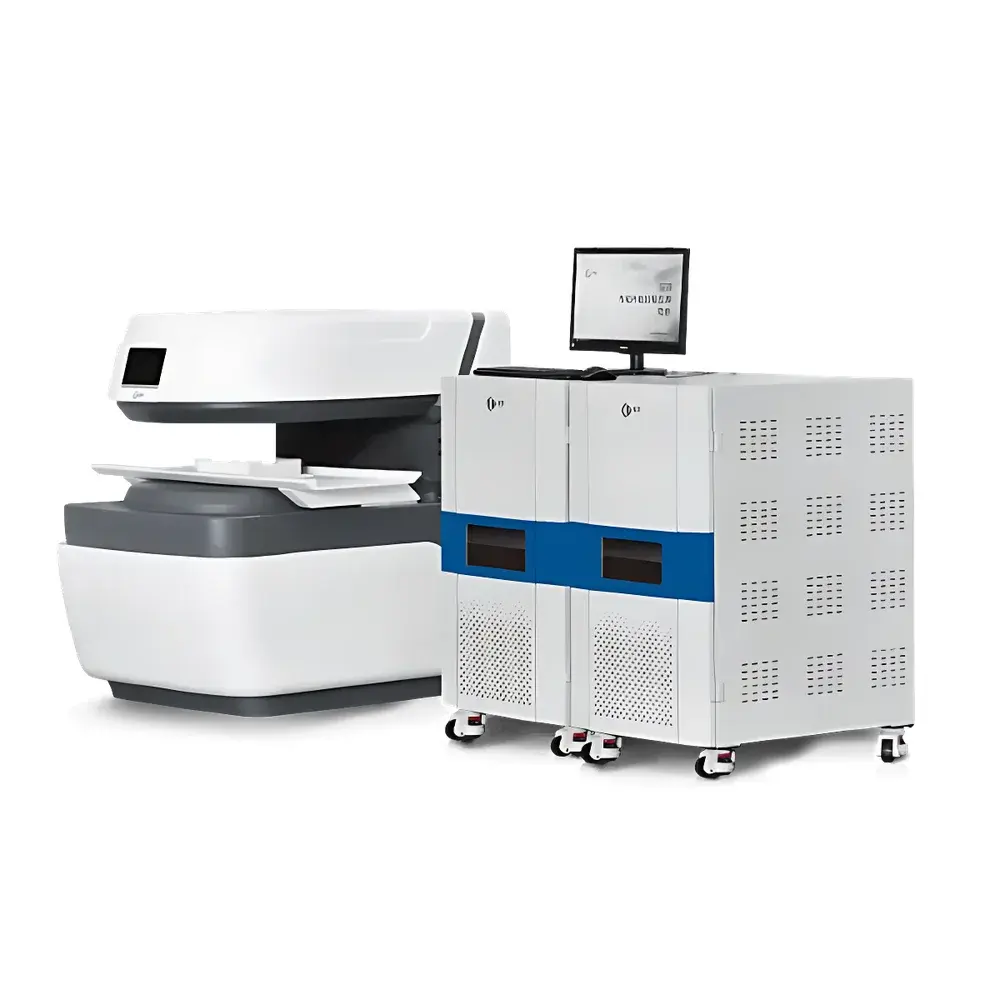
NIUMAG MacroMR12-150H-I Low-Field Nuclear Magnetic Resonance Analyzer for Geotechnical Microstructure Characterization
| Brand | NIUMAG |
|---|---|
| Origin | Jiangsu, China |
| Instrument Type | Low-Field NMR Analyzer |
| Model | MacroMR12-150H-I-3 |
| Sample Type | Solid-Liquid Combined |
| Magnetic Field Strength | 0.3 T ± 0.03 T |
| Magnet Geometry | C-Type Open Configuration |
| Field Homogeneity | ≤50 ppm |
| Maximum Sample Dimensions | Ø150 mm × H100 mm |
| Probe Orientation | Transverse/Longitudinal |
Overview
The NIUMAG MacroMR12-150H-I is a purpose-built low-field nuclear magnetic resonance (LF-NMR) analyzer engineered for non-invasive, quantitative microstructural characterization of geomaterials—including soils, rocks, sediments, and cementitious systems. Unlike destructive or indirect methods (e.g., mercury intrusion porosimetry, centrifugation, or X-ray CT), this system exploits the intrinsic magnetic resonance signal from hydrogen nuclei (1H) in pore-confined fluids (water, oil, brine) to extract intrinsic physical parameters without altering sample integrity. Operating at a stable 0.3 T static magnetic field, the instrument delivers high reproducibility in T1 and T2 relaxation time distributions—directly correlated to pore size, fluid mobility, surface-to-volume ratio, and phase behavior. Its open C-type magnet architecture enables unobstructed sample access and facilitates integration with ancillary environmental control units (temperature, pressure, fluid injection), supporting true multi-physics experimental protocols under near-natural conditions.
Key Features
- C-type open magnet design with transverse and longitudinal probe options—optimized for rapid, stress-free insertion of cylindrical core samples (Ø25–150 mm)
- High-stability temperature-controlled RF probe with integrated gradient subsystem—ensuring robust signal-to-noise ratio and spatial encoding fidelity for relaxometry and basic imaging
- Modular accessory ecosystem: customizable rock core holders, pressure cells, freeze-thaw chambers, and flow-through modules compliant with ISO 14688-1 and ASTM D422 for geotechnical standard alignment
- Simultaneous acquisition of T1, T2, and proton density-weighted data—enabling decoupled quantification of bound vs. free water, unfrozen water content, and hydration kinetics
- Calibration traceable to NIST-referenced standards; software supports audit trails per FDA 21 CFR Part 11 requirements for GLP/GMP-regulated labs
Sample Compatibility & Compliance
The MacroMR12-150H-I accommodates intact, saturated, or partially saturated geological specimens—no drying, vacuum saturation, or chemical fixation required. It is validated for use with unconsolidated soils, sedimentary cores, fractured rock, frozen ground, and hydrating cement pastes. All measurement protocols adhere to internationally recognized frameworks: T2 cutoff calibration follows ASTM D7928 for clay-bound water estimation; pore-size distribution derivation aligns with ISO 15797 for low-field NMR porosimetry; freeze-thaw cycle monitoring conforms to ASTM D560 and EN 12371 for frost resistance testing. The system’s non-ionizing operation eliminates regulatory constraints associated with X-ray or gamma-based techniques, and its electromagnetic emissions comply with IEC 61000-6-3 Class B limits.
Software & Data Management
Equipped with NIUMAG’s proprietary MultiQ™ NMR Analysis Suite, the platform provides automated processing pipelines for inversion of multi-exponential decay curves (using non-negative least squares and SVD regularization), pore-size distribution modeling via empirical or theoretical T2–r conversion, and time-series tracking of relaxation spectra across dynamic experiments. Raw FID and echo train data are stored in vendor-neutral HDF5 format, fully compatible with Python-based scientific workflows (NumPy, SciPy, scikit-learn). Audit logs record operator ID, timestamp, pulse sequence parameters, and environmental sensor inputs—supporting full traceability in regulated environments. Optional cloud synchronization enables secure remote data review and collaborative analysis across distributed research teams.
Applications
- Microstructural Quantification: Total porosity, pore-size distribution, layered porosity profiling, and nano-pore analysis below 10 nm using cryogenic T2 mapping
- Water Phase Discrimination: Quantitative separation of free water, capillary-bound water, adsorbed water, and unfrozen water in frozen soils down to –30°C
- Dynamic Fluid Transport: Real-time monitoring of imbibition, drainage, hydration, leaching, CO2 curing, and thermal–hydraulic–mechanical (THM) coupling processes
- Degradation & Damage Assessment: Non-destructive evaluation of microcrack evolution during triaxial loading, thermal cycling, acid/salt exposure, and freeze–thaw fatigue
- Material Development Support: Optimization of grouting formulations, soil stabilizers, pervious concrete mix designs, and geopolymer setting behavior
FAQ
Is the MacroMR12-150H-I suitable for field-deployable use?
No—it is a benchtop laboratory instrument requiring stable AC power, temperature-controlled environment (±2°C), and vibration isolation. Mobile NMR solutions are not offered in this product line.
Can it measure absolute permeability?
Not directly; however, permeability can be estimated via empirical correlations (e.g., Timur-Coates or SDR models) using T2 geometric mean and porosity outputs—validated against core flooding tests per API RP 40.
Does the system support 2D/3D imaging?
Yes—basic spin-echo and gradient-echo imaging sequences are available; resolution is limited to ~1–2 mm in-plane due to low-field constraints, sufficient for macro-scale fluid front tracking but not sub-millimeter microstructure.
What sample preparation is required?
Minimal: samples must be placed in standard NMR-compatible tubes or custom core holders; no drying, coating, or conductive treatment is needed. Saturation state should reflect in-situ conditions.
How is data validation performed?
Cross-validation against independent methods (e.g., helium pycnometry for grain density, gravimetric water content, or gas permeametry) is recommended per ISO/IEC 17025 guidelines; NIUMAG provides application notes and inter-laboratory comparison datasets.







