
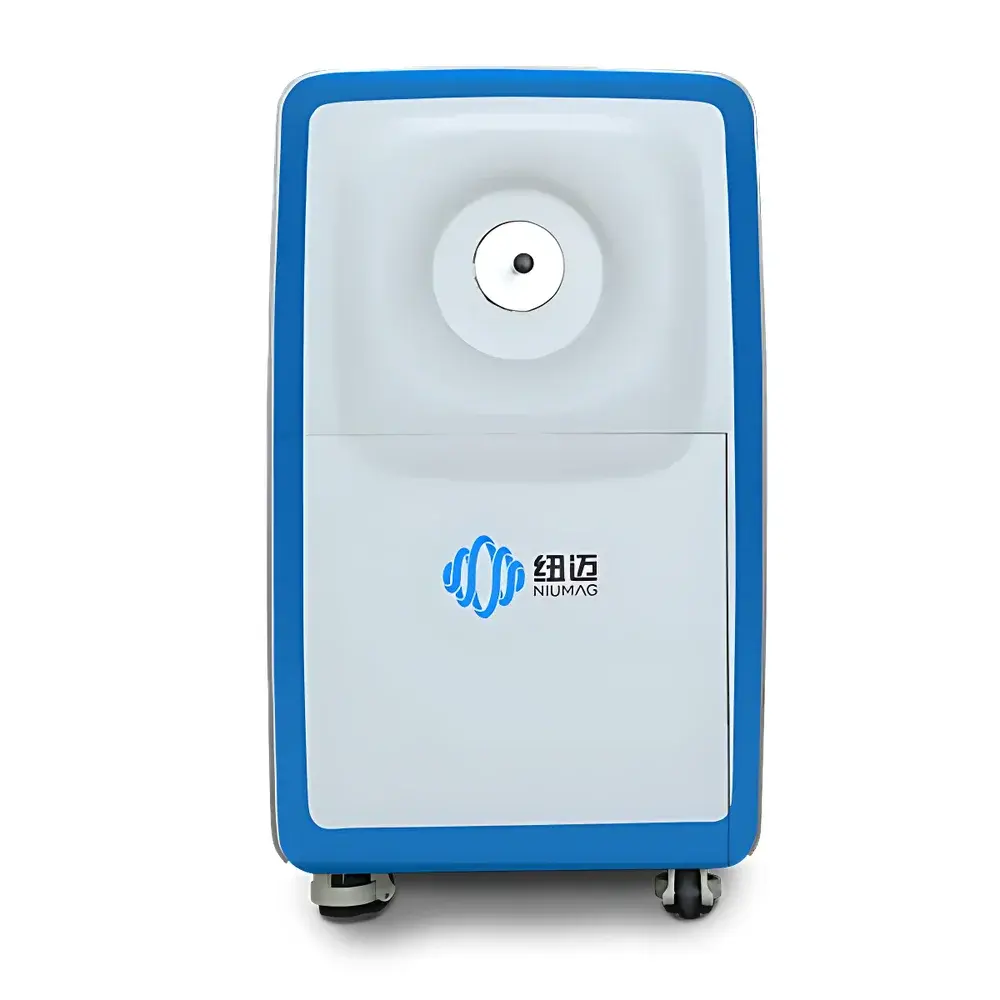
NIUMAG QMR06-090H-PRO Low-Field Nuclear Magnetic Resonance Analyzer for In Vivo Animal Body Composition Analysis
| Brand | NIUMAG |
|---|---|
| Origin | Jiangsu, China |
| Manufacturer Type | Instrument Manufacturer (not distributor) |
| Product Category | Domestic |
| Model | QMR06-090H-PRO |
| Instrument Type | Low-Field NMR Analyzer |
| Sample Type | Solid-Liquid Dual-Mode (Live Small Animals & Excised Tissues) |
| Magnet Type | Permanent Magnet |
| Static Field Strength | 0.15 ± 0.015 T |
| Magnetic Homogeneity | ≤300 ppm over DSV |
| Sample Weight Range | 0.1–6 g (excised tissues) |
Overview
The NIUMAG QMR06-090H-PRO is a purpose-built low-field nuclear magnetic resonance (LF-NMR) analyzer engineered for non-invasive, quantitative assessment of body composition in live small animal models. Operating at a static magnetic field of 0.15 T, it leverages the differential transverse relaxation behavior (T₂ decay) of proton signals from water and lipid phases to discriminate and quantify fat mass, lean mass, and free water content—without ionizing radiation, contrast agents, or surgical intervention. Unlike high-field MRI systems, this instrument is optimized for longitudinal metabolic phenotyping: its compact permanent magnet architecture enables stable, maintenance-free operation in standard laboratory environments, with no cryogen requirements or RF shielding rooms. The system adheres to the physical principles defined in ASTM E2971–22 (“Standard Guide for Quantitative Fat–Lean–Water Analysis Using Time-Domain NMR”) and supports compliance with GLP-aligned experimental workflows in preclinical research.
Key Features
- Non-anesthetized, awake-state measurement: Enables repeated, stress-minimized monitoring across the full lifecycle of murine and lagomorph models—critical for circadian, aging, or chronic intervention studies.
- Sub-2-minute acquisition protocol: Full-body composition quantification completed in ≤80 seconds per subject, supporting high-throughput screening of cohorts without compromising reproducibility.
- Dual-mode sample compatibility: Seamless transition between in vivo rodent scanning (10–800 g) and ex vivo tissue analysis (0.1–6 g), including adipose depots, skeletal muscle, liver, and tumor xenografts.
- Robust field homogeneity: ≤300 ppm over spherical volume ensures consistent signal fidelity across heterogeneous biological samples, minimizing calibration drift during multi-week studies.
- Zero-consumable operation: No solvents, reagents, or disposable coils required; routine calibration uses built-in reference standards traceable to NIST-traceable phantoms.
Sample Compatibility & Compliance
The QMR06-090H-PRO accommodates unrestrained or gently restrained live mice, rats, and rabbits within its ergonomic sample chamber, with integrated motion compensation algorithms to mitigate respiratory artifact. Excised tissues are analyzed in standardized cylindrical holders compatible with ISO/IEC 17025-compliant weighing protocols. Data output conforms to FAIR principles (Findable, Accessible, Interoperable, Reusable): raw FID data, T₂ distribution spectra, and compartmental mass fractions are stored in vendor-neutral HDF5 format. The system supports audit trail functionality compliant with FDA 21 CFR Part 11 when deployed with validated software configurations, and meets essential requirements of ISO 13485 for use in regulated preclinical development.
Software & Data Management
NIUMAG’s proprietary QMR-Analysis Suite v5.2 provides automated peak deconvolution of multi-exponential T₂ decay curves using constrained non-negative least squares (NNLS) fitting. The software exports standardized metrics—including total fat mass (g), lean body mass (g), fat fraction (%), and free/bound water ratio—directly to CSV or Excel for integration with statistical platforms (R, Python, GraphPad Prism). Batch processing mode enables parallel analysis of >50 subjects with configurable QC flags (e.g., motion threshold violation, SNR <15). All user actions—including parameter edits, calibration events, and report generation—are time-stamped and logged with operator ID, satisfying ALCOA+ data integrity criteria.
Applications
- Metabolic disease modeling: Longitudinal tracking of adiposity changes in diet-induced obesity (DIO), leptin-deficient (ob/ob), or AMPK-knockout models—validated in peer-reviewed studies published in Nature (DOI:10.1038/s41586-023-06018-w).
- Pharmacodynamic evaluation: Quantification of visceral fat reduction and lean mass preservation following GLP-1 receptor agonist or PPARγ modulator administration, reducing preclinical study duration by up to 6 months versus histomorphometry.
- Oncology metabolism studies: Correlation of intratumoral lipid accumulation (via localized T₂ mapping) with systemic fat redistribution during checkpoint inhibitor therapy.
- Neurodegeneration research: Detection of early myelin loss in EAE models through altered T₂ relaxation in spinal cord white matter, independent of gadolinium enhancement.
FAQ
What is the minimum sample weight for accurate fat quantification in excised tissues?
For reproducible results, a minimum mass of 0.3 g is recommended for homogeneous adipose tissue; heterogeneous samples (e.g., liver) require ≥0.5 g to ensure representative signal averaging.
Can the system distinguish brown adipose tissue (BAT) from white adipose tissue (WAT)?
Yes—through differential T₂ relaxation kinetics and temperature-controlled acquisition protocols (optional accessory), enabling BAT activation assessment via cold-challenge experiments.
Is method validation support available for regulatory submissions?
NIUMAG provides IQ/OQ documentation templates, system suitability test procedures, and on-site validation assistance aligned with ICH M10 and USP guidelines.
How does the QMR06-090H-PRO compare to DEXA for body composition analysis?
Unlike DEXA—which estimates soft-tissue composition indirectly via X-ray attenuation and cannot differentiate intramyocellular lipids—the QMR06-090H-PRO directly measures proton density and relaxation dynamics specific to lipid acyl chains and aqueous compartments.
What maintenance schedule is required for long-term field stability?
Annual field homogeneity verification and temperature sensor calibration are recommended; no magnet shimming or cryogen replenishment is necessary due to permanent magnet design.




