
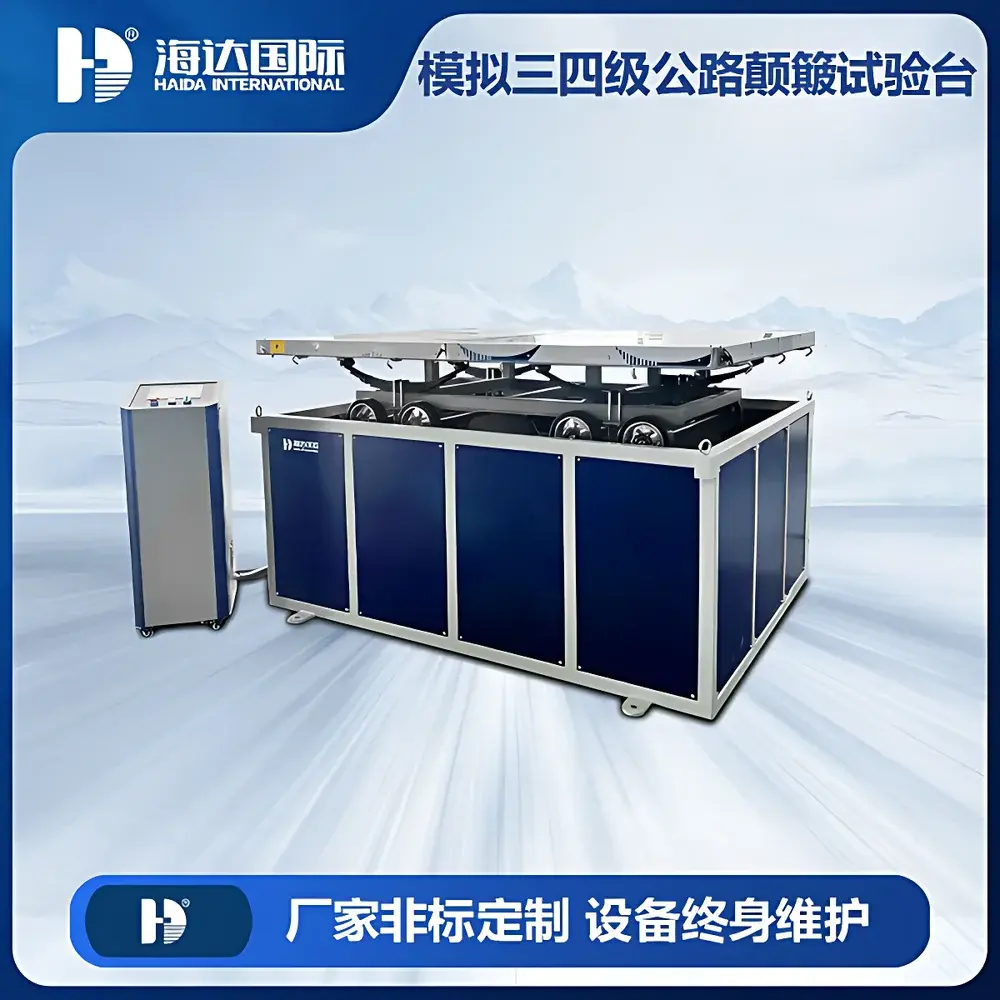
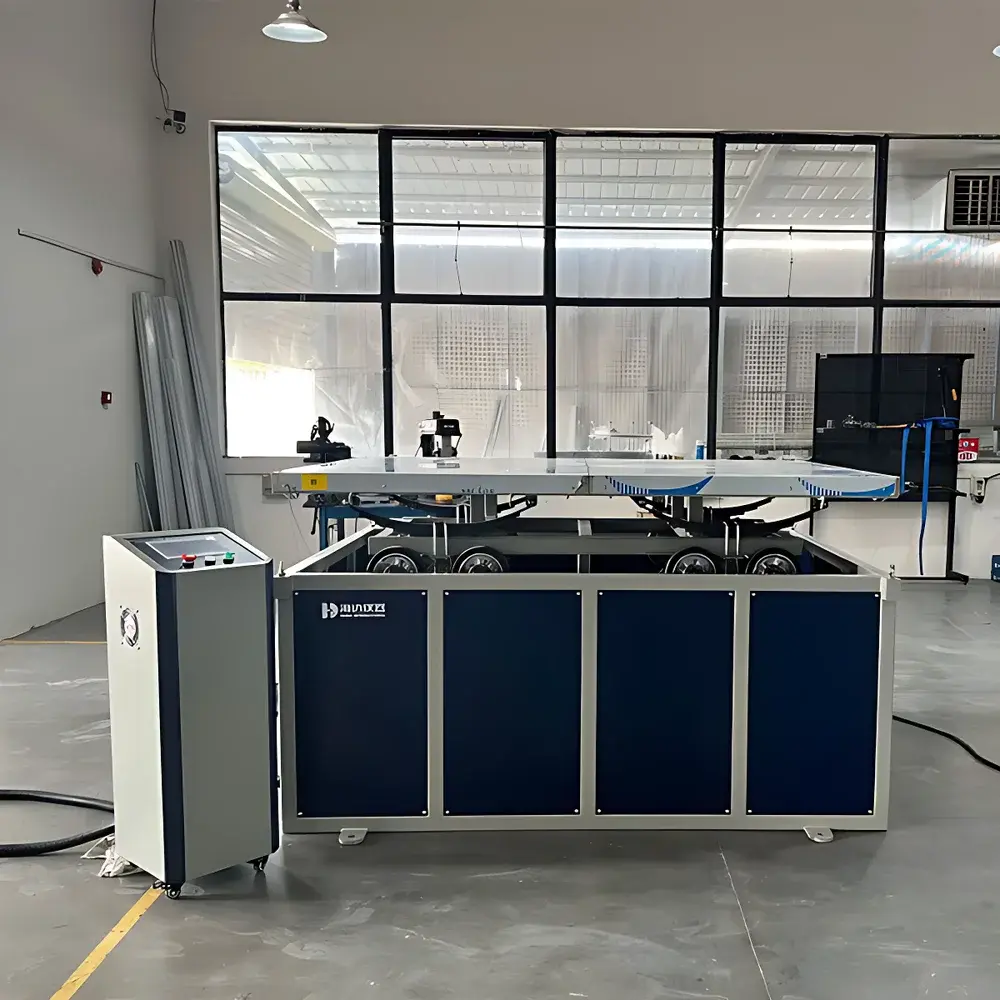
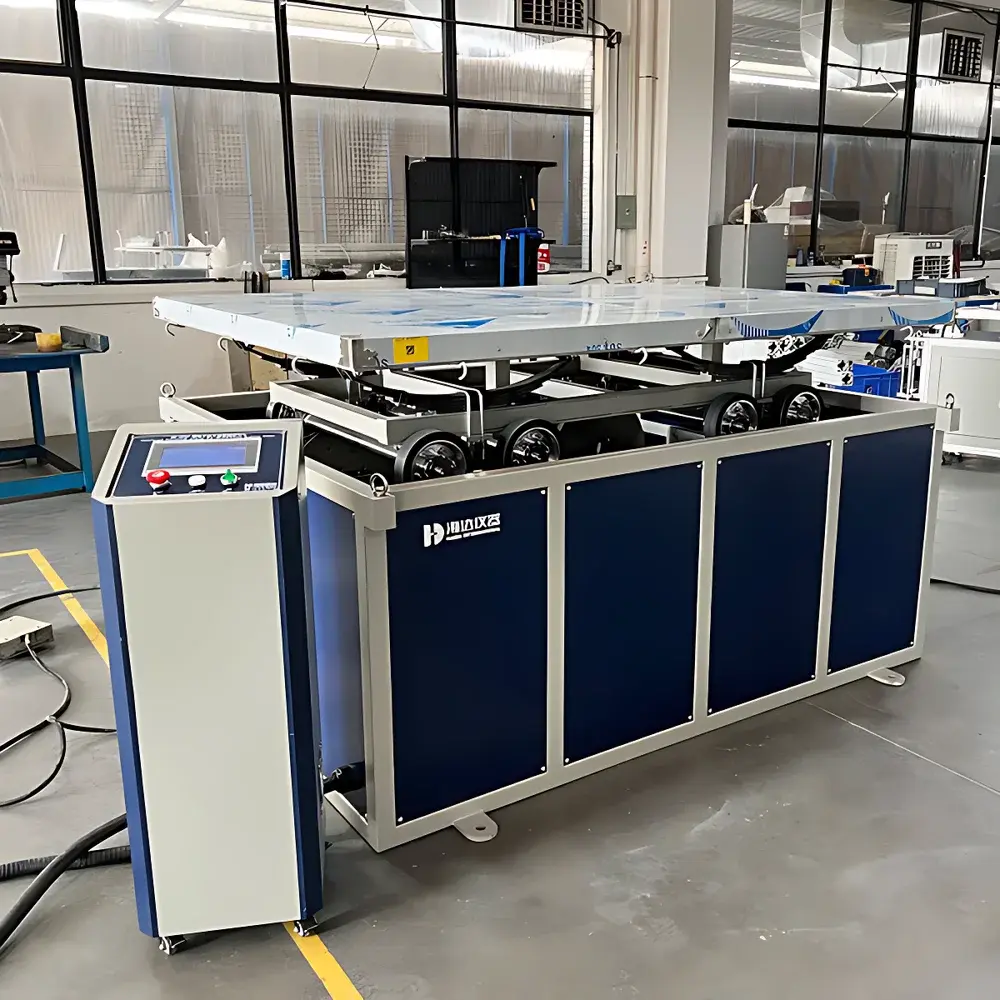
HAIDA HD-A521-5 Simulated Class III & IV Highway Bump Test System
| Brand | HAIDA INTERNATIONAL |
|---|---|
| Origin | Guangdong, China |
| Manufacturer Type | Direct Manufacturer |
| Country of Origin | China |
| Model | HD-A521-5 Simulated Class III & IV Highway Bump Test System |
| Instrument Type | Electromechanical Vibration Shaker |
| Rated Frequency Range | 10–40 Hz |
| Maximum Test Load | 100 kg |
| Table Dimensions (L×W) | Up to 1500 mm × 2000 mm |
| Amplitude Range | ≥0.35 mm |
| Vibration Mode | Broadband Random + Sine |
| Acceleration PSD Distribution | Approximate Gaussian |
| Simulated Road Surfaces | Class III (Medium-grade) and Class IV (Low-to-Medium-grade) Highways |
| Specimen Center-of-Gravity Height Limit | ≤700 mm |
| Continuous Operation Duration | 6 hours |
| Motor | 4 kW, Three-Phase AC |
| Table Surface Size | 1500 mm × 2000 mm (L×W) |
| Max Specimen Footprint | 1200 mm × 1700 mm (L×W) |
| Overall Dimensions (L×W×H) | ~1500 mm × 2000 mm × 1200 mm |
| Weight | ~2000 kg |
| Power Supply | 3Ø AC / 380 V |
| Total Power Consumption | ~5 kW |
Overview
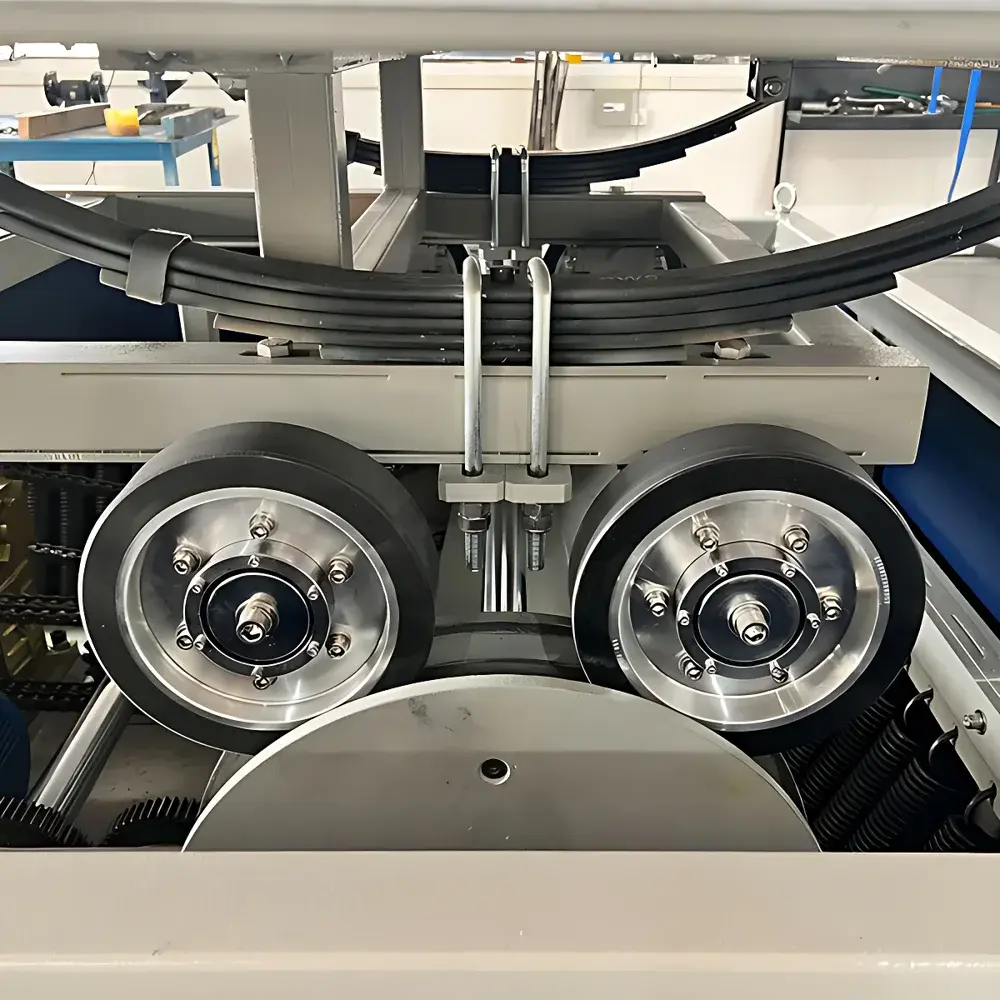
The HAIDA HD-A521-5 Simulated Class III & IV Highway Bump Test System is an electromechanical vibration shaker engineered for laboratory-based replication of real-world road-induced mechanical stress encountered during overland freight transport. Unlike conventional sinusoidal or fixed-frequency shakers, this system implements a statistically grounded broadband random vibration simulation methodology—designed in accordance with stochastic control theory and empirical power spectral density (PSD) profiles derived from field measurements on Class III (medium-grade) and Class IV (low-to-medium-grade) highways per JTG B01-2003 and GJB150.16A. Its core operating principle relies on dual-drum eccentric excitation: two counter-rotating cam drums—each fitted with adjustable 180°-offset convex blocks—drive elastomeric wheel assemblies connected via laminated steel leaf springs to the test table. The resulting motion combines deterministic harmonic components (governed by drum geometry and rotational speed) with inherent randomness arising from motor speed fluctuations, cam phase drift, and intermittent wheel-drum impact dynamics. This hybrid excitation ensures faithful reproduction of the acceleration RMS distribution, frequency-weighted energy content, and temporal non-stationarity characteristic of actual vehicle cabin vibration under typical rural and secondary highway conditions.
Key Features
- Robust structural architecture built from heavy-duty square tubing, channel steel, and solid carbon steel components—optimized for long-term dimensional stability and minimal parasitic resonance under dynamic loading.
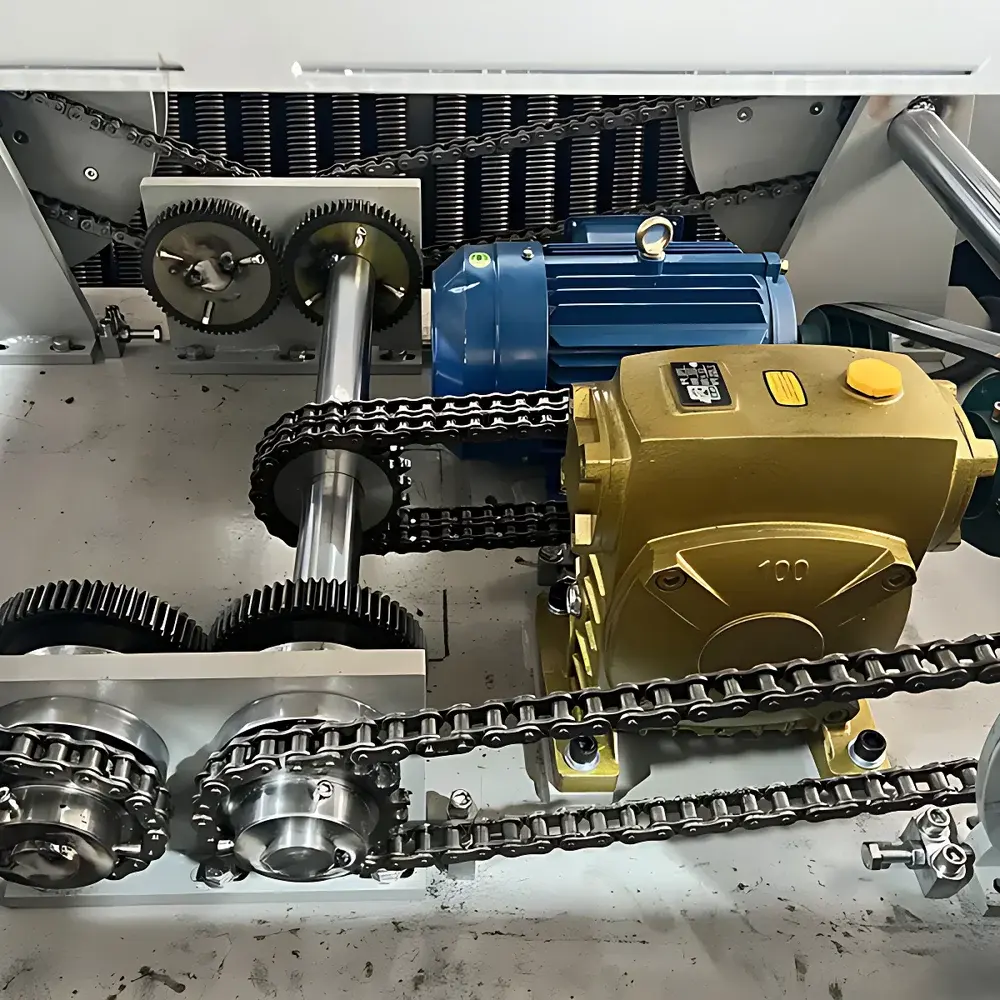
- Integrated 4 kW three-phase induction motor coupled via industrial-grade reduction gearbox and roller chain transmission—delivering high torque at low-speed drum rotation (typically 60–240 rpm) while maintaining thermal reliability during extended 6-hour test cycles.
- Adjustable cam height and width mechanism—enabling precise calibration of peak displacement amplitude (≥0.35 mm) and RMS acceleration magnitude across the 10–40 Hz operational band.
- Modular sand-ballast mass system—allowing fine-tuning of the effective mass-spring-damper characteristics to match specific vehicle suspension response profiles and target PSD envelopes.
- Industrial-grade 7.5 kW variable-frequency drive (VFD)—providing closed-loop speed regulation, programmable acceleration/deceleration ramps, and real-time torque monitoring for repeatable excitation control.
- 10.1-inch capacitive touch HMI interface—supporting intuitive parameter entry, real-time waveform visualization, fault logging, and embedded test protocol recall compliant with internal QA procedures.
Sample Compatibility & Compliance
The HD-A521-5 accommodates specimens up to 1200 mm × 1700 mm in footprint and 100 kg in mass, with center-of-gravity height constrained to ≤700 mm above the table surface to ensure stable inertial coupling. Its mechanical design conforms to ISO 2041:2018 (Vibration and Shock—Vocabulary), ASTM D999 (Standard Test Methods for Vibration Testing of Shipping Containers), and MIL-STD-810H Method 514.8 (Vibration). It satisfies the technical requirements specified in QJ/T 815.1–1994 and QJ/T 815.2–1994 for aerospace ground transportation simulation, and supports validation against JTG B01-2003 (Highway Engineering Technical Standards) for domestic civil infrastructure logistics assessment. All electrical subsystems comply with IEC 61800-5-1 for adjustable speed electrical power drive systems and meet CE marking requirements for EMC immunity (EN 61000-6-2) and emissions (EN 61000-6-4).
Software & Data Management
The proprietary HAIDA Vibration Control Suite (v3.2+) runs natively on the embedded HMI controller and implements a segmented PSD matching algorithm—partitioning the 10–40 Hz bandwidth into discrete sub-bands, each centered on a dominant vehicle-body natural frequency (e.g., 12 Hz, 18 Hz, 25 Hz, 32 Hz). Within each segment, the system enforces δi,table = δi,vehicle, where δ denotes RMS acceleration. Time-history data acquisition occurs at 2 kHz sampling rate with 16-bit resolution; raw acceleration waveforms are stored in IEEE-compliant .tdms format. Post-test analysis includes PSD estimation (Welch’s method), kurtosis/skewness calculation, fatigue damage spectrum (FDS) derivation per Steinberg’s narrow-band model, and pass/fail evaluation against user-defined threshold envelopes. Audit trails—including operator ID, timestamp, parameter set version, and calibration certificate reference—are retained for GLP/GMP traceability.
Applications
This test system is routinely deployed in quality assurance laboratories for evaluating the structural integrity and functional resilience of packaged electronics, automotive components, military hardware, pharmaceutical cold-chain shippers, and industrial control enclosures subjected to domestic over-the-road logistics. It enables comparative analysis of packaging system performance—quantifying degradation modes such as solder joint fatigue, connector loosening, foam compression set, or label delamination—under representative Class III/IV road spectra. In R&D environments, it supports iterative design validation of shock-absorbing mounts, isolation platforms, and chassis-level damping strategies prior to field trials. Additionally, it serves as a primary tool for generating vibration input specifications used in finite element analysis (FEA) boundary condition definition and durability life prediction modeling.
FAQ
What road classifications does the HD-A521-5 simulate, and how are they defined?
The system replicates the vibration signatures of Chinese Class III (medium-grade) and Class IV (low-to-medium-grade) highways per JTG B01-2003—characterized by asphalt or concrete surfaces with moderate irregularities, limited shoulder grading, and typical speed limits of 40–60 km/h.
Can the test profile be customized beyond standard Class III/IV spectra?
Yes—users may import custom PSD files in ASCII or .csv format, define multi-segment amplitude envelopes, or configure time-domain synthetic waveforms using the advanced scripting module.
Is the system compatible with external data acquisition hardware?
It features dual analog output channels (±10 V, 100 kΩ load) synchronized to internal sampling clock, enabling direct integration with third-party DAQ systems such as National Instruments PXI or Dewesoft X.
What maintenance intervals are recommended for long-term reliability?
Cam block wear inspection every 500 operational hours; greasing of all drum bearings and chain drive components every 200 hours; annual recalibration of accelerometer feedback loop and VFD current sensors by authorized HAIDA service engineers.
Does the system support automated pass/fail reporting per regulatory standards?
Yes—the software generates PDF-formatted compliance reports including test summary, PSD overlay plots, RMS deviation metrics, and digital signature fields aligned with FDA 21 CFR Part 11 electronic record requirements when configured with optional network authentication modules.



