
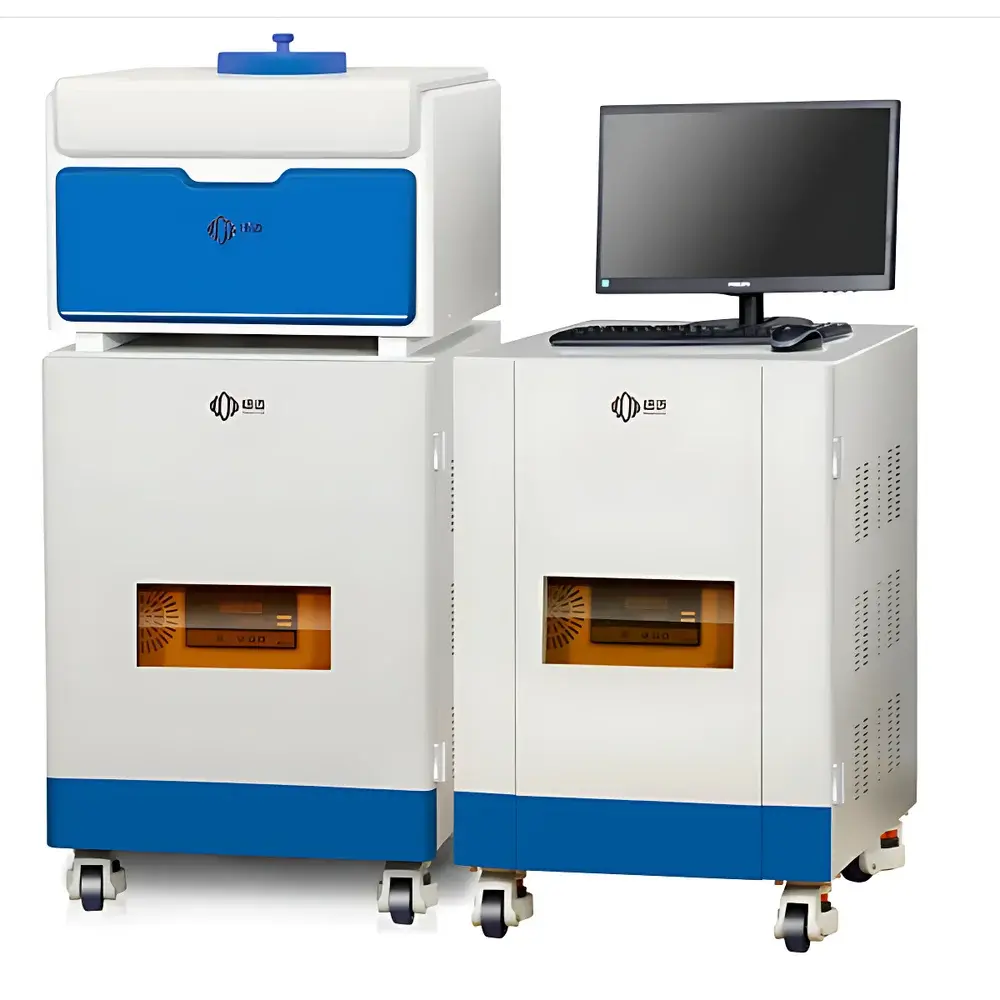
NIUMAG VTMR- Low-Field Nuclear Magnetic Resonance Analyzer for EVA Crosslink Density Measurement
| Brand | NIUMAG |
|---|---|
| Origin | Jiangsu, China |
| Manufacturer Type | Authorized Distributor |
| Origin Category | Domestic |
| Model | VTMR- |
| Instrument Type | Low-Field NMR Analyzer |
| Sample Type | Solid-Liquid Compatible |
| Operating Mode | Pulsed Fourier Transform |
| Magnet Type | Permanent Magnet |
| Magnetic Field Strength | 0.5 ± 0.05 T |
| Effective Sample Detection Volume | Ø8.5 mm × H20 mm |
| Temperature Control Range | RT to 130 °C (Standard) / RT to 180 °C (Optional) |
| Imaging Capability | Optional |
| Measurement Time | ≤2 min per sample |
Overview
The NIUMAG VTMR- Low-Field Nuclear Magnetic Resonance Analyzer is a purpose-engineered benchtop instrument designed for quantitative characterization of crosslink density in ethylene-vinyl acetate (EVA) copolymers and related elastomeric systems. It operates on the physical principle of proton (1H) spin relaxation in low-field magnetic environments—specifically measuring transverse relaxation time (T2) distributions via pulsed Fourier-transform NMR. In crosslinked polymer networks, segmental mobility of hydrogen-bearing chains is directly constrained by network junctions; thus, T2 decay profiles provide a robust, physics-based proxy for crosslink density without requiring calibration standards or destructive sample preparation. Unlike high-field NMR spectrometers optimized for molecular structure elucidation, the VTMR- leverages permanent magnet technology (0.5 ± 0.05 T) to deliver industrial-grade reproducibility in routine quality control and R&D environments—enabling rapid, non-invasive assessment of vulcanization, curing kinetics, thermal aging, and solvent–polymer interactions.
Key Features
- Sub-2-minute measurement cycle per sample—engineered for high-throughput lab and production-line integration
- Permanent magnet architecture ensuring field stability, minimal maintenance, and zero cryogen consumption
- Integrated temperature-controlled probe with standard RT–130 °C range (extendable to 180 °C) for real-time monitoring of crosslinking dynamics under thermal stress
- Non-destructive, reagent-free operation—preserves sample integrity for sequential testing or archival
- Simultaneous quantification of multiple material parameters: crosslink density, hard/soft segment ratio, plasticizer content, fluorine concentration (via 19F optional module), and phase separation behavior
- Optional NMR imaging capability for spatial mapping of heterogeneity, filler dispersion, microcrack formation, and interfacial compatibility in composite elastomers
Sample Compatibility & Compliance
The VTMR- accommodates solid, semi-solid, and liquid-phase samples within its defined detection volume (Ø8.5 mm × 20 mm height), making it suitable for uncured EVA pellets, compression-molded sheets, extruded profiles, gel fractions, and solvent-swollen specimens. Its solid–liquid dual-mode capability supports both bulk rubber analysis and swelling-based crosslink evaluation per ASTM D6246 and ISO 17226-2. The system complies with IEC 61000-6-3 (EMC) and IEC 61010-1 (safety) standards. Data acquisition and reporting workflows support audit-ready documentation aligned with GLP and GMP principles, including user access control, electronic signatures, and full metadata logging for traceability—facilitating compliance with FDA 21 CFR Part 11 where validated software modules are deployed.
Software & Data Management
The VTMR- is operated via NIUMAG’s proprietary NMIView™ software platform, which provides intuitive pulse sequence selection (CPMG, IR, SE), automated T2 inversion, multi-exponential fitting, and customizable report generation. Raw FID data, processed relaxation spectra, and derived metrics (e.g., crosslink density ρc calculated using the Flory–Rehner equation) are stored in vendor-neutral HDF5 format. Batch processing, trend analysis across time/temperature series, and export to CSV, MATLAB, or LIMS-compatible formats ensure seamless integration into enterprise QA/QC infrastructure. Optional validation packages include IQ/OQ documentation, uncertainty budgeting per ISO/IEC 17025, and periodic performance verification protocols.
Applications
- Optimization of peroxide- or silane-initiated EVA crosslinking processes in photovoltaic encapsulant manufacturing
- In-process monitoring of cure state during hot-press lamination or continuous extrusion
- Comparative assessment of antioxidant efficacy on long-term network stability
- Quantitative evaluation of nanofiller dispersion homogeneity in EVA–SiO2 or EVA–carbon black composites
- Swelling ratio–based crosslink density validation against equilibrium solvent uptake methods
- Correlation of T2 distribution width with mechanical hysteresis and compression set performance
FAQ
What physical parameter does the VTMR- measure to determine crosslink density?
It measures the transverse relaxation time (T2) distribution of 1H nuclei, from which crosslink density is derived using polymer physics models such as the Flory–Rehner equation.
Can the VTMR- analyze filled or pigmented EVA compounds?
Yes—the low-field NMR signal is insensitive to paramagnetic impurities commonly present in carbon black or metal oxide fillers, enabling direct analysis without sample purification.
Is temperature control required for routine crosslink density testing?
While ambient-temperature measurements are valid for comparative QC, controlled heating (up to 180 °C) is essential for studying cure kinetics, post-cure effects, or accelerated aging behavior.
How does VTMR- data correlate with traditional mechanical testing (e.g., modulus, elongation)?
Empirical correlations between T2 mean values and tensile modulus or Shore A hardness have been established for specific EVA formulations and can be embedded in custom calibration models.
Does the system support regulatory-compliant data archiving for pharmaceutical or medical device applications?
When configured with validated NMIView™ software and appropriate IT infrastructure, the VTMR- meets ALCOA+ data integrity criteria and supports 21 CFR Part 11 compliance through role-based access, audit trails, and electronic signature enforcement.



