
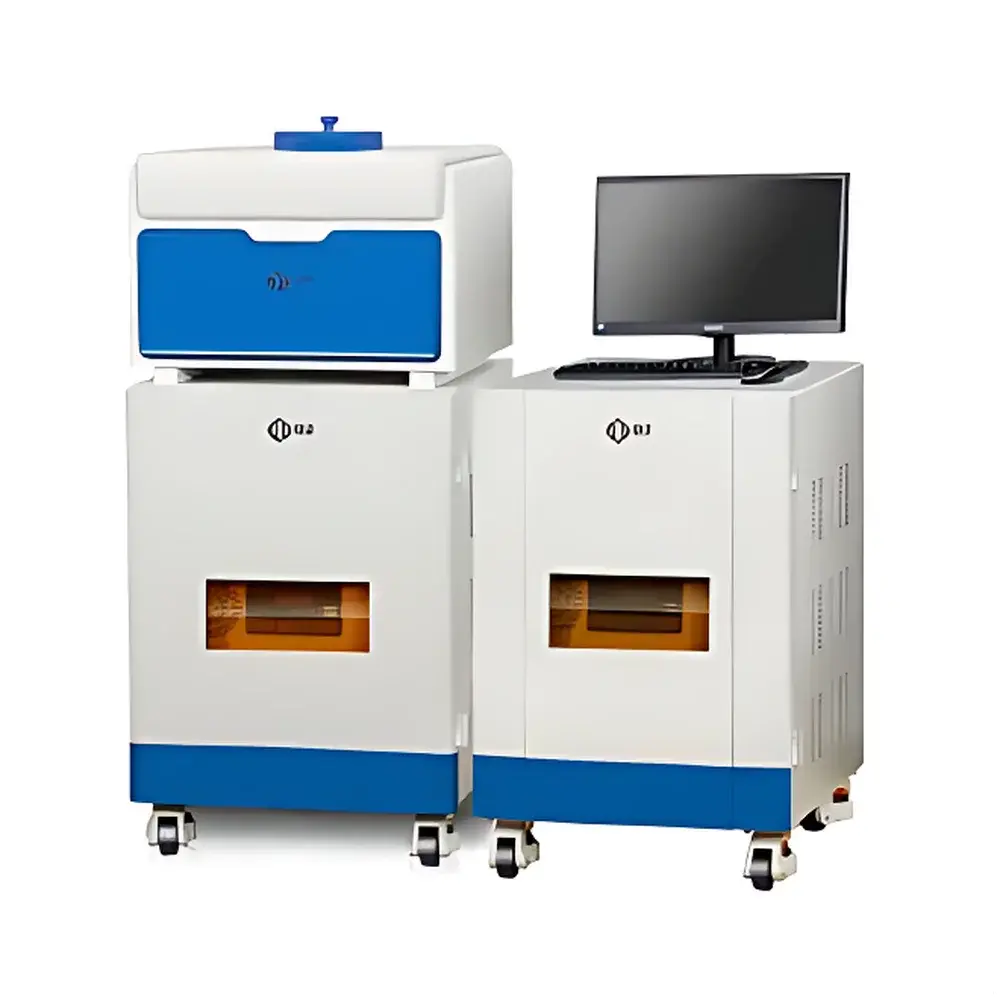
NIUMAG VTMR-nmr Variable Temperature Low-Field Nuclear Magnetic Resonance Analyzer
| Brand | NIUMAG |
|---|---|
| Origin | Jiangsu, China |
| Manufacturer Type | Authorized Distributor |
| Regional Classification | Domestic (China) |
| Model | VTMR-nmr |
| Instrument Type | Low-Field NMR Analyzer |
| Sample Compatibility | Solid-Liquid Dual-Phase |
| Magnetic Field Strength | 0.5 ± 0.05 T |
| Magnet Type | Permanent Magnet |
| Standard Temperature Range | Ambient to 130 °C |
| Optional Cryo/High-Temp Module | –100 °C to 200 °C |
| MRI Capability | Optional |
| Core Technology | FLAT (Fast Low-Amplitude Transient) Pulse Sequence for Short-T₂ Signal Acquisition |
| Primary Measurement Modes | T₁ & T₂ Relaxometry, Diffusion-Weighted Analysis, Spatially Resolved Imaging (with optional gradient set) |
Overview
The NIUMAG VTMR-nmr is a purpose-engineered variable temperature low-field nuclear magnetic resonance (NMR) analyzer designed for quantitative structural and dynamic characterization of polymeric and elastomeric materials under controlled thermal conditions. Operating at a stable static field of 0.5 ± 0.05 T generated by a high-homogeneity permanent magnet system, the instrument enables non-invasive, in-situ monitoring of molecular mobility, phase distribution, crosslink density, and network evolution across temperature gradients. Unlike conventional high-field NMR spectrometers, the VTMR-nmr leverages robust time-domain relaxometry—specifically optimized for short-T₂ systems such as vulcanized rubber, thermosets, gels, and heterogeneous composites—without requiring cryogenic infrastructure or superconducting magnets. Its integrated temperature control module permits precise, programmable ramping and isothermal stabilization from ambient up to 130 °C (standard), with extended range options spanning –100 °C to 200 °C for deep cryogenic or accelerated aging studies. The system’s core analytical capability rests on multi-exponential T₂ decay inversion, longitudinal relaxation (T₁) mapping, and diffusion-relaxation correlation (D–T₂), enabling direct quantification of crosslink density (ν) via the Flory–Rehner equation and segmental mobility analysis through constrained polymer chain dynamics.
Key Features
- Engineered for precision thermal control: PID-regulated sample chamber with ±0.1 °C stability over full operating range; real-time temperature logging synchronized with NMR acquisition.
- FLAT pulse sequence architecture: Specifically developed for rapid, high-SNR acquisition of weak, fast-decaying signals from rigid or semi-crystalline domains in elastomers and filled polymers.
- Modular hardware design: Interchangeable probe configurations support standard 10–25 mm OD tube formats, custom-built solid-state rotors, and flow-through cells for in-line process monitoring.
- Dual-mode operation: Simultaneous or sequential T₁/T₂ measurement protocols; optional imaging gradients enable spatially resolved relaxometry (1D/2D) for heterogeneity mapping and defect detection.
- Self-contained electronics: Integrated RF transceiver, digital signal processor, and lock-in amplifier eliminate external dependency on third-party consoles—ensuring reproducibility and long-term calibration stability.
Sample Compatibility & Compliance
The VTMR-nmr accommodates a broad spectrum of physical states—including bulk solids, powdered blends, swollen gels, emulsions, and solvent-swollen elastomer samples—without chemical labeling or destructive preparation. It supports ASTM D6247 (Standard Practice for Determining Crosslink Density of Vulcanized Rubber Using NMR), ISO 17987 (Rubber—Determination of Crosslink Density by NMR), and aligns with GLP-compliant data integrity requirements through audit-trail-enabled software. All firmware and acquisition modules are validated per ICH Q2(R2) guidelines for analytical method verification where used in QC/QA environments. Data files conform to NMRFx and Bruker TopSpin-compatible ASCII formats for third-party processing interoperability.
Software & Data Management
NIUMAG’s proprietary MestReNova-integrated NMR console software provides end-to-end workflow automation—from pulse sequence selection and temperature ramp definition to inverse Laplace transform (ILT) processing and statistical model fitting. Key modules include: Crosslink Density Quantification Suite (with built-in Flory–Rehner solver), Multi-Component T₂ Distribution Analyzer, Diffusion-Relaxation Correlation Mapper, and Time-Series Thermal Response Tracker. All raw FIDs and processed parameter maps are stored with embedded metadata (temperature, field homogeneity, shimming status, pulse power). Software complies with FDA 21 CFR Part 11 requirements for electronic records and signatures, including role-based access control, electronic audit trails, and secure user authentication.
Applications
- Rubber & Elastomer R&D: Real-time tracking of sulfur vulcanization kinetics, peroxide curing profiles, and post-cure aging mechanisms via T₂ shift and amplitude decay trends.
- Formulation Optimization: Quantitative assessment of plasticizer migration, filler dispersion uniformity, and phase separation onset in thermoplastic elastomers (TPEs) and TPVs.
- Material Degradation Studies: Accelerated thermal aging evaluation using Arrhenius-based T₁/T₂ activation energy extraction and reversible/irreversible mobility loss differentiation.
- Composite Interface Analysis: Detection of interfacial adhesion quality between rubber matrices and reinforcing fibers or nanoparticles through bound/rubbery/mobile phase quantification.
- Process Monitoring: Integration-ready interface for inline coupling with extruders, calenders, or autoclaves to correlate NMR-derived network parameters with mechanical output metrics.
FAQ
What sample volume is required for reliable crosslink density measurement?
Typical requirement is 0.5–2.0 mL for liquid-swollen rubber or 0.3–1.5 g for solid elastomer specimens, depending on proton density and T₂ relaxation characteristics.
Can the VTMR-nmr distinguish between covalent and physical crosslinks?
Yes—through combined T₁/T₂ temperature-dependent analysis and selective saturation transfer experiments, it differentiates thermally labile physical junctions (e.g., crystallites, hydrogen bonds) from permanent covalent networks.
Is calibration traceable to international standards?
All instruments undergo factory calibration against NIST-traceable reference standards (e.g., doped water, polyethylene glycol, and crosslinked PDMS phantoms); annual recalibration services include homogeneity mapping and RF power linearity verification.
Does the system support automated batch analysis for QA/QC labs?
Yes—the software includes scriptable macro functions and CSV-based batch queue management, enabling unattended overnight runs with pass/fail criteria based on user-defined T₂ distribution thresholds.
How is data security ensured during remote support sessions?
Remote access utilizes encrypted VNC tunneling with session-specific one-time passwords; no data is transmitted outside the local network unless explicitly exported by the operator via AES-256 encrypted archives.





