
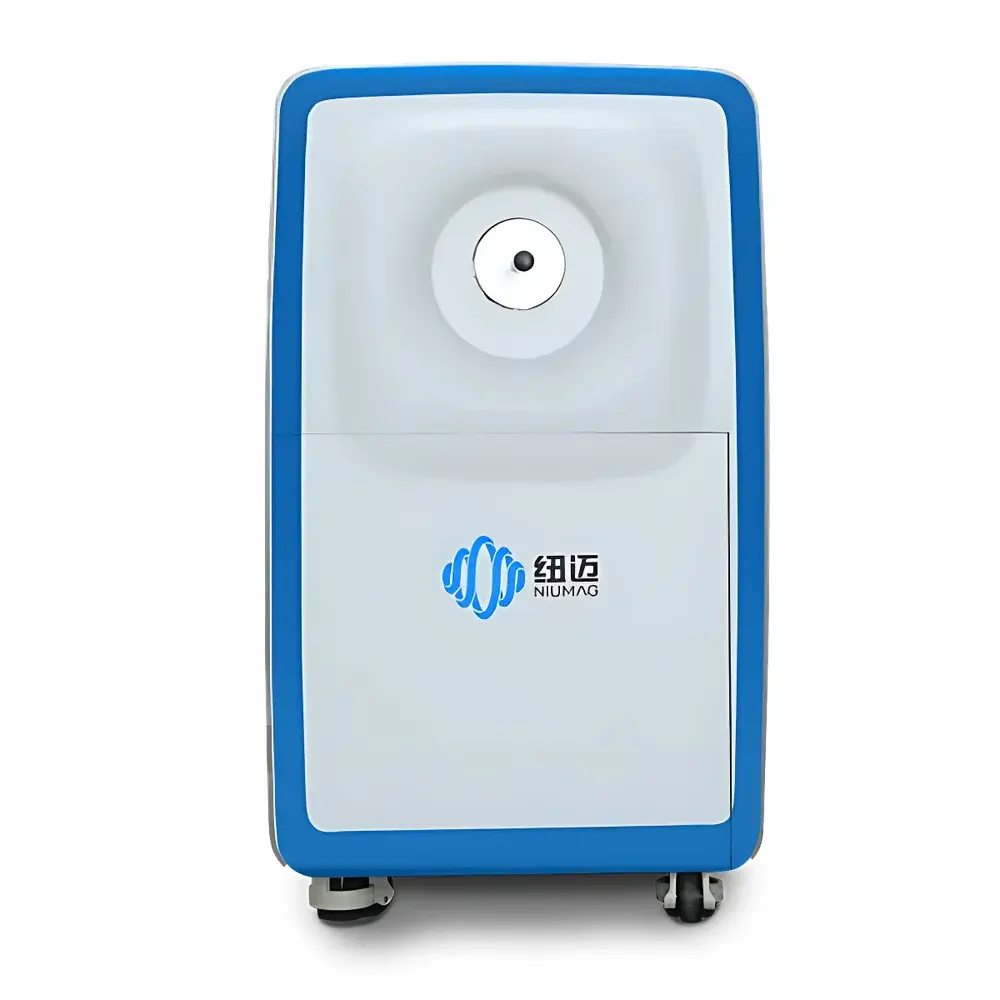
NIUMAG QMR06-090H-1 Low-Field Nuclear Magnetic Resonance Analyzer for In Vivo Rodent Body Composition Analysis
| Brand | NIUMAG |
|---|---|
| Origin | Jiangsu, China |
| Instrument Type | Low-Field NMR Spectrometer |
| Model | QMR06-090H-1 |
| Sample Compatibility | Solid-Liquid Dual-Phase (Live Small Animals) |
| Magnet System | Permanent Magnet |
| Probe | Dedicated Mouse/Rat Body Composition RF Coil |
| Measurement Principle | T₂ Relaxation Time Discrimination of Fat, Lean Tissue, and Free Water |
| Software | NIUMAG Proprietary Rodent Body Composition Analysis Suite |
| Regulatory Context | Designed for GLP-Compliant Preclinical Research Environments |
Overview
The NIUMAG QMR06-090H-1 is a dedicated low-field nuclear magnetic resonance (LF-NMR) analyzer engineered for non-invasive, quantitative in vivo assessment of body composition in rodent models—particularly diet-induced obese (DIO) rats and mice. Unlike destructive or ionizing modalities, this system exploits intrinsic differences in transverse relaxation times (T₂) among adipose tissue, lean muscle mass, and free water protons. Under a stable permanent magnet field (0.06–0.09 T), the instrument acquires multi-echo Carr–Purcell–Meiboom–Gill (CPMG) decay signals, which are deconvoluted using constrained inverse Laplace transformation to resolve three distinct relaxation components. These correspond directly to fat (short T₂: ~40–100 ms), lean tissue (intermediate T₂: ~150–300 ms), and free fluid (long T₂: >400 ms). The resulting quantification yields absolute masses (g) or percentage composition of total body fat, lean mass, and total body water—without anesthesia, radiation exposure, or terminal sacrifice.
Key Features
- Non-invasive, real-time in vivo measurement: Enables longitudinal monitoring of the same animal across multiple time points—critical for pharmacokinetic/pharmacodynamic (PK/PD) studies and chronic intervention trials.
- Dedicated small-animal RF probe: Optimized 25 mm inner diameter solenoid coil ensures high signal-to-noise ratio (SNR) and uniform B₁ field distribution over standard C57BL/6, Sprague-Dawley, or Wistar rats (up to 500 g) and mice (15–40 g).
- Sub-minute acquisition: Full T₂ decay acquisition and automated quantification completed in ≤90 seconds per subject; throughput supports up to 20–25 animals per hour under standard lab conditions.
- No sample preparation required: Animals remain fully conscious and unrestrained during measurement; no fasting, sedation, or positioning fixtures needed beyond gentle manual placement in the cradle.
- Robust thermal stability: Permanent magnet design eliminates cryogen dependency and provides field homogeneity < 10 ppm over 8 cm DSV, ensuring measurement repeatability across days and operators.
Sample Compatibility & Compliance
The QMR06-090H-1 accommodates live rodents—including DIO rats, ob/ob mice, Zucker fatty rats, and other genetically or diet-modified metabolic models—as well as rabbits (≤1.5 kg) and guinea pigs. All measurements comply with OECD Test Guideline 452 (Chronic Toxicity Studies) and align with NIH Office of Laboratory Animal Welfare (OLAW) standards for minimally stressful endpoints. While not FDA-cleared as a diagnostic device, the system supports data integrity requirements for preclinical regulatory submissions: audit trails, user access control, electronic signatures, and raw FID/CPMG data export conform to ALCOA+ principles. It is routinely deployed in laboratories adhering to ISO/IEC 17025:2017 (for testing competence) and supports 21 CFR Part 11-compliant workflows when integrated with validated LIMS environments.
Software & Data Management
NIUMAG’s proprietary RodentBodyPro™ software provides full workflow automation—from pulse sequence selection (standard CPMG, inversion-recovery CPMG for fat/water separation) to T₂ spectrum fitting, component integration, and statistical reporting. Each measurement generates a structured XML metadata file containing acquisition parameters, operator ID, timestamp, animal ID, weight input, and calibrated mass outputs. Batch processing mode allows parallel analysis of ≥50 subjects with automatic outlier detection based on T₂ distribution skewness and SNR thresholds. Export formats include CSV (for Excel/GraphPad Prism), HDF5 (for MATLAB/Python), and PDF summary reports compliant with institutional animal care and use committee (IACUC) documentation requirements.
Applications
- Preclinical evaluation of anti-obesity therapeutics: Quantitative tracking of fat mass reduction kinetics and lean mass preservation during compound dosing regimens.
- Metabolic phenotyping: Differentiation of visceral vs. subcutaneous adiposity proxies via regional T₂ dispersion analysis (when combined with anatomical referencing).
- Diabetes and insulin resistance modeling: Correlation of adipose tissue expansion rate with HOMA-IR, fasting glucose, and lipid panel changes.
- Nutritional intervention studies: Assessment of dietary fat source, fiber content, or caloric restriction effects on compartmental water shifts and lean tissue hydration status.
- Toxicology screening: Detection of drug-induced lipodystrophy or ectopic fat deposition in liver/muscle through localized T₂ mapping protocols.
FAQ
Is anesthesia required for scanning?
No. Animals are scanned awake and unrestrained; only gentle manual placement into the probe cradle is necessary.
Can the system distinguish between visceral and subcutaneous fat?
Not anatomically—but T₂ spectral profile deviations (e.g., shorter mean T₂ in visceral depots due to higher cellularity) can be correlated with dissection-validated reference data for semi-quantitative regional inference.
What is the minimum and maximum animal weight supported?
Validated range: 15–500 g. Optimal performance achieved for mice (15–40 g) and rats (200–450 g); reproducibility declines above 550 g due to RF penetration limits.
Does the system require routine calibration with phantoms?
Yes. A standardized tri-component phantom (fat-mimic oil, muscle-mimic gel, water) is included for daily SNR verification and T₂ response validation prior to animal runs.
Is raw FID data accessible for custom algorithm development?
Yes. Full time-domain CPMG echo trains (including phase-encoded variants) are exportable in IEEE 754 binary format with full parameter metadata for third-party MATLAB, Python (NumPy), or C++ analysis pipelines.



