
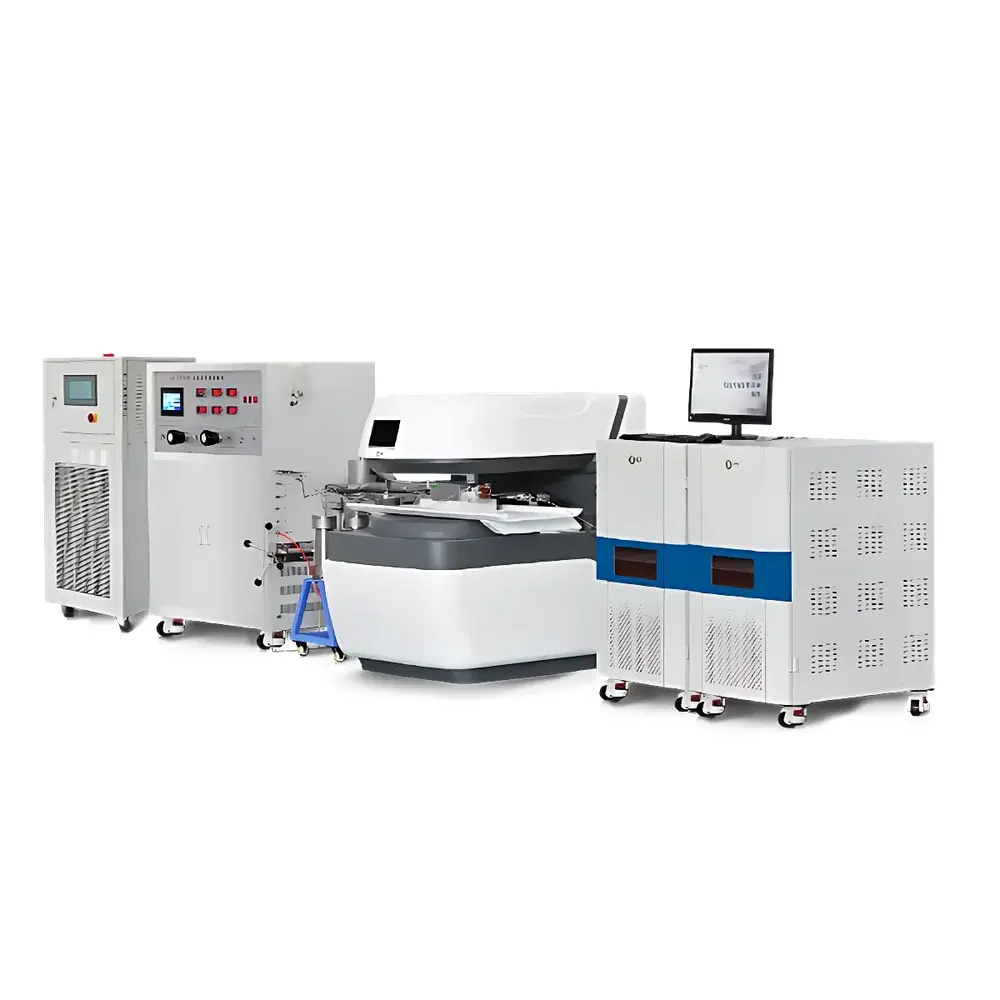
NIUMAG MacroMR12-150H-I Hydrate Triaxial Mechanical Properties Analyzer with Low-Field NMR
| Brand | NIUMAG |
|---|---|
| Origin | Jiangsu, China |
| Model | MacroMR12-150H-I |
| Magnetic Field Strength | 0.3 T ± 0.03 T |
| Magnet Homogeneity | ≤50 ppm |
| Magnet Type | C-shaped open configuration |
| Sample Orientation | Transverse/Longitudinal |
| Sample Compatibility | Solid–liquid dual-phase (core samples up to 4-inch diameter) |
| Core Functionality | Real-time T₁/T₂ relaxation spectroscopy and T₁/T₂/PD-weighted imaging under triaxial stress, temperature, and pore-pressure control (with optional accessories) |
| Compliance | Designed for ASTM D4767, ISO 17892-7, and USP <1058> analytical instrument qualification frameworks |
Overview
The NIUMAG MacroMR12-150H-I Hydrate Triaxial Mechanical Properties Analyzer is an integrated low-field nuclear magnetic resonance (LF-NMR) system engineered for in situ characterization of gas hydrate-bearing sediments under controlled triaxial mechanical loading. Unlike conventional triaxial test apparatuses that rely solely on macroscopic stress–strain measurements, this platform couples mechanical deformation with real-time, non-invasive NMR detection of hydrogen proton dynamics—enabling quantitative correlation between microstructural evolution (e.g., pore network rearrangement, fluid redistribution, hydrate dissociation kinetics) and bulk mechanical response. The system operates at a static magnetic field of 0.3 T, optimized for high signal-to-noise ratio in heterogeneous, low-proton-density geological samples while maintaining thermal and electromagnetic stability under concurrent pressure (up to 40 MPa), temperature (−20 °C to +80 °C), and fluid saturation conditions. Its C-shaped open magnet architecture permits unobstructed integration with custom-designed triaxial cells, enabling true simultaneous acquisition of mechanical data (axial load, confining pressure, pore pressure, axial displacement) and NMR parameters (T₂ distribution, T₁ recovery, diffusion-weighted contrast) without sample interruption or repositioning.
Key Features
- C-shaped permanent magnet with ≤50 ppm homogeneity over a 150 mm DSV, facilitating stable LF-NMR signal acquisition during dynamic mechanical loading
- Dual-axis sample orientation capability (transverse and longitudinal) for flexible integration with standard and high-pressure triaxial cells
- High-precision thermostatic probe with ±0.1 °C stability, supporting temperature-controlled hydrate formation/dissociation experiments
- Modular gradient subsystem enabling advanced pulse sequences: CPMG for T₂ mapping, IR for T₁ quantification, and stimulated echo for diffusion profiling
- Expandable accessory interface for synchronized application of confining pressure (up to 40 MPa), back pressure, fluid injection (brine, methane, CO₂), and electrical resistivity monitoring
- Fully programmable acquisition engine compliant with Bruker ParaVision-compatible pulse sequence libraries and third-party automation APIs
Sample Compatibility & Compliance
The MacroMR12-150H-I accommodates cylindrical rock core specimens ranging from 25.4 mm (1 inch) to 101.6 mm (4 inches) in diameter and up to 200 mm in length. It supports both consolidated and unconsolidated sediments, synthetic hydrate analogs (e.g., THF, TBAB), and natural sediment cores preserved under cryogenic or pressure-maintained conditions. All hardware and software modules are designed in accordance with ICH Q5C, ASTM D4767-22 (Standard Test Method for Triaxial Compressive Strength of Soil), ISO 17892-7:2017 (Geotechnical investigation and testing — Laboratory testing of soil — Part 7: Triaxial compression tests), and FDA 21 CFR Part 11 requirements for electronic records and signatures when configured with audit-trail-enabled data acquisition software. Instrument qualification follows IQ/OQ/PQ protocols aligned with USP Analytical Instrument Qualification.
Software & Data Management
Data acquisition and processing are managed via NIUMAG’s proprietary MultiScan™ v4.2 platform, which provides real-time visualization of T₂ spectra, relaxation time histograms, and parametric image overlays synchronized with mechanical transducer outputs. Raw FID and echo train data are stored in vendor-neutral HDF5 format with embedded metadata (timestamp, pressure, temperature, load, sequence parameters). Batch processing supports automated T₂ inversion using non-negative least squares (NNLS) with regularization, pore-size distribution conversion via the Coates equation, and saturation calculation using internal reference standards. Export modules generate CSV, MATLAB .mat, and NIfTI files compatible with MATLAB, Python (NumPy/SciPy), and commercial reservoir simulators (CMG, ECLIPSE). Full audit trail logging—including user login, parameter modification history, and raw data checksums—is enabled by default and exportable for GLP/GMP compliance reviews.
Applications
- Hydrate-bearing sediment mechanics: Quantifying strength degradation, strain localization, and critical state behavior as functions of hydrate saturation, effective confining pressure, and dissociation rate
- Pore-scale damage evolution: Mapping spatially resolved T₂ shifts during triaxial loading to identify microcrack initiation, grain debonding, and hydrate-matrix interfacial failure
- Multiphase flow–mechanics coupling: Correlating movable/immobile water saturation changes (from T₂ cutoff analysis) with permeability reduction and shear-enhanced fluid expulsion
- Thermo-hydro-mechanical-chemical (THMC) process simulation: Validating coupled numerical models using time-resolved NMR-derived porosity, saturation, and relaxation time fields under realistic P–T–σ paths
- CO₂–CH₄ exchange kinetics: Monitoring competitive adsorption and structural transformation in hydrate lattices via sequential T₁/T₂ contrast under constant stress
- Reservoir geomechanics calibration: Deriving constitutive parameters (e.g., Biot coefficient, Skempton’s B, elastic moduli) directly from NMR-constrained effective stress–strain relationships
FAQ
Can this system perform true in situ NMR measurements during active triaxial compression?
Yes—the C-shaped magnet design and transverse/longitudinal sample access allow uninterrupted RF excitation and signal reception while axial load, confining pressure, and pore pressure are dynamically adjusted.
What is the minimum detectable hydrate saturation level using T₂ contrast?
Under optimal signal averaging and SNR conditions, reliable differentiation of hydrate-bound water (T₂ ≈ 0.1–1 ms) from pore water (T₂ ≈ 10–1000 ms) enables quantification down to ~3 vol% hydrate saturation in sand-rich sediments.
Is the system compatible with high-pressure triaxial cells exceeding 20 MPa?
Yes—when equipped with the optional MacroMR12-150H-HTHP module, it supports full NMR acquisition at confining pressures up to 40 MPa and pore pressures up to 35 MPa, with active temperature control from −20 °C to +80 °C.
Does the software support automated sequence triggering based on mechanical feedback signals?
Yes—MultiScan™ v4.2 accepts TTL or analog input from external load cells and pressure transducers to initiate predefined NMR sequences at user-defined stress or strain thresholds.
Are calibration standards and traceable reference materials provided?
Each system ships with NIST-traceable quartz and doped water phantoms for T₂ and T₁ calibration, along with documented uncertainty budgets per ISO/IEC 17025 requirements.






