
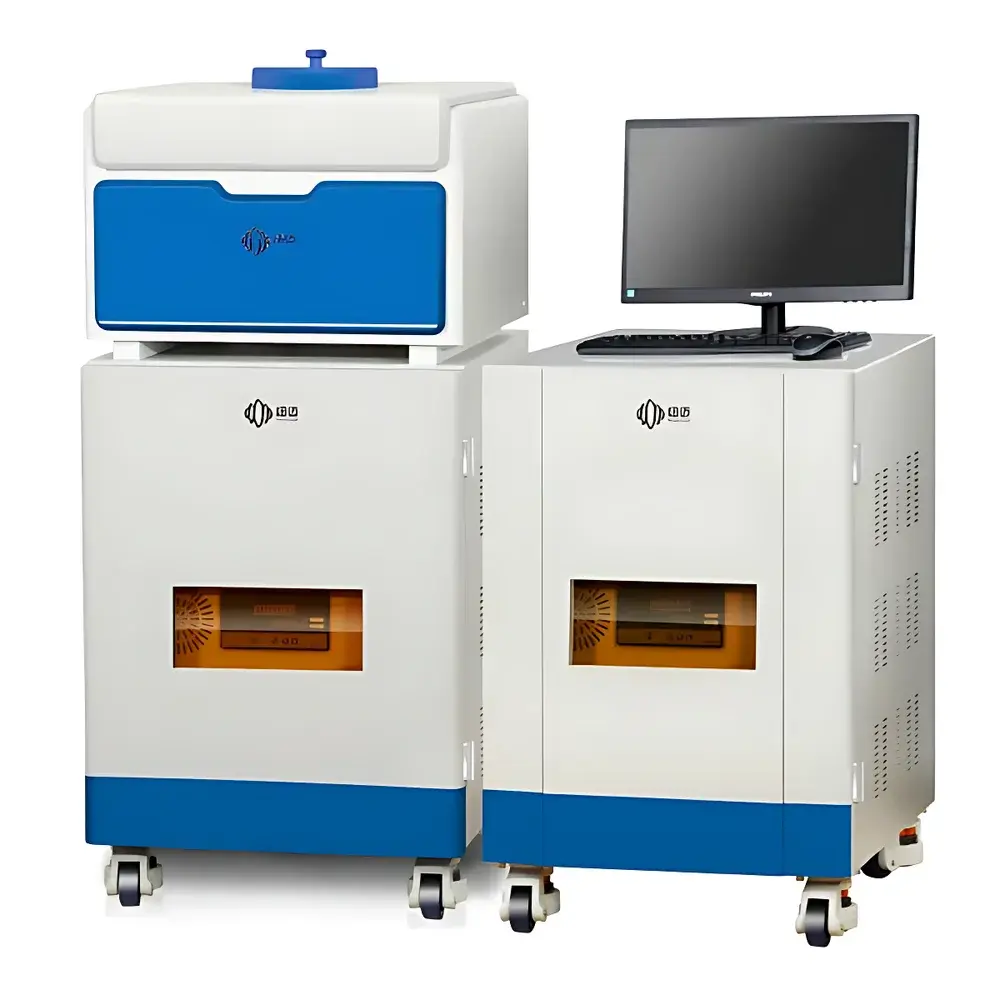
NIUMAG VTMR Composite Resin Content Analyzer
| Brand | NIUMAG |
|---|---|
| Origin | Jiangsu, China |
| Manufacturer Type | Authorized Distributor |
| Product Category | Domestic |
| Model | VTMR |
| Instrument Type | Low-Field Nuclear Magnetic Resonance (LF-NMR) Analyzer |
| Sample Type | Solid-Liquid Hybrid |
| Operating Mode | Pulsed Fourier Transform (PFT) |
| Magnet Type | Permanent Magnet |
| Magnetic Field Strength | 0.5 ± 0.05 T |
| Standard Temperature Range | Ambient to 130 °C |
| Optional Cryo/High-Temp Module | −100 °C to 200 °C |
| Typical Measurement Time | ≤2 min per sample |
| Core Techniques | T₁/T₂ Relaxometry, NMR Imaging (MRI), FLAT (Fast Low-Amplitude Transient) Acquisition for Short-T₂ Signals |
Overview
The NIUMAG VTMR Composite Resin Content Analyzer is a purpose-built low-field nuclear magnetic resonance (LF-NMR) instrument engineered for quantitative, non-destructive assessment of resin content in polymer matrix composites. It operates on the fundamental principles of pulsed Fourier-transform NMR, detecting hydrogen proton (¹H) signal decay in response to controlled radiofrequency excitation within a stable 0.5 T permanent magnet field. Unlike destructive gravimetric or solvent-extraction methods, the VTMR leverages intrinsic differences in transverse (T₂) and longitudinal (T₁) relaxation times between resin-bound protons and reinforcing fillers (e.g., carbon fiber, glass fiber, mineral particles) to deliver rapid, calibration-free quantification. Its design targets industrial R&D labs, quality control departments, and process engineering teams requiring real-time feedback during composite formulation, curing optimization, aging studies, and batch-to-batch consistency verification — all without chemical reagents, sample destruction, or operator-intensive preparation.
Key Features
- Integrated multi-parameter NMR platform supporting simultaneous T₁, T₂, and diffusion-weighted relaxometry, enabling decoupling of resin phase dynamics from filler interactions.
- FLAT (Fast Low-Amplitude Transient) acquisition architecture optimized for short-T₂ signals (<1 ms), critical for highly crosslinked resins, filled elastomers, and semi-crystalline thermosets where conventional echo trains fail to capture early decay components.
- Standard temperature-controlled probe (ambient to 130 °C) with optional extended-range module (−100 °C to 200 °C), permitting kinetic monitoring of vitrification, gelation, post-cure, and thermal degradation under controlled thermal profiles.
- Non-invasive, non-contact measurement: samples remain intact before, during, and after analysis — essential for in-process validation and repeated measurements on the same specimen across time-dependent studies.
- Robust mechanical architecture with active shimming and field homogeneity stabilization, ensuring reproducibility 10,000 consecutive acquisitions under routine lab conditions.
Sample Compatibility & Compliance
The VTMR accommodates heterogeneous solid–liquid systems typical of prepregs, RTM feedstocks, injection-molded composites, rubber compounds, and fiber-reinforced thermoplastics. It accepts cylindrical samples up to Ø25 mm × H50 mm and supports custom insert geometries for inline flow cells or embedded sensor integration. All hardware and firmware comply with IEC 61000-6-3 (EMC emissions) and IEC 61000-6-2 (immunity). Data integrity protocols align with GLP/GMP expectations: audit trails record user ID, timestamp, parameter set, raw FID data, and processing history; export formats include ASCII, CSV, and Bruker-compatible ParaVision *.fid for third-party spectral analysis. While not FDA 21 CFR Part 11–certified out-of-the-box, the system supports validated deployment via documented IQ/OQ/PQ protocols and electronic signature workflows when integrated into regulated environments.
Software & Data Management
Control and analysis are performed via NIUMAG’s proprietary NMI-Studio software suite, built on Qt/C++ with Python API extension support. The interface provides guided workflows for resin quantification (using reference-free T₂ distribution deconvolution), crosslink density mapping (via double-quantum filtering), and 2D/3D NMR imaging (slice-selective spin-echo sequences). All processed results — including relaxation spectra, image reconstructions, and kinetic parameter fits (e.g., Arrhenius activation energy from temperature-series T₂ shifts) — are stored in a relational SQLite database with configurable metadata tagging (batch ID, operator, environmental conditions). Raw data retention follows ISO/IEC 17025:2017 clause 7.5.2 requirements, with automated backup to network-attached storage or cloud endpoints (SFTP/HTTPS).
Applications
- Resin content quantification: Direct mass-fraction determination in carbon-fiber/epoxy laminates, glass-fiber/polyester panels, and natural-fiber biocomposites — traceable to NIST SRM 1479a (polyethylene) via internal reference calibration.
- Curing kinetics: Real-time monitoring of epoxy amine reactions through T₂ shortening and amplitude loss; correlation with DSC and rheometry data for model validation.
- Aging & degradation assessment: Detection of microvoid formation, plasticizer migration, or hydrolytic cleavage via changes in multi-exponential T₂ components and spatial MRI contrast.
- Filler dispersion analysis: Quantifying agglomeration state in silica-filled rubber using T₂ heterogeneity metrics derived from pixel-wise relaxogram variance.
- Process validation: In-line compatibility with automated sample changers and PLC-linked triggers for closed-loop feedback in autoclave or press curing cycles.
FAQ
How does the VTMR differentiate resin from reinforcement without chemical labeling?
It exploits inherent differences in molecular mobility: resin protons exhibit longer T₂ values due to segmental motion, while rigid filler surfaces restrict nearby proton motion, yielding shorter T₂ components. Deconvolution of the full T₂ distribution isolates these populations quantitatively.
Can the system measure resin content below 5 wt%?
Yes — detection limit is ~0.8 wt% for epoxy in carbon fiber composites (based on SNR ≥10 in 2-min acquisition at 0.5 T), verified against ASTM D3171-22 Annex A3 gravimetric reference method.
Is cryogenic operation required for low-Tg thermoplastics?
Not necessarily — the standard ambient-to-130 °C module suffices for most polyolefin, PET, or PA-based composites; cryo capability is reserved for ultra-low-Tg elastomers or sub-ambient vitrification studies.
Does the VTMR support ASTM or ISO-standardized test methods?
While no single ASTM/ISO standard yet defines LF-NMR for resin content, the VTMR methodology aligns with principles in ASTM D7904 (NMR for polymer characterization) and ISO 10525 (NMR relaxation time measurement), and its validation documentation satisfies ISO/IEC 17025 clause 7.2.2 for method equivalence.
What maintenance is required for the permanent magnet system?
Zero routine maintenance — the NdFeB magnet assembly is passively stabilized with temperature-compensating alloys and requires no cryogens, power, or recalibration over its rated 15-year service life. Annual field homogeneity verification using a certified water phantom is recommended.
Related Products





