
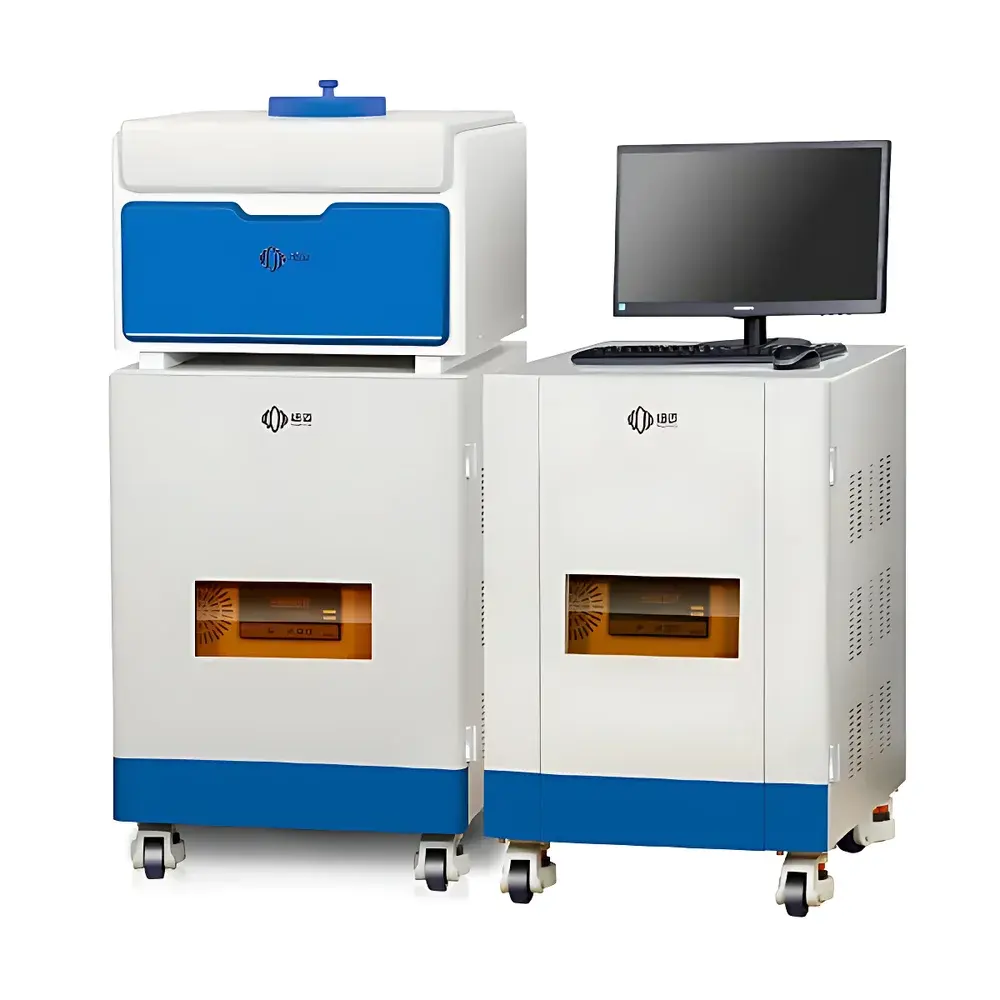
NIUMAG VTMR20-010V-8 Low-Field Nuclear Magnetic Resonance Analyzer for Crosslink Density Measurement in Elastomers
| Brand | NIUMAG |
|---|---|
| Origin | Jiangsu, China |
| Magnet Type | Permanent Magnet |
| Magnetic Field Strength | 0.5 ± 0.05 T |
| Sample Dimensions | Ø8.5 mm × H20 mm |
| Temperature Control Range | Ambient to 130 °C (standard), extended options available |
| Sample Type | Solid–Liquid Compatible |
| Instrument Category | Low-Field NMR Spectrometer |
| Model | VTMR20-010V-8 |
Overview
The NIUMAG VTMR20-010V-8 is a dedicated low-field nuclear magnetic resonance (LF-NMR) analyzer engineered for quantitative crosslink density assessment in elastomeric and polymeric materials. It operates on the fundamental principle of 1H transverse relaxation time (T2) measurement, exploiting the direct correlation between polymer chain mobility and local molecular dynamics. In crosslinked rubber networks, constrained segments exhibit rapid T2 decay due to restricted segmental motion, while unbound or loosely entangled chains display longer T2 components. By acquiring and deconvoluting multi-exponential T2 distributions—typically via inverse Laplace transform (ILT) of CPMG echo trains—the instrument enables non-invasive, physics-based quantification of crosslink density without chemical derivatization or destructive sampling. This approach aligns with ISO 17987:2021 (Rubber — Determination of crosslink density by NMR) and supports GLP-compliant workflows when integrated with audit-trail-enabled software.
Key Features
- Sub-60-second T2 acquisition: Single-scan CPMG sequences deliver reproducible T2 spectra in ≤30 s per sample, enabling high-throughput QC screening in production environments.
- Integrated temperature-controlled probe: Standard ambient-to-130 °C Peltier-based heating/cooling allows controlled thermal ramping and isothermal studies—critical for evaluating vulcanization kinetics, post-cure effects, and thermally induced network rearrangements.
- Permanent magnet architecture: 0.5 T permanent magnet eliminates cryogen dependency (no liquid N2/He), ensuring operational continuity, reduced infrastructure requirements, and near-zero consumable costs over instrument lifetime.
- Non-destructive solid–liquid compatibility: Accommodates raw rubber compounds, cured elastomer parts (e.g., tire treads, seals, hoses), gels, and swollen samples without solvent extraction or sectioning beyond minimal physical trimming (Ø8.5 mm × 20 mm).
- Multi-parameter NMR capability: Supports both T1 inversion-recovery and T2 CPMG measurements, facilitating complementary analysis of spin–lattice relaxation (related to energy exchange with lattice) and spin–spin relaxation (sensitive to local heterogeneity and mobility gradients).
Sample Compatibility & Compliance
The VTMR20-010V-8 accepts heterogeneous elastomer systems—including natural rubber (NR), styrene–butadiene rubber (SBR), ethylene–propylene–diene monomer (EPDM), silicone, fluorocarbon (FKM), and thermoplastic elastomers (TPEs). It is validated for use with filled systems (e.g., carbon black-, silica-, or clay-reinforced compounds) and formulations containing plasticizers, curatives, and antioxidants. Method development adheres to ASTM D8255–22 (Standard Guide for Low-Field NMR Characterization of Polymer Networks) and supports alignment with FDA 21 CFR Part 11 requirements when deployed with compliant software configurations. Data integrity is maintained through electronic signatures, user access control, and full audit trails for all acquisition, processing, and reporting events.
Software & Data Management
The proprietary MesoMR software suite provides end-to-end workflow management—from pulse sequence selection and parameter optimization to automated T2 distribution fitting, peak integration, and crosslink density calibration using reference standards (e.g., known-dose peroxide-cured EPDM). Raw FID and echo train data are stored in vendor-neutral formats (e.g., HDF5), enabling third-party reprocessing. Batch processing, statistical trend analysis (X̄–R charts), and export to LIMS-compatible CSV/XML formats support integration into enterprise QA/QC infrastructures. Software validation documentation (IQ/OQ/PQ protocols) and 21 CFR Part 11 compliance packages are available upon request.
Applications
- Real-time monitoring of sulfur/vulcanization accelerator efficiency during cure cycle development
- Quantitative comparison of crosslink density homogeneity across molded rubber components (e.g., detecting under-cured zones in thick-section parts)
- Accelerated aging studies: tracking network degradation via T2 shift and distribution broadening after thermal/ozone exposure
- Formulation screening: evaluating impact of filler type/loading, plasticizer migration, or co-agent addition on network topology
- Process validation: establishing NMR-based release criteria for rubber compounding lines and extrusion processes
- Educational use: illustrating polymer physics concepts including Flory–Rehner theory, free volume, and dynamic mechanical analogies in undergraduate and graduate laboratories
FAQ
How does LF-NMR crosslink density measurement compare to traditional swelling or DSC methods?
LF-NMR requires no solvents, avoids equilibrium swelling artifacts, and delivers spatially averaged molecular-level insight without thermal history interference—unlike DSC, which measures thermal transitions indirectly related to network constraints.
Can the system analyze irregularly shaped industrial parts?
Yes—samples are trimmed to fit the Ø8.5 mm × 20 mm cavity; representative sub-sampling is validated for bulk property correlation in ASTM D8255–22.
Is calibration required for each material type?
A single-point calibration using a reference material with known crosslink density (e.g., peroxide-cured standard) establishes the T2-to-density correlation; subsequent analyses use this transferable model.
What maintenance is required beyond routine cleaning?
None—permanent magnets require no field stabilization; temperature module calibration is recommended annually using traceable NIST-standard thermocouples.
Does the system support method transfer between instruments?
Yes—pulse sequence parameters, processing algorithms, and calibration models are fully exportable and reproducible across VTMR20-series platforms under identical environmental conditions.





