
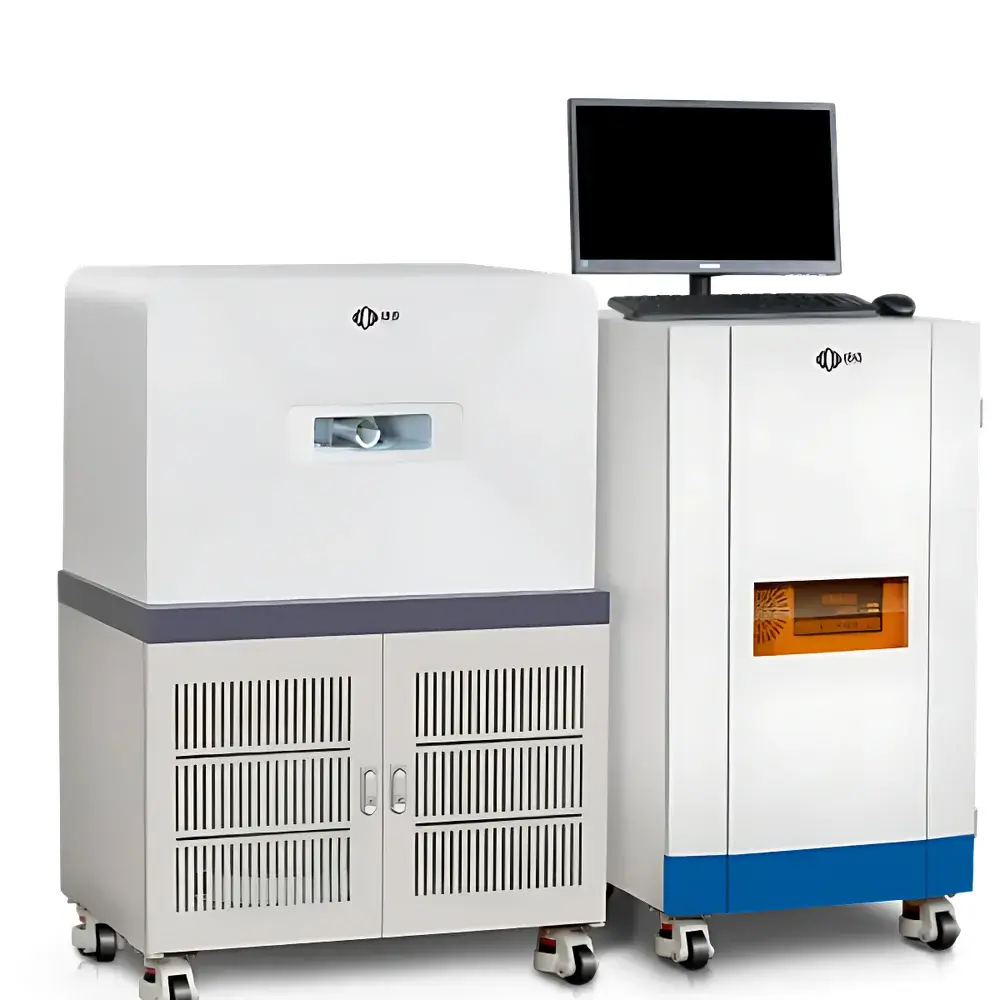
NIUMAG MesoMR Series Triaxial Rock NMR Imaging Analyzer
| Brand | NIUMAG |
|---|---|
| Origin | Jiangsu, China |
| Manufacturer Type | Authorized Distributor |
| Origin Category | Domestic |
| Model | MesoMR Series |
| Instrument Type | Low-Field Nuclear Magnetic Resonance Analyzer |
| Sample Compatibility | Solid–Liquid Dual-Phase |
| Operating Frequency | 21.3 MHz |
| Data Acquisition Method | Fourier Transform |
| Magnet Type | Permanent Magnet |
| Magnetic Field Strength | 0.5 ± 0.08 T |
| Probe Coil Diameter | 60 mm |
Overview
The NIUMAG MesoMR Series Triaxial Rock NMR Imaging Analyzer is a specialized low-field nuclear magnetic resonance (LF-NMR) platform engineered for in situ, non-invasive characterization of rock mechanical behavior under controlled thermo-hydro-mechanical (THM) coupling conditions. Unlike conventional benchtop NMR spectrometers, this system integrates a triaxial pressure cell—capable of applying independent confining and axial loads—within the homogeneous region of a permanent magnet (0.5 ± 0.08 T), enabling real-time acquisition of spin–lattice (T₁) and spin–spin (T₂) relaxation spectra and high-contrast NMR images during mechanical loading. The instrument operates at a Larmor frequency of 21.3 MHz, optimized for robust signal-to-noise performance in heterogeneous geological samples while maintaining thermal stability and long-term field homogeneity. Its Fourier-transform-based pulse sequence architecture supports standard CPMG, inversion-recovery, and diffusion-weighted acquisitions—essential for quantifying pore structure evolution, fluid saturation dynamics, microcrack propagation, and damage accumulation across multiple stress paths including monotonic compression, cyclic loading, and stress relaxation.
Key Features
- Integrated triaxial pressure cell with independent control of confining pressure (up to 70 MPa) and axial load (up to 100 kN), fully compatible with NMR signal acquisition
- Permanent magnet system offering stable field homogeneity (< 10 ppm over 30 mm DSV) and minimal thermal drift, eliminating cryogen dependency
- 60 mm diameter RF probe coil optimized for rock core diameters ranging from 25 mm to 50 mm (standard ASTM D4543 geometry)
- Real-time synchronized data logging: simultaneous recording of mechanical load/displacement, pore pressure, temperature, and NMR relaxation spectra
- Modular pulse programming interface supporting user-defined sequences for advanced contrast generation (e.g., T₁–T₂ correlation, diffusion–relaxation mapping)
- Ruggedized RF shielding and vibration-damping design to maintain spectral fidelity under dynamic mechanical actuation
Sample Compatibility & Compliance
The MesoMR Series accommodates cylindrical rock cores (25–50 mm diameter × 50–100 mm length), unconsolidated sediments, and synthetic porous media. It supports dual-phase analysis—simultaneous detection of bound water, movable water, hydrocarbon phases, and gas-saturated pores—via multi-echo T₂ distribution deconvolution. All hardware and software modules comply with ISO/IEC 17025:2017 requirements for testing laboratories, and data acquisition workflows are structured to support GLP-compliant audit trails per FDA 21 CFR Part 11 when paired with validated NIUMAG NMR Studio software. Instrument calibration protocols reference ASTM D6913 (particle-size distribution), ASTM D5550 (pore-size distribution via NMR), and ISO 10119 (rock permeability estimation using T₂ cutoff models).
Software & Data Management
NIUMAG NMR Studio v5.2 provides an integrated environment for pulse sequence design, real-time visualization of relaxation decay curves and 2D/3D NMR images, and automated quantification of porosity, irreducible water saturation, clay-bound water content, and pore-throat radius distribution. The software includes built-in modules for T₂ spectrum inversion using non-negative least squares (NNLS) with regularization, T₁–T₂ correlation analysis, and time-resolved image registration for tracking spatial damage progression. Raw FID data are stored in vendor-neutral HDF5 format with embedded metadata (sample ID, load history, temperature setpoint, RF gain), ensuring interoperability with MATLAB, Python (SciPy, scikit-learn), and third-party reservoir simulation platforms (e.g., CMG, PETREL). Audit logs record all parameter modifications, user logins, and export actions—fully traceable for regulatory review.
Applications
- Quantitative mapping of microcrack nucleation and coalescence during triaxial compression, correlated with T₂ shortening and amplitude loss in specific relaxation sub-populations
- In situ monitoring of water redistribution and capillary trapping under varying effective stress—critical for CO₂ sequestration and enhanced oil recovery modeling
- Multi-field coupling experiments: coupled thermal–mechanical–fluid flow effects on shale matrix swelling, kerogen–bitumen interaction, and hydrate dissociation kinetics
- Evaluation of chemical degradation mechanisms: acidizing, brine-induced clay migration, freeze–thaw cycling, and blast-induced fracturing via time-lapse T₂ imaging
- Calibration of digital rock physics (DRP) models using experimentally derived pore geometry constraints and fluid saturation states
FAQ
What is the minimum detectable pore size resolution achievable with this system?
The effective pore size resolution is governed by surface relaxivity and fluid saturation state; typical T₂ cutoff values range from 1–10 ms in sandstones and 0.1–2 ms in shales, corresponding to pore radii of ~0.1–10 µm under standard surface-to-volume ratio assumptions.
Can the system operate under elevated temperatures?
Yes—the triaxial cell supports temperature control from –20 °C to +80 °C using integrated Peltier and fluid-circulation modules, with NMR performance validated across this range.
Is remote operation supported for long-duration creep or fatigue tests?
Fully supported via secure SSH and VNC protocols; scheduled acquisition scripts can run unattended for up to 72 hours with automatic disk management and email alerts on anomalies.
How does the system handle magnetic susceptibility artifacts in iron-rich rocks?
The permanent magnet’s moderate field strength (0.5 T) inherently reduces susceptibility-induced line broadening compared to high-field systems; additionally, echo train optimization and post-processing phase correction mitigate residual distortions.
Are application-specific pulse sequences available for unconventional reservoir characterization?
Yes—NIUMAG provides validated sequences for clay typing (T₁–T₂–D correlation), kerogen saturation mapping, and gas–water differentiation in tight formations, all documented in peer-reviewed method notes (SPE 210212, AAPG Bulletin Vol. 107, No. 4).





