
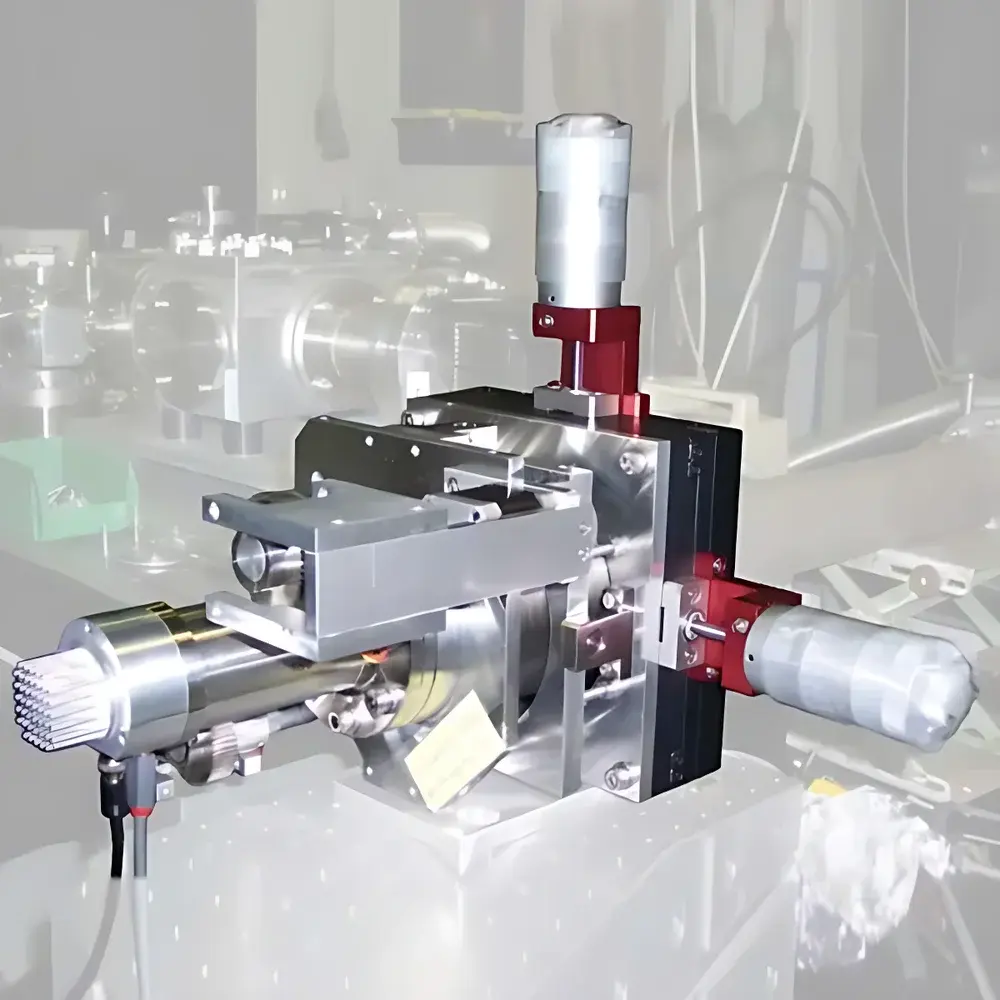
ProOpto DUV/EUV Hartmann-Shack Wavefront Sensor
| Brand | ProOpto |
|---|---|
| Origin | Germany |
| Model | DUV/EUV |
| Spectral Range | 190–1100 nm (with quantum conversion coating) |
| Field of View | 9 mm × 6.7 mm (customizable) |
| Dynamic Range | 14-bit |
| Hartmann Plate | precision pinholes Ø75 µm, 250 µm pitch |
| Tilt Range | ±10° |
| XY Adjustment Range | ±10 mm |
| UHV Compatibility | CF63 flange |
| Single-Pulse Repeatability (EUV) | λ/116 wrms at λ = 13.5 nm |
| Camera Support | >20 models |
Overview
The ProOpto DUV/EUV Hartmann-Shack Wavefront Sensor is a high-precision optical metrology instrument engineered for quantitative wavefront characterization of deep ultraviolet (DUV) and extreme ultraviolet (EUV) radiation sources. Operating on the well-established Hartmann-Shack principle, it employs a micro-lens array to sample the incident wavefront and reconstruct both phase distribution and intensity profile from a single exposure. This enables direct, non-intrusive measurement of beam propagation parameters—including beam divergence, focusability (M²), pointing stability, and wavefront aberrations—under conditions relevant to synchrotron beamlines, free-electron lasers (FELs), high-harmonic generation (HHG) systems, and EUV lithography (EUVL) plasma sources. Its design accommodates both coherent and partially coherent radiation, making it suitable for pulsed and CW operation across a broad spectral range—from 190 nm (deep UV) up to 1100 nm (NIR)—via interchangeable quantum conversion coatings optimized for photon detection efficiency in the DUV/EUV regime.
Key Features
- High-fidelity wavefront reconstruction with single-pulse repeatability of λ/116 wrms at 13.5 nm (EUV), validated in UHV environments such as FLASH (DESY, Hamburg) and LCLS (SLAC, Stanford)
- Modular micro-lens array platform supporting customizable lenslet pitch, focal length, and active area—enabling optimization for specific beam diameters and numerical aperture requirements
- UHV-compatible mechanical architecture with CF63 flange interface, rated for pressures down to 10⁻⁹ mbar, suitable for integration into FEL and EUVL source chambers
- Precision mechanical alignment stage with ±10 mm XY translation and ±10° tip/tilt adjustment, facilitating real-time optical alignment and feedback control loops
- 14-bit dynamic range imaging system compatible with over 20 scientific-grade camera models—including back-illuminated sCMOS and EMCCD sensors—optimized for low-light DUV/EUV detection
- Quantum conversion coating technology extending sensitivity below 190 nm, enabling reliable operation at 13.5 nm (EUV) and 1.5 nm (soft X-ray edge)
Sample Compatibility & Compliance
The sensor is designed for use with a wide range of radiation sources, including but not limited to: laser-produced plasma (LPP) and discharge-produced plasma (DPP) EUVL sources; seeded and self-amplified spontaneous emission (SASE) FELs; tabletop HHG systems; excimer lasers (e.g., ArF at 193 nm); and broadband DUV lamps. All core beam parameter measurements conform to internationally recognized ISO standards: beam diameter and M² (ISO 11146), beam profile flatness (ISO 13694), pointing stability (ISO 11670), and wavefront phase distribution (ISO 15367). The system supports GLP-compliant data acquisition workflows, with timestamped metadata, hardware-triggered synchronization, and audit-ready output formats for regulatory submissions under FDA 21 CFR Part 11 where applicable.
Software & Data Management
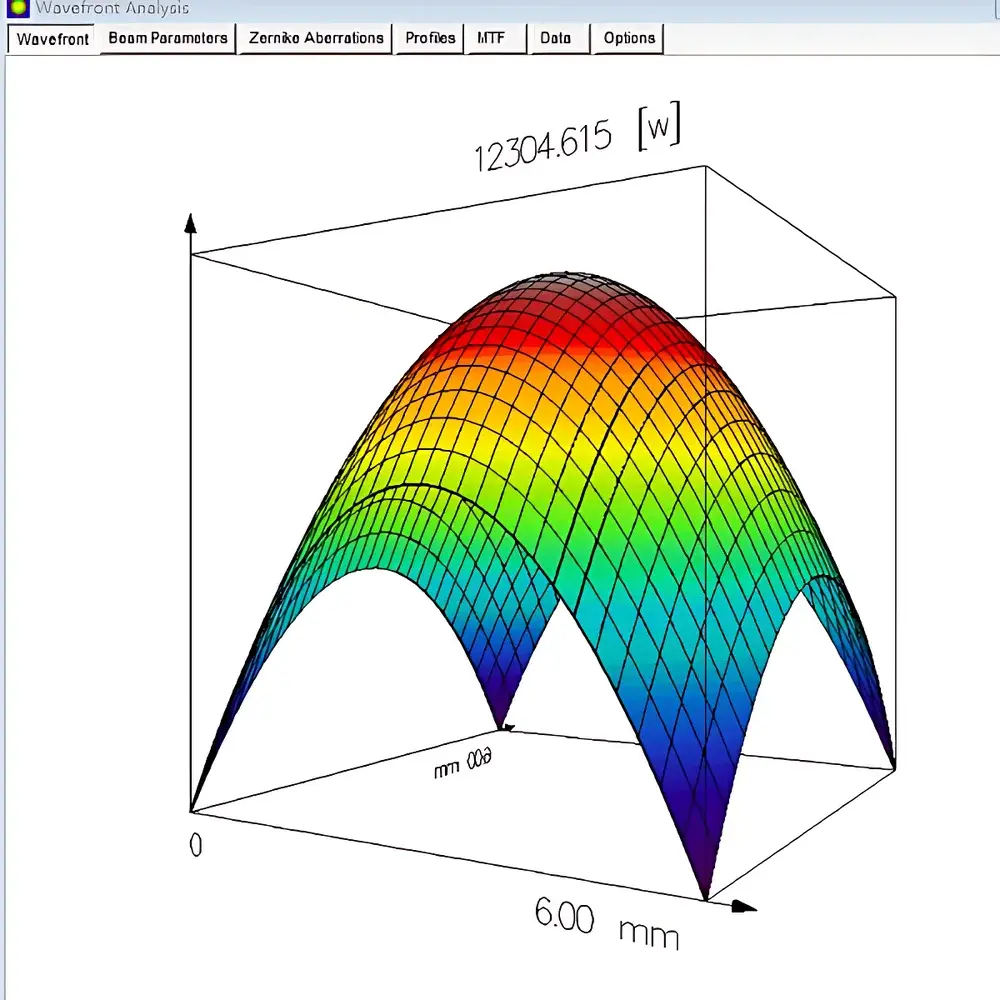
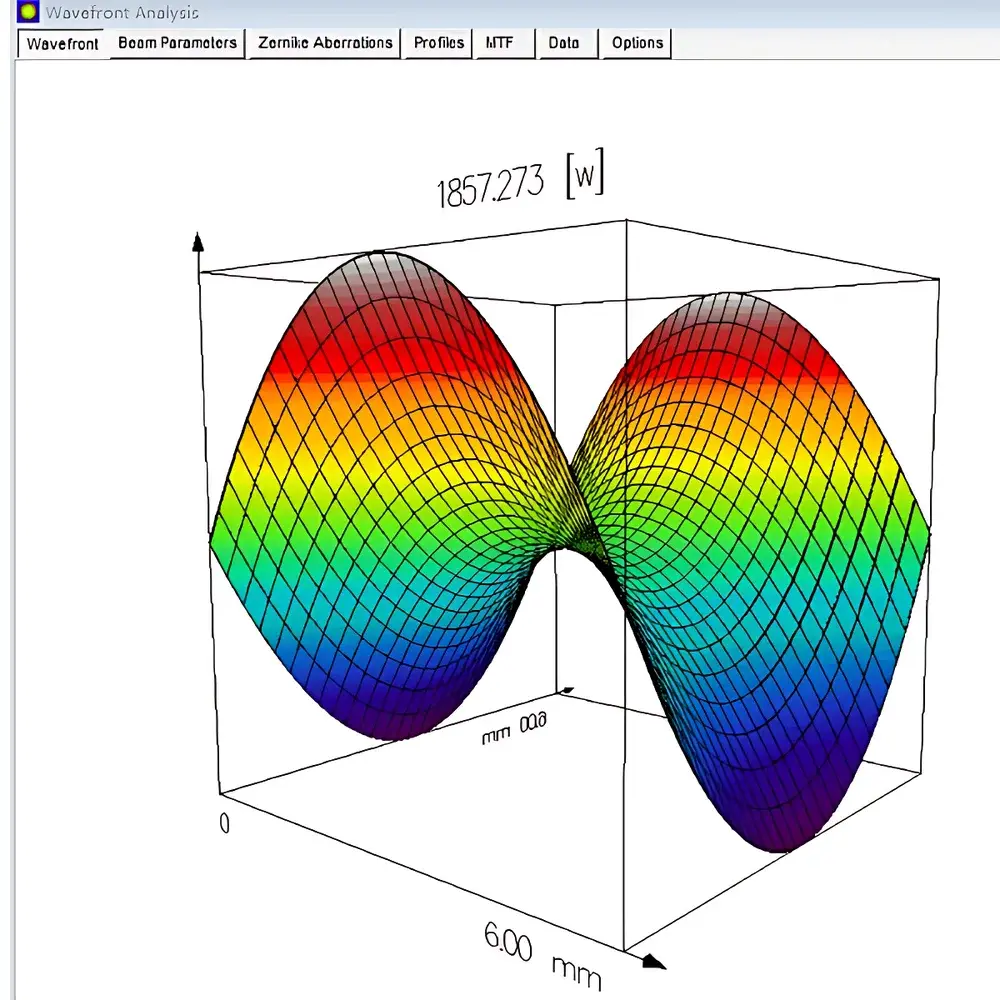
The included wavefront analysis software provides a modular, scriptable environment for real-time processing and post-acquisition evaluation. It delivers Zernike polynomial decomposition (up to 36 terms), RMS/PV wavefront error quantification, beam propagation simulation (via angular spectrum method), and M² calculation per ISO 11146-1/-2. Export options include HDF5, TIFF, CSV, and MATLAB .mat formats, ensuring compatibility with third-party analysis pipelines. The software architecture supports remote operation via TCP/IP, integrates with LabVIEW and Python APIs (PyProOpto SDK), and maintains full traceability of calibration history, sensor configuration, and environmental logs—essential for GMP-aligned optical testing laboratories.
Applications
- Wavefront monitoring and feedback control in EUVL scanner illumination systems
- Beamline commissioning and optics alignment at FEL facilities (e.g., FLASH, LCLS, European XFEL)
- Characterization of HHG sources for attosecond science and coherent diffractive imaging
- Quality assurance of DUV excimer laser delivery systems in semiconductor mask inspection tools
- Validation of adaptive optics correction in high-power DUV laser amplifiers
- Phase-resolved diagnostics of plasma-based EUV sources under varying discharge parameters
FAQ
What is the minimum detectable wavelength with standard quantum conversion coating?
Standard configurations support operation down to 13.5 nm (EUV) using boron carbide or silicon-based multilayer coatings; custom coatings are available for soft X-ray extension to 1.5 nm.
Is vacuum compatibility limited to CF63, or can other flange types be integrated?
CF63 is the default UHV interface; however, custom flange adapters (e.g., KF40, ISO100) are available upon request for integration into legacy beamline infrastructure.
Does the system support real-time closed-loop wavefront correction?
Yes—the sensor outputs centroid displacement data at up to 100 Hz (depending on camera readout speed) and provides native API access for integration with deformable mirrors and piezo-driven mirror mounts.
How is calibration traceability maintained across different wavelengths?
Each sensor ships with NIST-traceable calibration certificates for lenslet geometry, pixel scale, and quantum efficiency curves per coating type; recalibration services are offered annually or after major optical reconfiguration.
Can the software generate ISO-compliant test reports automatically?
Yes—predefined report templates comply with ISO 11146, ISO 15367, and ISO 13694 requirements and include pass/fail thresholds, uncertainty budgets, and digital signatures for QA sign-off.



