
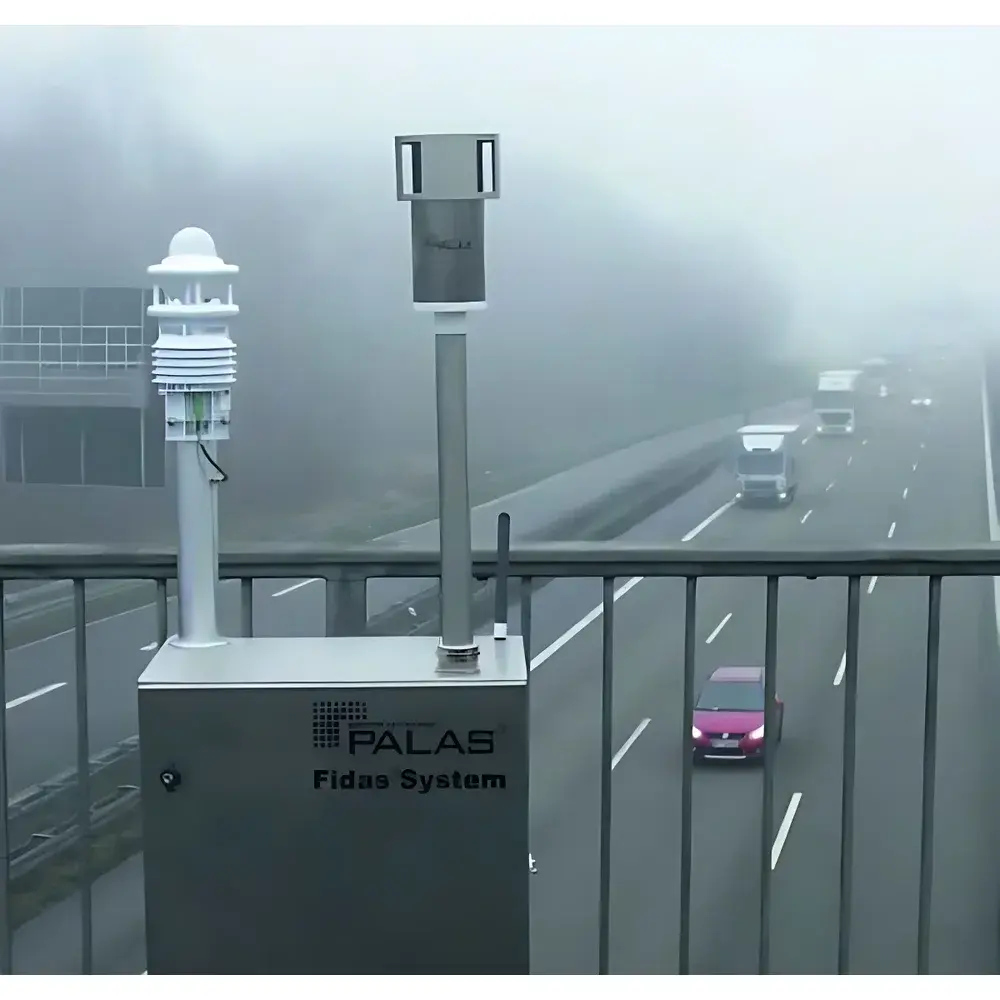
Palas Fidas 200 Environmental Air Particulate Matter Continuous Automatic Monitoring System
| Brand | Palas |
|---|---|
| Origin | Germany |
| Model | Fidas 200 |
| Certification | EN 16450-compliant |
| Measurement Principle | Single-particle optical aerosol spectrometry (OPC) |
| PM Metrics | Simultaneous real-time PM₂.₅ and PM₁₀ mass concentration |
| Particle Count & Size Distribution | 18 size channels from 0.17–19.2 µm |
| Time Resolution | Adjustable from >1 s to 24 h |
| Light Source | High-stability, long-life LED |
| Data Availability | >99% uptime |
| Compliance | EN 15267-3 type approval, EN 16450 reference equivalent |
Overview
The Palas Fidas 200 is a certified environmental air particulate matter continuous automatic monitoring system engineered for regulatory-grade compliance and scientific rigor in ambient air quality surveillance. It employs single-particle optical aerosol spectrometry (OPC), a physically grounded measurement principle wherein individual airborne particles pass through a focused LED light beam; scattered light intensity is detected and converted into aerodynamic particle diameter via Mie theory-based calibration. Unlike beta attenuation or tapered element oscillating microbalance (TEOM) methods, the Fidas 200 delivers simultaneous, real-time mass concentration data for both PM₂.₅ and PM₁₀—without reliance on empirical correction factors or gravimetric post-processing. Its design adheres strictly to EN 16450:2017, which defines performance requirements for automated measuring systems used in ambient air quality monitoring networks across the European Union. As an EN 15267-3 Type Approved instrument, it satisfies the metrological traceability, stability, and uncertainty criteria required for official reporting under Directive 2008/50/EC.
Key Features
- EN 16450-compliant real-time measurement of PM₂.₅ and PM₁₀ mass concentrations with independent sensor architecture for dual-channel validation
- Integrated particle number concentration and full size distribution output across 18 logarithmically spaced channels (0.17–19.2 µm aerodynamic diameter)
- Adjustable time resolution—from sub-second event capture (>1 s integration) to daily averaged outputs (up to 24 h)—enabling flexible deployment in both episodic and baseline monitoring scenarios
- Dual redundant sampling pumps ensuring uninterrupted operation and fail-safe continuity during maintenance or pump failure
- Self-monitoring system diagnostics with real-time display of operational status, flow integrity, optical alignment, and calibration validity
- Radiation-free LED light source offering >50,000 hours of stable illumination life, eliminating licensing, shielding, and disposal concerns associated with beta sources
- Field-verifiable calibration protocol compliant with EN 15267-3 Annex C, supporting on-site traceable verification using NIST-traceable polystyrene latex (PSL) standards
- Web-enabled remote access and control via embedded Ethernet interface and secure cloud synchronization through the Palas Server platform
Sample Compatibility & Compliance
The Fidas 200 is validated for outdoor ambient air sampling under representative environmental conditions—including temperature ranges from −30 °C to +50 °C and relative humidity up to 95% non-condensing. Its inlet configuration meets EN 12341:2014 specifications for PM₁₀ and PM₂.₅ sampling heads, ensuring isokinetic aspiration and minimal particle loss across wind speeds up to 10 m/s. The system complies with EU Reference Equivalent status per EN 16450, enabling direct comparability with gravimetric reference methods in official air quality networks. It supports GLP-aligned data handling with audit-trail-capable firmware, fulfilling foundational requirements for regulatory submissions under national implementation plans aligned with the EU Ambient Air Quality Directives. While not intrinsically FDA 21 CFR Part 11 compliant, its data export structure (CSV, XML, JSON) and metadata-rich output facilitate integration into validated LIMS or ELN environments governed by GxP frameworks.
Software & Data Management
Data acquisition and visualization are managed via the Palas Fidas Control Center software, a Windows-based application supporting local configuration, real-time dashboarding, alarm thresholds, and scheduled report generation. All raw scatter pulse data, size-resolved counts, and derived mass concentrations are timestamped with UTC-synchronized precision and stored in a structured SQLite database. Export formats include ISO 8601-compliant CSV files with embedded metadata (instrument ID, calibration date, flow rate, temperature/humidity), facilitating seamless ingestion into national air quality databases such as EEA’s AirBase or EPA’s AQS. Remote firmware updates and parameter reconfiguration are supported over TLS-secured connections. Optional integration with third-party SCADA platforms (e.g., Ignition, Siemens Desigo) is available via Modbus TCP or OPC UA gateways.
Applications
- Regulatory compliance monitoring within national and municipal air quality monitoring networks (AQMN)
- Source apportionment studies leveraging temporal correlation between particle number concentration spikes and localized emission inventories
- Long-term epidemiological research linking ultrafine particle exposure (UFPs < 100 nm) to respiratory morbidity endpoints
- Emergency response monitoring during industrial accidents, wildfire plumes, volcanic ash dispersion, or dust storm events
- Urban background and traffic-oriented site characterization with high-temporal-resolution particle dynamics analysis
- Validation of numerical atmospheric dispersion models (e.g., CALPUFF, WRF-Chem) using spatially resolved size distribution inputs
FAQ
Is the Fidas 200 suitable for unattended operation in remote locations?
Yes—the system features industrial-grade enclosure options (Fidas 200S for all-weather cabinet installation), dual-pump redundancy, low-power consumption (<35 W average), and cellular or satellite telemetry readiness via optional gateway modules.
Does it require annual factory recalibration?
No—its optical calibration is stable over time and can be verified on-site using PSL reference aerosols. Full metrological recalibration is recommended every 24 months or after major component replacement.
Can it distinguish between dust, soot, and sea salt particles?
Not chemically—but its high-resolution size distribution (18 channels) combined with hygroscopic growth factor modeling allows for probabilistic classification when integrated with co-located meteorological and gaseous pollutant data.
What is the minimum detectable particle concentration?
At 1-minute averaging, the limit of detection for PM₂.₅ is ≤0.3 µg/m³ under typical urban background conditions, validated against gravimetric reference samplers per EN 12341 Annex B protocols.
How does it handle high-humidity environments?
The heated inlet option (standard on Fidas 200S) maintains sample line temperature above dew point, minimizing water droplet interference and hygroscopic bias in sub-micrometer particle sizing.
Related Products







