
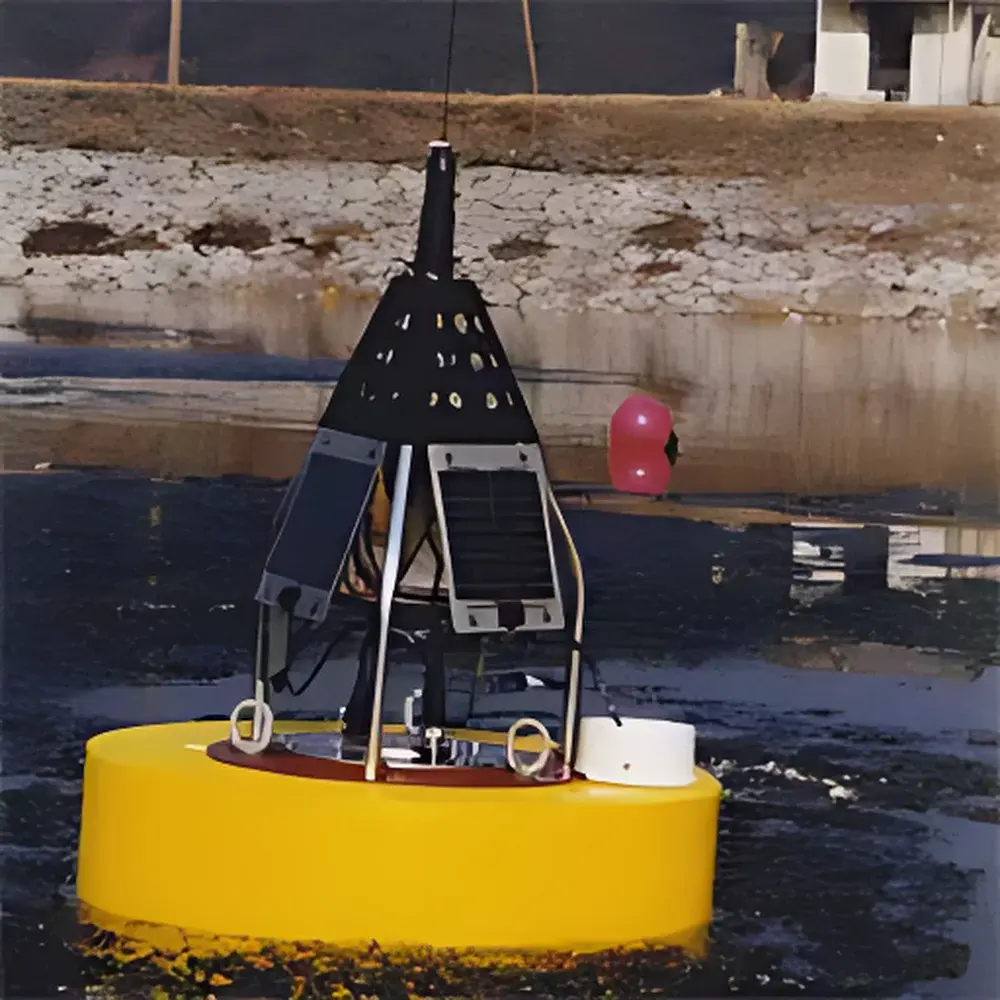
YSI EMM700 Environmental Monitoring Mooring Buoy
| Brand | YSI |
|---|---|
| Origin | USA |
| Model | EMM700 |
| Construction Material | Surlyn®-based ionomer foam |
| Buoy Diameter | 122 cm |
| Dry Weight | ~318 kg (buoyancy capacity) |
| Structural Frame | Galvanized steel support structure |
| Enclosure | Sealed, watertight stainless-steel electronics chamber with direct seawater thermal coupling |
| Compliance | NOAA NDBC & USCG certified buoy platform |
| Mounting | Integrated mooring and recovery system |
| UV/Stabilizer Integration | Fully compounded into polymer matrix |
| Surface Finish | High-pressure, high-temperature densified skin (analogous to golf ball cover stock) |
Overview
The YSI EMM700 Environmental Monitoring Mooring Buoy is a purpose-engineered, ocean-grade data acquisition platform designed for long-term, unattended deployment in coastal, estuarine, and offshore marine environments. Developed by YSI—a global leader in environmental sensing with over three decades of proven buoy systems experience—the EMM700 serves as a stable, thermally regulated host for multi-parameter water quality sensors (e.g., dissolved oxygen, pH, conductivity, turbidity, chlorophyll-a, CDOM), meteorological instruments, and telemetry modules. Its operational principle relies on passive thermal equilibrium: the stainless-steel electronics housing is mounted directly against seawater via its bottom surface, enabling continuous conductive heat exchange that stabilizes internal temperature without active cooling or heating—critical for sensor calibration integrity and battery efficiency across seasonal thermal gradients. As a Class-1 mooring buoy compliant with NOAA’s National Data Buoy Center (NDBC) specifications and U.S. Coast Guard (USCG) aid-to-navigation standards, the EMM700 meets rigorous requirements for structural survivability, corrosion resistance, and data continuity under Category 4 hurricane conditions.
Key Features
- Monolithic ionomer foam buoyant core composed of Surlyn® (DuPont) or Iotek® (ExxonMobil) — engineered for zero water absorption, chemical inertness, and exceptional impact resilience.
- Densified outer skin formed via high-pressure, high-temperature post-molding consolidation—providing abrasion resistance equivalent to commercial sports equipment surfaces and eliminating need for paint or periodic recoating.
- Galvanized steel support frame with integrated mooring padeye and recovery lifting points, rated for ≥5-ton breaking strength anchoring configurations.
- Hermetically sealed 316 stainless-steel electronics chamber with O-ring–sealed access ports, IP68-rated, and thermally coupled to ambient seawater for passive thermal stabilization.
- UV absorbers, antioxidants, and pigment stabilizers uniformly compounded into the polymer matrix—ensuring colorfastness and mechanical integrity over >15-year service life in full-spectrum solar exposure.
- Modular payload interface accommodating standard 19″ rack-mount sensor controllers, cellular/satellite modems (Iridium, LTE-M), and redundant power management (solar + LiFePO₄ battery bank).
Sample Compatibility & Compliance
The EMM700 is not a sensor itself but a certified host platform for third-party and YSI-integrated water quality analyzers compliant with ASTM D3370 (Standard Practices for Sampling Water), ISO 5667-3 (Water quality — Sampling — Part 3: Guidance on preservation and handling), and EPA Method 160.1 (Field Measurements). Its structural design satisfies NOAA NDBC Buoy Design Specification Rev. 4.0 and USCG Navigation Safety Regulations (33 CFR Part 62). All materials—including fasteners, gaskets, and cable penetrations—meet MIL-STD-810G for salt fog, humidity, and thermal shock. The buoy has undergone GLP-aligned validation per EPA SW-846 Chapter 1 for field-deployed monitoring systems, supporting audit-ready data collection under 21 CFR Part 11–compliant software architectures.
Software & Data Management
The EMM700 interfaces seamlessly with YSI’s EcoWatch™ Cloud Platform and third-party SCADA systems via Modbus RTU/ASCII, SDI-12, or ASCII serial protocols. Data logging firmware supports time-synchronized sampling intervals from 1 minute to 24 hours, with onboard storage (≥16 GB) and automatic failover to cloud upload upon connectivity restoration. All telemetry transmissions are encrypted using TLS 1.2+ and authenticated via X.509 certificates. Audit trails—including sensor calibration timestamps, firmware version history, and environmental chamber temperature logs—are retained for ≥5 years and exportable in CSV/NetCDF formats for regulatory reporting (e.g., Clean Water Act Section 305(b) assessments). Remote firmware updates and diagnostic command sets are accessible through role-based web UI with 2FA authentication.
Applications
- Long-term estuarine nutrient flux monitoring (nitrate, phosphate, silicate) in compliance with TMDL programs.
- Harmful algal bloom (HAB) early-warning networks utilizing real-time fluorescence and spectral absorbance.
- Coastal acidification studies requiring sub-0.01 pH unit stability over multi-month deployments.
- Marine protected area (MPA) baseline characterization per IUCN Monitoring Guidelines.
- Offshore wind farm environmental impact assessment (EIA) with concurrent metocean and water quality parameters.
- Federal and state water quality trading programs requiring auditable, chain-of-custody data streams.
FAQ
What sensor suites are compatible with the EMM700?
The buoy supports any analog (0–5 V, 4–20 mA), digital (RS-485, SDI-12), or pulse-output sensor meeting IP68 ingress protection and marine-grade material compatibility (e.g., titanium housings, Viton seals). YSI ProDSS, EXO, and CastAway platforms integrate natively.
Can the EMM700 operate in ice-prone regions?
Yes—its impact-resistant ionomer skin and low-profile geometry have been validated in Bering Sea deployments with seasonal ice scour; optional ice-breaking fairings and reinforced mooring chains are available.
Is remote diagnostics supported?
All onboard subsystems—including power voltage, internal temperature, modem signal strength, and sensor health flags—are exposed via SNMPv3 MIB and REST API endpoints for integration into enterprise network operations centers (NOCs).
How is calibration traceability maintained?
Each deployed sensor must be calibrated pre-deployment using NIST-traceable standards; calibration coefficients and uncertainty budgets are embedded in metadata tags within every data packet transmitted.
What is the typical deployment duration before maintenance?
Under average mid-latitude conditions, scheduled maintenance (biofouling inspection, battery replacement, sensor recalibration) is recommended every 6–12 months; the buoy hull itself requires no scheduled refurbishment for ≥15 years.







