
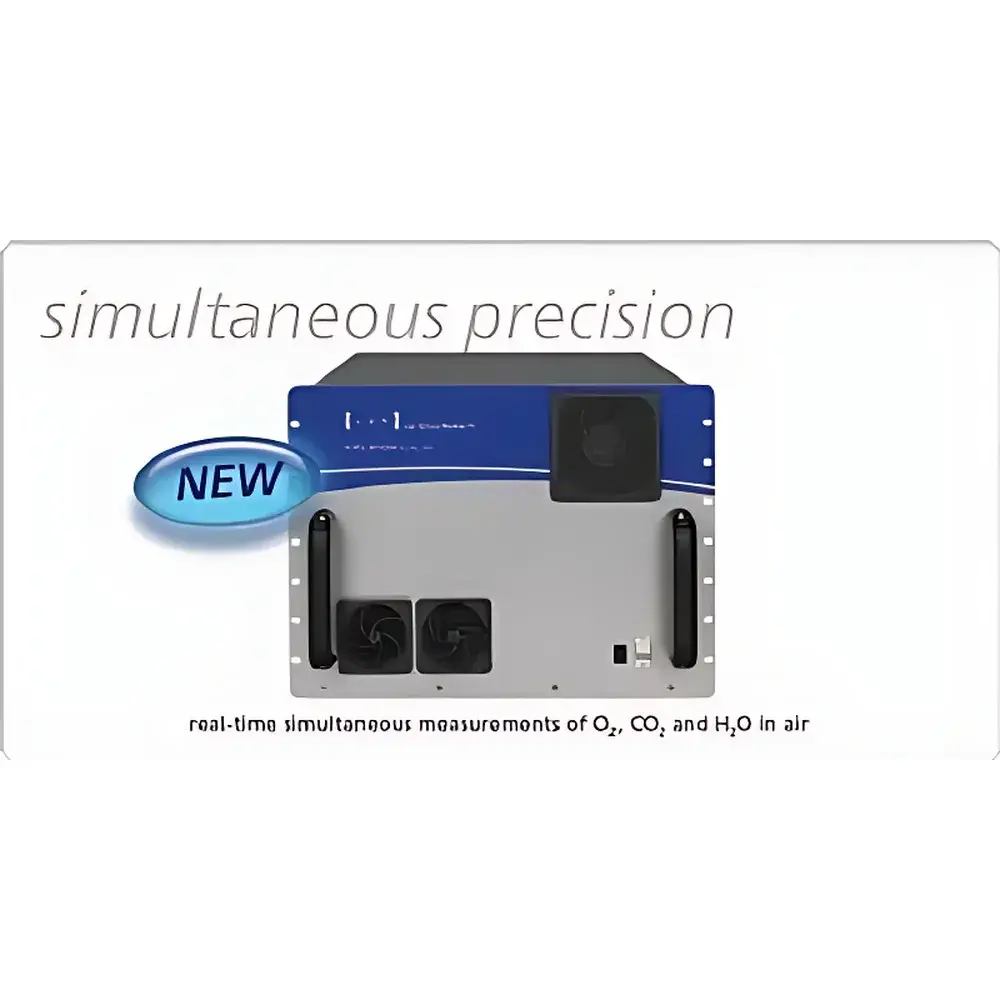
Los Gatos Research 911-0035 O₂/CO₂/H₂O Analyzer
| Origin | USA |
|---|---|
| Manufacturer Type | Authorized Distributor |
| Origin Category | Imported |
| Model | 911-0035 |
| Pricing | Available Upon Request |
Overview
The Los Gatos Research 911-0035 O₂/CO₂/H₂O Analyzer is a high-precision, field-deployable trace gas analyzer engineered for continuous, simultaneous measurement of oxygen (O₂), carbon dioxide (CO₂), and water vapor (H₂O) in ambient air. It employs Off-Axis Integrated Cavity Output Spectroscopy (OA-ICOS), a patented laser absorption spectroscopy technique that delivers exceptional sensitivity, stability, and spectral resolution. Unlike conventional NDIR or electrochemical sensors, OA-ICOS utilizes a thermally stabilized high-finesse optical cavity with ultra-low-loss mirrors to achieve effective path lengths exceeding 1 km within a compact footprint—enabling detection limits in the sub-ppb range for CO₂ and sub-ppm for O₂ and H₂O. The instrument is specifically designed for atmospheric science applications requiring rigorous quantification under variable environmental conditions, including eddy covariance flux studies, soil respiration chambers, atmospheric boundary layer profiling, and calibration transfer validation. Its ability to output dry-mole-fraction concentrations—without external drying or post-acquisition correction—is rooted in real-time spectroscopic modeling of pressure-broadening and water-dilution effects directly from acquired absorption spectra.
Key Features
- Simultaneous, real-time quantification of O₂, CO₂, and H₂O using a single OA-ICOS optical platform
- Direct output of dry-mole-fraction concentrations—no post-processing or physical sample drying required
- Integrated temperature-stabilized cavity and precision wavelength control to minimize drift (<120 ppb CO₂ over 24 h)
- Onboard Linux-based embedded computer for autonomous data logging, time synchronization (NTP), and local storage (≥32 GB SSD)
- Remote operation via Ethernet: web-based GUI, SSH access, and RESTful API for integration into networked observatory systems
- Configurable measurement rate from 0.01 Hz to 1 Hz; <6 s system response time with optional vacuum pump (N920)
- Rack-mount form factor (35.6 × 48.3 × 61 cm; 40 kg) with industrial-grade I/O: RS-232, analog (0–5 V / 4–20 mA), USB 2.0, and Gigabit Ethernet
- Full spectral acquisition mode enables real-time viewing of raw absorption features for diagnostic validation and interference screening
Sample Compatibility & Compliance
The 911-0035 is validated for use with ambient air, chamber headspace gases, and low-particulate sampled streams across temperatures from –10 °C to +50 °C and relative humidity up to 100% RH (non-condensing). It complies with fundamental requirements of ISO 14644-1 (cleanroom air classification support), ASTM D6348 (standard test method for gaseous emissions by FTIR), and supports GLP/GMP-aligned workflows through audit-trail-capable data logging. While not certified for hazardous area installation (e.g., ATEX/IECEx), its design meets UL 61010-1 and CE marking directives for laboratory and field environmental instrumentation. All firmware and data handling protocols are compatible with FDA 21 CFR Part 11 requirements when deployed with validated LGR Data Acquisition Software (Model 904-0002).
Software & Data Management
The analyzer ships with factory-installed Linux OS and LGR’s proprietary acquisition suite, supporting synchronized timestamping (GPS-optional), multi-instrument aggregation (e.g., co-located anemometers, spectrometers, or GPS units), and configurable metadata tagging. Data are stored in HDF5 format—self-describing, compressible, and interoperable with Python (h5py), MATLAB, and NetCDF ecosystems. Remote users can initiate diagnostics, adjust averaging windows, trigger calibration sequences, and export spectral snapshots via secure HTTPS interface. Optional Data Acquisition Software (904-0002) extends functionality with automated QA/QC flagging, linear drift correction routines, and export to CF-compliant NetCDF for submission to ICOS, AmeriFlux, or FLUXNET repositories.
Applications
- Atmospheric flux measurements using closed- or open-path chamber systems
- Soil CO₂ efflux and O₂ depletion kinetics in biogeochemical incubation studies
- Calibration verification of reference gas standards and secondary transfer standards
- Long-term monitoring of urban background air quality and greenhouse gas baseline stations
- Validation of satellite-based column-integrated XCO₂/XO₂ retrievals (e.g., OCO-2, TROPOMI)
- Process control in controlled-environment agriculture and vertical farming facilities
- Carbon capture utilization and storage (CCUS) site atmospheric surveillance
FAQ
Does the 911-0035 require external drying or permeation dryers for accurate dry-mole-fraction reporting?
No. The instrument applies first-principles spectroscopic correction for H₂O dilution and pressure broadening in real time, enabling native dry-mole-fraction output without hardware-based drying.
Can the analyzer operate unattended for extended periods in remote field sites?
Yes. With its low-power architecture (150 W max), internal data storage, and Ethernet/SSH remote management, it supports year-round deployment in off-grid locations when paired with appropriate power conditioning and environmental enclosures.
Is spectral raw data accessible for custom analysis or third-party algorithm development?
Yes. Full-resolution absorption spectra (wavenumber vs. intensity) are available via API or local file export for advanced spectral fitting, interference identification, or machine learning model training.
What multi-gas sampling configurations are supported?
Up to 16 channels via optional 16-channel multiplexer (Model 908-0003-9001), enabling spatially distributed flux networks or parallel chamber comparisons with shared optical core.
How is long-term calibration stability maintained?
The OA-ICOS cavity is actively temperature-controlled to ±0.01 °C; zero/span verification is performed using certified reference gases, and drift compensation algorithms leverage stable water vapor absorption features as internal baselines.







