
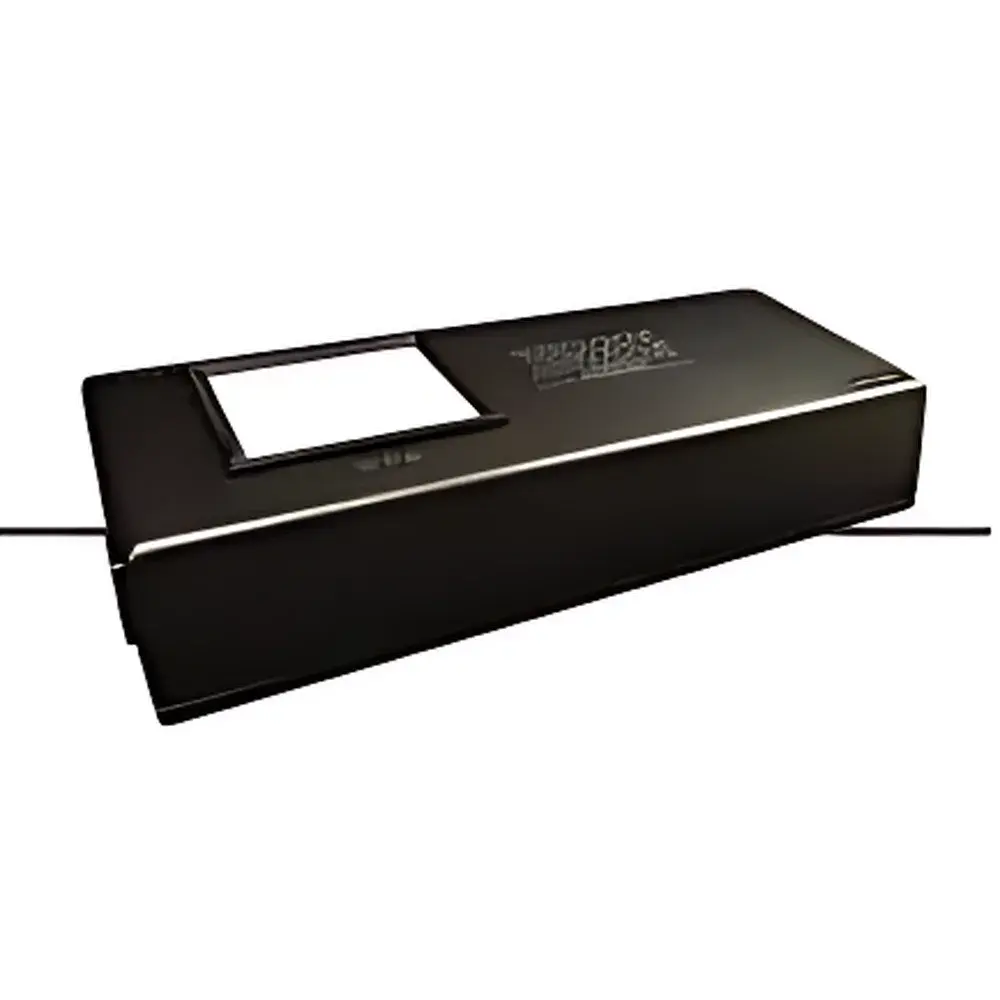
LGR DLT-100 / RMT-200 Fast Methane Analyzer
| Brand | LGR |
|---|---|
| Origin | USA |
| Model | DLT-100 (Benchtop), RMT-200 (Portable) |
| Detection Principle | Off-Axis Integrated Cavity Output Spectroscopy (Off-Axis ICOS) |
| Measurement Range | 0.3–25 ppm CH₄ |
| Precision | 1 ppb @ 1 Hz (ambient conditions) |
| Response Time | <0.05 s (with external pump), 25 s (internal pump) |
| Accuracy | Better than ±1% of reading |
| Operating Temperature | 0–50 °C |
| Relative Humidity | <98% RH, non-condensing |
| Data Output | RS-232, Analog (0–10 V / 4–20 mA), Ethernet |
| Data Storage | Internal 20 GB HDD + 12.1" color TFT display |
| Power | 115/230 V AC, 50/60 Hz, 80 W (excl. optional external pump) |
| Dimensions (Benchtop) | 25.4 × 96.5 × 35.56 cm |
| Dimensions (Portable) | 22.2 × 48.26 × 60.9 cm |
| Weight | 27 kg |
| Compliance | Designed for field-deployable, unattended operation |
Overview
The LGR DLT-100 and RMT-200 Fast Methane Analyzers are high-performance, field-deployable trace gas analyzers engineered for quantitative, real-time methane (CH₄) concentration measurement in environmental monitoring, eddy covariance flux studies, chamber-based emission quantification, and natural gas infrastructure leak detection. These instruments utilize Off-Axis Integrated Cavity Output Spectroscopy (Off-Axis ICOS), a robust laser absorption technique that eliminates pressure broadening effects and cross-interference from ambient water vapor, carbon dioxide, and other common atmospheric constituents. Unlike conventional multi-pass cells—limited to path lengths under 200 m—the Off-Axis ICOS cavity employs ultra-high-reflectivity mirrors (R > 99.999%) to achieve effective optical path lengths exceeding 2.5 km within a compact 25 cm physical cavity. This enables sub-part-per-trillion sensitivity and exceptional signal-to-noise ratio without calibration drift or reliance on reference gases. The analyzer operates autonomously with an embedded industrial computer, supporting continuous unattended deployment for weeks or months in remote locations.
Key Features
- Real-time measurement at up to 20 Hz data acquisition rate—optimized for turbulent flux applications requiring high temporal resolution
- Pressure-insensitive detection: no correction required for barometric fluctuations; inherently stable under variable field conditions
- Zero cross-sensitivity to H₂O, CO₂, N₂O, and O₂—eliminates need for drying or scrubbing pre-treatment
- Dual configuration options: benchtop DLT-100 (908-0001) for fixed-site monitoring and portable RMT-200 (907-0001) for mobile surveys and rapid deployment
- Integrated data handling: 20 GB internal solid-state storage, 12.1″ sunlight-readable TFT display, and timestamped binary logging compliant with FAIR data principles
- Flexible power architecture: accepts 115/230 V AC input; optional DC conversion kits available for battery- or solar-powered operation
- Multi-interface connectivity: simultaneous analog (0–10 V / 4–20 mA), RS-232 serial, and 10/100BASE-T Ethernet output for integration into SCADA, CR1000X, or Picarro-style data acquisition networks
Sample Compatibility & Compliance
The DLT-100 and RMT-200 are validated for direct analysis of ambient air, soil gas extracts, headspace samples, and pipeline-grade natural gas streams (diluted to safe operating range). Sample inlet configurations support both low-flow (2 L/min) active pumping via optional external diaphragm pump. All wetted materials—including 3/8″ and 1/2″ Swagelok fittings (DLT-100) and 1/4″ stainless steel tubing (RMT-200)—are electropolished 316 SS or PFA-lined to prevent adsorption or catalytic decomposition of CH₄. The system meets electromagnetic compatibility requirements per IEC 61326-1 and is rated for continuous operation in IP20 environments (indoor or sheltered outdoor enclosures). While not certified as intrinsic safety (ATEX/IECEx), it is routinely deployed in Class I, Division 2 zones when housed in explosion-proof cabinets per NFPA 70 and API RP 500 guidelines. Data integrity conforms to GLP/GMP-aligned audit trails, supporting 21 CFR Part 11 compliance when paired with validated third-party software platforms.
Software & Data Management
LGR’s proprietary AcqView™ software provides local instrument control, real-time spectral visualization, and automated baseline correction using cavity ring-down-derived mirror loss metrics. Raw absorbance spectra, calibrated concentration time series, cavity pressure/temperature logs, and diagnostic flags are written to timestamped .csv and HDF5 files. Export modules support CF-1.6 metadata conventions for interoperability with FluxNet, AmeriFlux, and ICOS ERIC data portals. Remote access is enabled via SSH or HTTPS-enabled web interface, permitting firmware updates, parameter reconfiguration, and log retrieval without physical intervention. All stored data include embedded GPS coordinates (when connected to external GNSS receiver), instrument serial number, and user-defined site identifiers—ensuring full traceability per ISO/IEC 17025 documentation requirements.
Applications
- Eddy covariance CH₄ flux measurements over wetlands, rice paddies, landfills, and permafrost regions
- Static and dynamic chamber-based quantification of soil-atmosphere exchange in agricultural and ecological research
- Mobile mapping of fugitive emissions along transmission pipelines, compressor stations, and distribution networks
- Calibration transfer validation for open-path FTIR and drone-mounted miniaturized sensors
- Long-term background monitoring at GAW (Global Atmosphere Watch) and ACTRIS (Aerosols, Clouds, and Trace gases Research Infrastructure) stations
- Method validation studies supporting EPA AP-42, IPCC Tier 3 inventory reporting, and EU MRV (Monitoring, Reporting, Verification) frameworks
FAQ
What distinguishes Off-Axis ICOS from traditional TDLAS or CRDS?
Off-Axis ICOS decouples cavity resonance from beam alignment constraints, enabling stable long-path operation without active cavity locking—critical for vibration-prone field deployments.
Can the analyzer measure CH₄ and CO₂ simultaneously?
No—the DLT-100/RMT-200 are dedicated CH₄ analyzers. For dual-species capability, LGR offers the UC-100 or MGGA-200 series with co-located, independently tuned lasers.
Is pressure compensation required during altitude changes?
No. Off-Axis ICOS is intrinsically insensitive to total pressure variation due to its direct absorption depth quantification method.
How is zero/span verification performed in the field?
Factory-calibrated response eliminates routine zero/span checks; however, optional automated valve manifolds support periodic injection of certified standard gases (NIST-traceable) for QA/QC auditing.
What maintenance intervals are recommended?
Mirror reflectivity degradation is negligible over 5+ years; primary maintenance involves annual inspection of inlet filters, pump membranes (if used), and desiccant cartridges in humid environments.







