
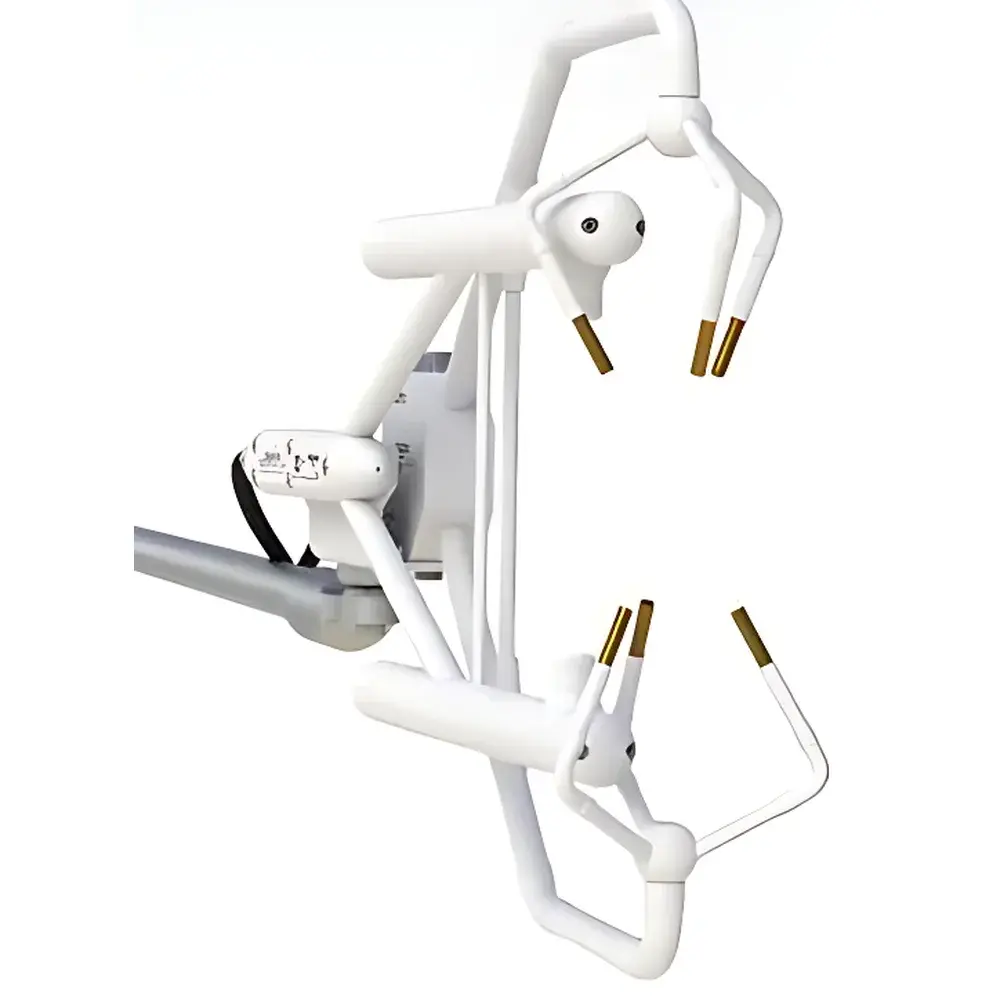
EC150 Open-Path Eddy Covariance System
| Brand | Campbell |
|---|---|
| Origin | USA |
| Model | EC150 |
| Measurement Principle | Open-path infrared absorption (CO₂/H₂O) + ultrasonic anemometry (3D wind, sonic temperature) |
| Output Frequency | Up to 60 Hz |
| Bandwidth | 20 Hz |
| Power Consumption | Low-power design suitable for solar-powered operation |
| Environmental Rating | Outdoor-rated, rain-resistant housing with hydrophobic mesh and angled optical windows |
| Calibration | Factory-calibrated for CO₂, H₂O, air temperature, barometric pressure, and sonic temperature across wide operational ranges |
| Compatibility | Native integration with Campbell Scientific dataloggers (CR6, CR1000X, etc.) for configuration, zero/span adjustment, diagnostics, and real-time data streaming |
| Diagnostic Capabilities | Comprehensive internal diagnostics including signal strength, window contamination index, path alignment status, and transducer health monitoring |
| Compliance | Designed to meet field requirements for FLUXNET, AmeriFlux, ICOS, and other long-term eddy covariance networks adhering to AmeriFlux/ICOS Best Practices and ISO 17025 traceable calibration protocols |
Overview
The EC150 Open-Path Eddy Covariance System is a rigorously engineered, field-deployable instrument suite developed by Campbell Scientific for high-temporal-resolution measurement of turbulent fluxes of carbon dioxide (CO₂), water vapor (H₂O), sensible heat, and momentum in atmospheric boundary layer research. It operates on the eddy covariance principle—relying on fast, synchronous sampling of vertical wind velocity (w) and scalar gas concentrations (e.g., CO₂, H₂O) to compute covariance-based fluxes. The system comprises two core components: the EC150 open-path infrared gas analyzer and the CSAT3A three-dimensional ultrasonic anemometer. These units share a common electronics architecture and timing reference, ensuring sub-millisecond synchronization without external triggering or post-hoc time-lag correction. This co-located, co-timed design minimizes spatial separation error and phase lag—critical factors affecting flux accuracy under non-ideal atmospheric stability conditions.
Key Features
- Single-beam, open-path infrared optical path optimized for minimal aerodynamic disturbance and reduced flow distortion around the sensor head;
- Integrated digital signal processing architecture enabling simultaneous acquisition of CO₂, H₂O, sonic temperature, and three orthogonal wind components at up to 60 Hz;
- 20 Hz analog bandwidth supporting compliant flux computation per AmeriFlux and ICOS data processing standards;
- Passive thermal management—no active heater required—with real-time temperature compensation algorithms embedded in firmware;
- Angled optical windows combined with hydrophobic mesh over ultrasonic transducers significantly reduce rain-induced signal attenuation and acoustic scattering;
- Low power consumption (< 4 W typical) enabling multi-year deployment on solar-rechargeable battery systems;
- Robust aluminum housing rated IP65 for continuous outdoor operation in extreme environments—from arctic tundra to tropical rainforest canopies;
- Comprehensive diagnostic suite including path contamination index, signal-to-noise ratio (SNR) metrics, transducer resonance detection, and alignment validation flags;
- Native support for Campbell Scientific’s PakBus protocol, allowing full remote configuration, zero/span calibration, and firmware updates via CR-series dataloggers.
Sample Compatibility & Compliance
The EC150 is designed for direct, in-situ atmospheric sampling without inlet tubing, filters, or drying systems—ensuring preservation of high-frequency turbulence structure essential for eddy covariance. It meets the physical and metrological requirements specified in the AmeriFlux Manual Version 3 and ICOS Atmospheric Thematic Centre Quality Assurance Framework. All factory calibrations are traceable to NIST-certified standards, with documented uncertainty budgets for CO₂ (±0.2 ppm @ 400 ppm), H₂O (±0.02 mmol/mol @ 10 mmol/mol), and sonic temperature (±0.1 °C). The system supports GLP-compliant data logging when paired with CR1000X or CR6 dataloggers configured with audit-trail-enabled firmware (v6.0+), satisfying 21 CFR Part 11 requirements for environmental monitoring in regulatory contexts.
Software & Data Management
Data acquisition, quality control, and post-processing are supported through Campbell Scientific’s LoggerNet and PC400 software suites, as well as open-source tools including EddyPro® (LI-COR), TK3 (Max Planck Institute), and Python-based eddyproc libraries. Raw 60 Hz time series are stored in binary or CSV format with embedded metadata (GPS timestamp, instrument serial number, diagnostic flags). The EC150 outputs standardized variables—including u, v, w, Ts (sonic temperature), CO₂ density, H₂O density, and auxiliary measurements such as barometric pressure and air temperature—formatted to comply with FluxNet Level 1 data submission conventions. Firmware updates and configuration changes are performed via direct USB or RS-232 connection, with version-controlled parameter files archived for reproducibility.
Applications
- Long-term ecosystem carbon and water flux monitoring in FLUXNET-tier sites;
- Soil–atmosphere exchange studies of greenhouse gases under controlled agricultural or restoration treatments;
- Urban boundary layer investigations assessing anthropogenic CO₂ emissions and latent heat partitioning;
- Validation of satellite-derived land surface models (e.g., MODIS ET, OCO-2 XCO₂);
- Process-level studies of stomatal conductance, evapotranspiration partitioning, and drought response dynamics;
- Regulatory compliance monitoring for carbon sequestration projects certified under Verra or Gold Standard methodologies.
FAQ
Does the EC150 require periodic zero/span calibration in the field?
Yes—while factory calibrations provide baseline accuracy, best practices recommend biannual span checks using certified gas standards and annual zero verification with nitrogen or synthetic air. Automated zero routines are supported via datalogger scripting.
Can the EC150 be deployed in high-humidity or fog-prone environments?
Yes—the angled optical windows and hydrophobic mesh minimize condensation adhesion and acoustic interference. However, persistent fog may reduce SNR; users should monitor the built-in contamination index and apply spectral correction where appropriate.
Is the EC150 compatible with non-Campbell data loggers?
It can output analog or SDM signals to third-party loggers, but full functionality—including diagnostics, firmware updates, and synchronized timing—requires native PakBus communication with Campbell CR-series dataloggers.
What is the recommended mounting height and fetch requirement?
Per AmeriFlux guidelines, installation height should exceed the displacement height (d) by ≥2.5 × roughness length (z₀), with unobstructed fetch ≥100× measurement height in the dominant wind direction.
How is rain contamination mitigated during heavy precipitation?
The CSAT3A’s adaptive signal processing dynamically adjusts gain and pulse timing, while the EC150’s optical path geometry prevents water pooling; performance degradation is typically limited to <5% flux bias during moderate rain and recovers within seconds after cessation.
Related Products







