
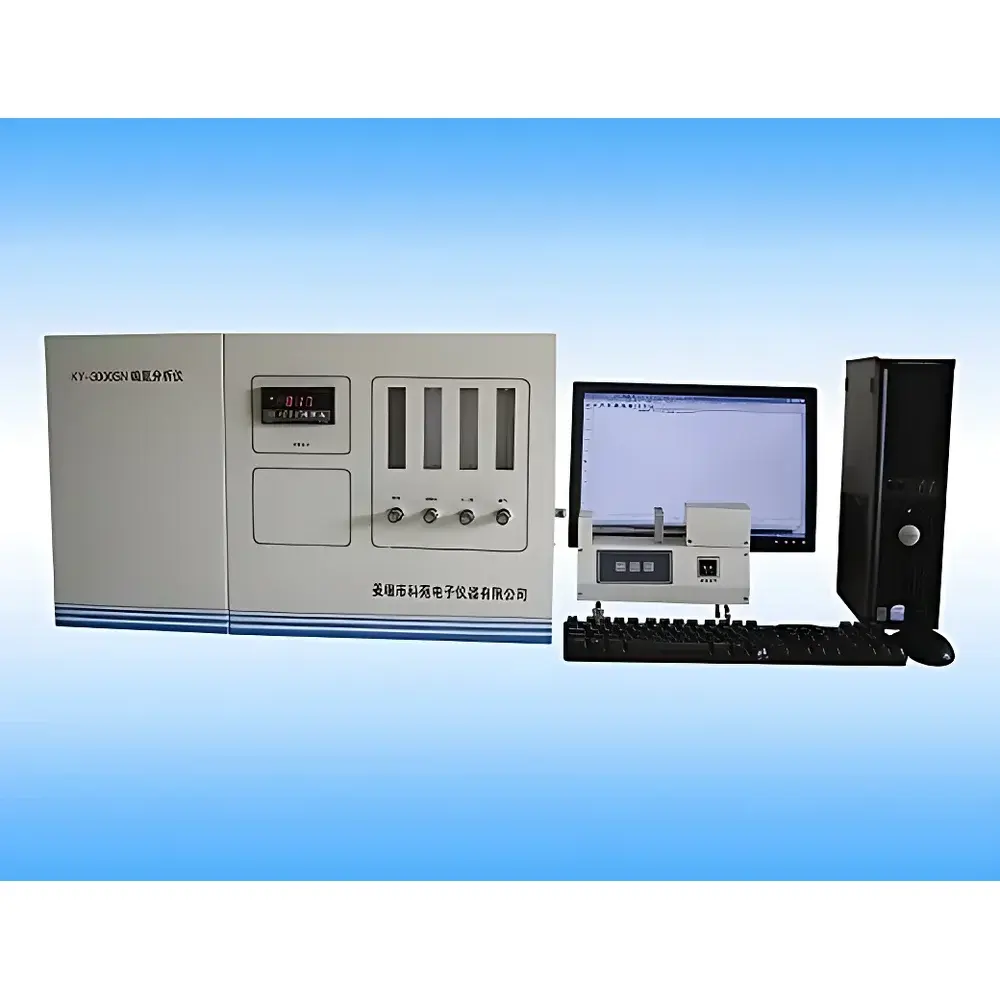
Kyoyuan KY-3000S UV Fluorescence Sulfur Analyzer
| Brand | Kyoyuan |
|---|---|
| Model | KY-3000S |
| Origin | Jiangsu, China |
| Manufacturer Type | OEM Manufacturer |
| Detection Principle | UV Fluorescence (S) |
| Detection Range | 0.2 mg/L to 5000 ppm (up to % level) |
| LOD | 0.2 mg/L (as S) |
| Repeatability | ±0.2 mg/L at 1.0 mg/L |
| Temperature Control Range | Ambient to 1300 °C |
| Temperature Stability | ±1 °C |
| Power Consumption | 2 kW |
| Gas Requirements | High-purity O₂ (≥99.98%) and Ar (≥99.98%) |
| Data Acquisition | 24-bit ADC, USB interface, min. detectable signal <1 µV |
| Compliance Standards | SH/T 0689, ASTM D5453, GB/T 34100-2017 |
Overview
The Kyoyuan KY-3000S UV Fluorescence Sulfur Analyzer is a laboratory-grade elemental analyzer engineered for precise, trace-level quantification of total sulfur in liquid, solid, and gaseous hydrocarbon samples. It operates on the well-established ultraviolet fluorescence detection principle: sample is combusted in a high-temperature quartz furnace under controlled oxygen/argon atmosphere, converting all sulfur species to SO₂; the resulting SO₂ is carried into a reaction chamber where it is excited by pulsed UV light, emitting characteristic fluorescence proportional to sulfur concentration. This photometric signal is detected by a high-gain, voltage-tunable photomultiplier tube (PMT), enabling sub-ppm sensitivity and wide dynamic range. Designed for compliance with SH/T 0689, ASTM D5453, and GB/T 34100-2017, the KY-3000S serves as a primary method instrument for quality control and regulatory reporting in refineries, petrochemical R&D labs, fuel certification facilities, and third-party testing organizations.
Key Features
- High-precision temperature control system (ambient to 1300 °C, ±1 °C stability) ensures complete oxidative conversion of refractory sulfur compounds including thiophenes and sulfides.
- 24-bit analog-to-digital data acquisition with USB 2.0 interface delivers high-resolution signal capture and minimizes quantization noise; minimum detectable fluorescence signal <1 µV.
- Tunable PMT high-voltage supply allows real-time optimization of detector gain across diverse sample matrices—critical for maintaining linearity from 0.2 mg/L to percent-level sulfur.
- Flexible calibration architecture supports both single-point and multi-point calibration curves using certified reference materials (CRMs), with automatic curve fitting and residual error reporting.
- Modular gas handling subsystem with dual high-purity gas channels (O₂ ≥99.98%, Ar ≥99.98%) includes mass flow controllers, pressure sensors, and leak-tight quartz combustion tube assembly.
- Robust hardware design incorporates imported critical components—including furnace heating elements, quartz reactor, and optical filter sets—to ensure long-term thermal and photometric stability.
Sample Compatibility & Compliance
The KY-3000S accommodates a broad spectrum of petroleum and chemical matrices: liquid fuels (gasoline, diesel, jet fuel, naphtha), crude oils, lubricants, plastic pyrolysates, and liquefied petroleum gas (LPG) when paired with optional gas sampling modules. Solid samples (e.g., catalysts, polymers, coal extracts) require pre-treatment via solvent dissolution or microcombustion boats. All operational protocols align with internationally recognized test methods: ASTM D5453 (light hydrocarbons, spark-ignition fuels, diesel), SH/T 0689 (Chinese national standard for gasoline and diesel), and GB/T 34100-2017 (equivalent technical scope). The system supports GLP-compliant workflows through audit-trail-enabled software logging, electronic signature capability, and secure user access levels—facilitating FDA 21 CFR Part 11 readiness when deployed in regulated environments.
Software & Data Management
Kyoyuan’s proprietary analysis software runs natively on Windows 7/10/11 (32- and 64-bit) without runtime dependencies. It provides full instrument control, real-time fluorescence waveform visualization, peak integration with baseline correction algorithms, and automated report generation compliant with ISO/IEC 17025 documentation requirements. Raw data files (.kyd) are stored in structured binary format with embedded metadata (operator ID, calibration date, gas pressures, furnace ramp profiles). Data export supports CSV, PDF, and XML formats for LIMS integration. Version-controlled software updates include enhanced interference compensation routines for nitrogen-rich or halogenated samples, and configurable pass/fail logic against specification limits per ASTM D975 or EN 590.
Applications
- Refinery process monitoring: sulfur tracking across hydrotreater feed/effluent streams to optimize catalyst life and meet pipeline specifications.
- Fuel certification: verification of ultra-low-sulfur diesel (ULSD, ≤10 ppm) and gasoline (≤10 ppm) per EPA Tier 3 and Euro 6 mandates.
- Research & development: kinetic studies of sulfur removal reactions, catalyst screening, and speciation validation via coupling with GC-SCD.
- Quality assurance in polymer manufacturing: detection of sulfur-containing stabilizers or residual catalysts affecting thermal stability.
- Environmental compliance: sulfur content verification in marine distillate fuels (IMO 2020 ≤0.50% m/m) and biofuel blends.
FAQ
What combustion gases are required, and why must they be high-purity?
High-purity oxygen (≥99.98%) ensures complete oxidation without sulfate formation artifacts; high-purity argon (≥99.98%) serves as carrier and diluent gas to prevent quenching of SO₂ fluorescence and maintain detector linearity.
Can the KY-3000S measure sulfur in solid samples like rubber or asphalt?
Yes—when used with solid-sample introduction kits (quartz boats, programmable autosampler), provided samples are homogenized and weighed precisely; method validation per ASTM D7183 is recommended.
Is the instrument compatible with LIMS or ERP systems?
Yes—via standardized CSV/XML exports and optional OPC UA interface module (available upon request), supporting bidirectional data exchange with major laboratory informatics platforms.
How often does the PMT require recalibration?
PMT gain is digitally stabilized and verified during each startup sequence; full optical alignment and sensitivity check is recommended every 6 months or after 500 analyses, using NIST-traceable sulfur standards.
Does the system support multi-element analysis (e.g., sulfur + nitrogen)?
The KY-3000S is dedicated to sulfur quantification only; for simultaneous S/N analysis, Kyoyuan offers the KY-3000SN variant, which integrates dual-channel fluorescence detection with independent SO₂ and NO chemiluminescence modules.





