
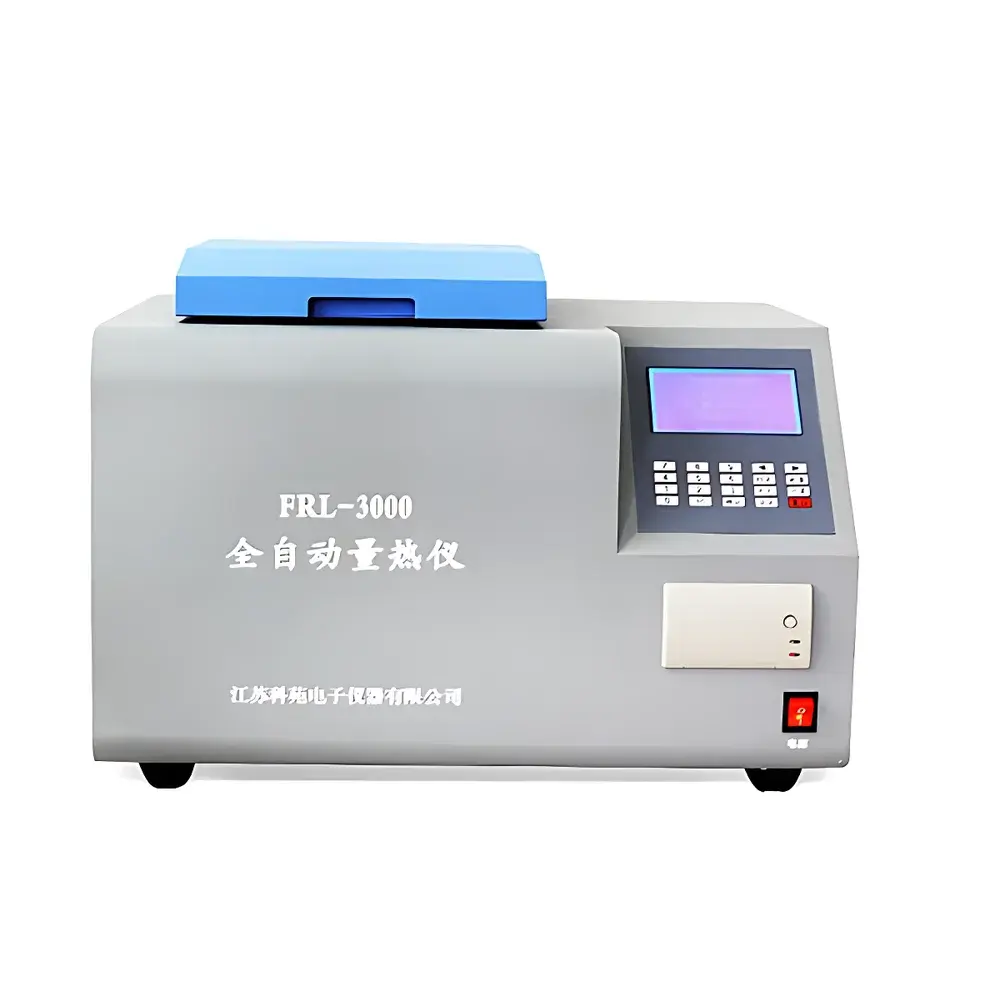
Koyuan FRL-3000 Microcomputer-Controlled Isoperibol Calorimeter
| Brand | Koyuan Instruments |
|---|---|
| Origin | Jiangsu, China |
| Manufacturer Type | Direct Manufacturer |
| Country of Origin | China |
| Model | FRL-3000 |
| Quotation | Upon Request |
| Heat Capacity (Water Equivalent) | ~10,500 J/K (≈2,500 cal/K) |
| Oxygen Bomb Working Pressure | 2.8–3.0 MPa (max 3.2 MPa) |
| Oxygen Bomb Hydrostatic Test Pressure | 20 MPa |
| Oxygen Bomb Volume | 300 mL |
| Oxygen Bomb Mass | 50 kg |
| Inner Bucket Water Volume | ~2,100 mL |
| Outer Jacket Water Volume | ~40 L |
| Precision | ≤0.1% |
| Temperature Measurement Range | 5–40 °C |
| Temperature Resolution | 0.001 K |
Overview
The Koyuan FRL-3000 Microcomputer-Controlled Isoperibol Calorimeter is a precision instrument engineered for the accurate determination of gross and net calorific values of solid and liquid combustible materials—including coal, petroleum products, foodstuffs, wood, and explosives—according to standardized thermodynamic principles. It operates on the isoperibol principle, wherein the outer jacket temperature remains constant during combustion, and heat exchange between the inner bucket and surroundings is quantified via high-resolution temperature monitoring and rigorous thermal compensation algorithms. The system complies with GB/T 213–1996, which aligns closely with international standards such as ASTM D5865 (Standard Test Method for Gross Calorific Value of Coal and Coke) and ISO 1928:2020 (Solid mineral fuels — Determination of gross calorific value by the bomb calorimeter and calculation of net calorific value). Designed for laboratory environments requiring regulatory traceability, the FRL-3000 integrates real-time Windows-based control software to manage ignition timing, thermal equilibration, water-level regulation, stirring kinetics, and post-combustion data reduction—all without manual intervention.
Key Features
- Full automation of the entire calorimetric cycle: automatic water temperature regulation, inner bucket filling/drainage, thermal drift compensation, sample weighing integration (via optional RS-232/USB scale interface), magnetic stirring, controlled ignition, status visualization, audible alerts, and fault diagnostics with on-screen error codes.
- High reproducibility with precision ≤0.1% RSD (relative standard deviation) across repeated measurements under controlled ambient conditions, validated per ISO/IEC 17025 calibration protocols.
- Robust oxygen bomb assembly rated for 20 MPa hydrostatic test pressure and operational use up to 3.2 MPa; constructed from corrosion-resistant stainless steel with a 300 mL internal volume and 50 kg mass for stable thermal inertia.
- Dual-bucket architecture: inner bucket holds ~2,100 mL deionized water; outer jacket contains ~40 L thermostatically stabilized water, minimizing external thermal perturbations.
- Support for dual calorimeter operation—single workstation can concurrently manage one or two isoperibol units, enabling parallel sample throughput while maintaining independent calibration records.
- Built-in unit conversion engine supporting joule (J) and calorie (cal) outputs, with automated derivation of both gross calorific value (GCV) and net calorific value (NCV) on as-received basis, including moisture and hydrogen correction per ASTM D3176 and ISO 1928 Annex B.
Sample Compatibility & Compliance
The FRL-3000 accommodates homogeneous solid samples (e.g., pulverized coal <0.2 mm, certified reference materials such as NIST SRM 1812) and liquid fuels (e.g., diesel, biodiesel blends) when encapsulated in sealed crucibles compatible with high-pressure oxygen combustion. Sample mass ranges from 0.5 g to 1.2 g, optimized for complete oxidation at 3.0 MPa O₂. All hardware and firmware conform to electromagnetic compatibility (EMC) requirements per IEC 61326-1 and electrical safety standards IEC 61010-1. Data integrity meets GLP/GMP expectations through audit-trail-enabled software logging, user access levels, and electronic signature support—fully compatible with FDA 21 CFR Part 11 compliance configurations when deployed with validated IT infrastructure.
Software & Data Management
The embedded Windows application provides intuitive workflow navigation, real-time graphical display of temperature vs. time curves, and dynamic correction for nitric acid and sulfuric acid formation heats. Raw sensor data (PT100 resistance, relay states, valve actuation timestamps) are logged at 10 Hz and stored in encrypted binary archives with SHA-256 checksums. Export options include CSV, PDF reports (with customizable headers, lab ID, analyst signature fields), and XML formats compliant with LIMS interfaces. Audit trail records capture operator login/logout events, parameter modifications, calibration updates, and result approvals—retained for ≥36 months per internal QA policy. Remote diagnostics and firmware updates are supported via secure HTTPS channel.
Applications
- Coal quality control in power generation and coking plants, delivering GCV and NCV results required for energy billing and boiler efficiency modeling.
- Quality assurance of alternative fuels (e.g., RDF, SRF, torrefied biomass) under EN 15403 and ISO 18125.
- R&D laboratories evaluating energetic materials (propellants, explosives) where precise enthalpy-of-combustion data informs formulation stability and safety assessments.
- Food science applications measuring metabolizable energy content (Atwater factors), aligned with AOAC 933.01 and ISO 9831.
- Academic research in thermochemistry, particularly for validation of computational models predicting bond dissociation energies and reaction enthalpies.
FAQ
What standards does the FRL-3000 comply with for coal analysis?
It conforms to GB/T 213–1996, and its measurement methodology is technically equivalent to ASTM D5865 and ISO 1928:2020.
Can the system calculate net calorific value directly?
Yes—it automatically computes received-base net calorific value (NCVar) using measured moisture, hydrogen, and ash content entered manually or imported from linked proximate analysis instruments.
Is remote software support available?
Yes—technical assistance includes screen-sharing diagnostics, configuration review, and firmware patch deployment via secure TLS-encrypted connection.
What maintenance is required for long-term accuracy?
Annual recalibration of the PT100 sensor and heat capacity verification using certified benzoic acid (NIST SRM 39j or equivalent) is recommended; oxygen bomb seal inspection every 500 firings.
Does the system support LIMS integration?
Yes—through configurable ODBC drivers and RESTful API endpoints for bidirectional data exchange with major laboratory information management systems.





