
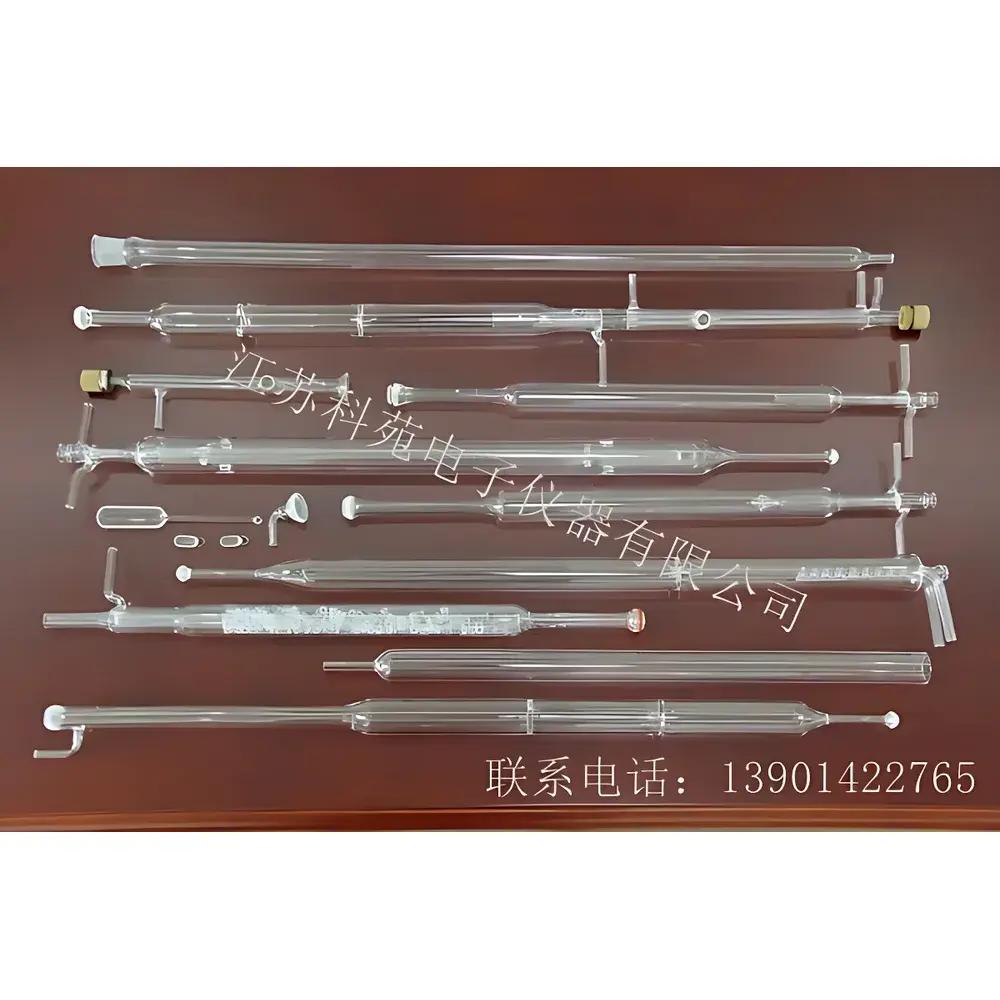
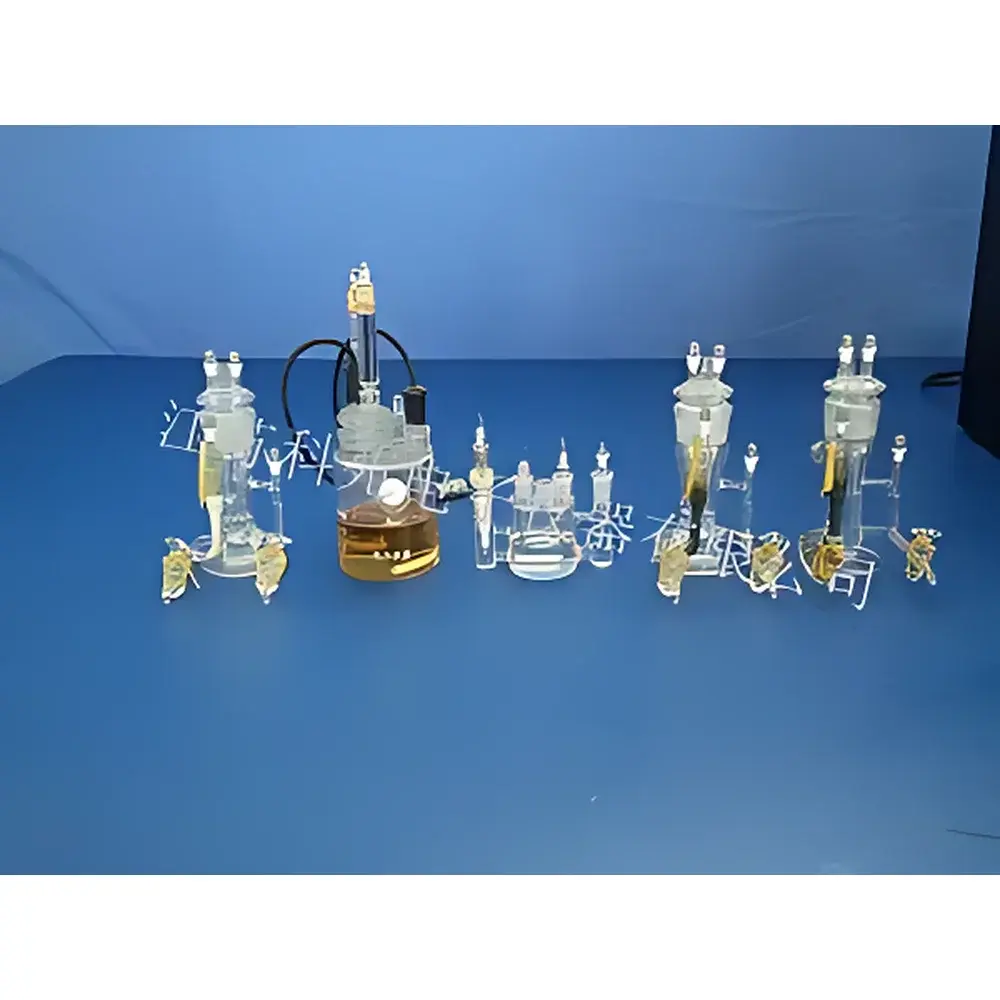
Electrochemical Cell and Quartz Tube Kit
| Brand | Keyuan Instruments |
|---|---|
| Origin | Jiangsu, China |
| Manufacturer Type | OEM/ODM Producer |
| Country of Origin | China |
| Model | Accessory Kit |
| Pricing | Upon Request |
Overview
The Electrochemical Cell and Quartz Tube Kit is a precision-engineered accessory system designed for integration with benchtop and modular electrochemical workstations, potentiostats, and in-situ spectroelectrochemical platforms. This kit comprises two core components: a chemically inert, high-purity fused quartz tube (typically 10–25 mm OD, wall thickness ≥1.0 mm) and a standardized three-electrode electrochemical cell housing compatible with common reference electrodes (e.g., Ag/AgCl, SCE), counter electrodes (Pt wire or mesh), and working electrode mounts (e.g., rotating disk electrode shafts or custom holders). The quartz tube serves dual functions—as an optically transparent window for UV-Vis-NIR transmission spectroscopy during real-time electrochemical reactions, and as a thermally stable, vacuum-tight enclosure for controlled-atmosphere or elevated-temperature experiments. The cell body is constructed from PTFE, Kel-F, or glass-filled polypropylene to ensure dielectric integrity, chemical resistance to acids, bases, and organic solvents, and minimal background current leakage (<10 pA at ±1 V).
Key Features
- Fused quartz tubing with certified UV transparency (≥85% transmittance from 190–2500 nm) and low hydroxyl content (<10 ppm), enabling reliable in-situ spectroelectrochemical measurements.
- Modular cell design supporting standard Luggin capillary placement, gas-tight sealing (rated to 1 bar), and optional temperature control ports (for integration with circulating water jackets or Peltier modules).
- Electrode port geometry conforms to ASTM D1149 and ISO 17835 dimensional tolerances, ensuring mechanical interchangeability with commercial potentiostat accessories.
- Quartz tube ends are precision-ground and polished to λ/4 surface flatness, minimizing optical distortion and Fresnel reflection losses during spectral acquisition.
- Cell body includes threaded NPT or ISO-KF interfaces for vacuum compatibility and optional inert-gas purging (N2, Ar) per ASTM E2913 guidelines for oxygen-sensitive redox systems.
Sample Compatibility & Compliance
This kit supports liquid-phase electrochemical analysis of aqueous, non-aqueous, and ionic liquid electrolytes—including LiPF6 in EC/DMC, [BMIM][PF6], and 1 M H2SO4. It accommodates solid working electrodes (glassy carbon, Au, Pt, Ni foam), suspended nanoparticle catalysts, and thin-film photoelectrodes mounted on conductive substrates. All materials comply with RoHS Directive 2011/65/EU and are certified free of leachable heavy metals (Pb, Cd, Hg, Cr6+) per IEC 62321-5:2013. The quartz component meets USP requirements for pharmaceutical-grade optical clarity and extractables testing when used in regulated QC environments.
Software & Data Management
While the kit itself is hardware-only, it is fully interoperable with industry-standard electrochemical software suites—including BioLogic EC-Lab®, Pine AfterMath®, and Metrohm NOVA—enabling synchronized acquisition of current/potential waveforms and time-resolved absorbance spectra. When paired with spectrometers equipped with USB-2000+ or QE Pro detectors, the system supports automated data logging with timestamped metadata (cell temperature, gas flow rate, applied potential), audit-trail generation, and export to CSV, HDF5, or MDF4 formats compliant with FDA 21 CFR Part 11 requirements for electronic records in GLP/GMP laboratories.
Applications
- In-situ UV-Vis spectroelectrochemistry of metalloporphyrins, conducting polymers, and battery cathode materials (e.g., NMC, LFP) during charge/discharge cycling.
- Photoelectrochemical water splitting studies using TiO2, BiVO4, or perovskite-based photoanodes under simulated AM 1.5G illumination.
- Corrosion monitoring of stainless steel or aluminum alloys in chloride-containing media via electrochemical impedance spectroscopy (EIS) with optical endpoint validation.
- Redox mechanism elucidation of organic electrosynthesis intermediates (e.g., aryl diazonium reduction, CO2 electroreduction) using chronoabsorptometry.
- Development and validation of reference methods for electrochemical sensor calibration in environmental and clinical diagnostics.
FAQ
Is this kit compatible with Gamry Reference 600+ and CHI 760E potentiostats?
Yes—the cell’s electrode port dimensions and electrical interface follow universal 4-mm banana jack and BNC standards, ensuring plug-and-play compatibility.
Can the quartz tube be customized for specific optical path lengths or flange types?
Yes—custom machining (e.g., side windows, vacuum flanges, fiber-optic couplers) is available under OEM agreement with minimum order quantities.
Does the kit include electrodes or electrolyte?
No—electrodes, reference elements, and electrolytes are supplied separately to allow user-specific configuration and regulatory traceability.
What is the maximum operating temperature and pressure rating?
The quartz tube is rated to 1000 °C in inert atmosphere; the PTFE cell body is rated to 120 °C and 1 bar absolute pressure.
Do you provide validation documentation for GMP use?
Yes—material certificates of conformance (CoC), dimensional inspection reports, and UV transmittance verification data are provided upon request for IQ/OQ protocol support.





