
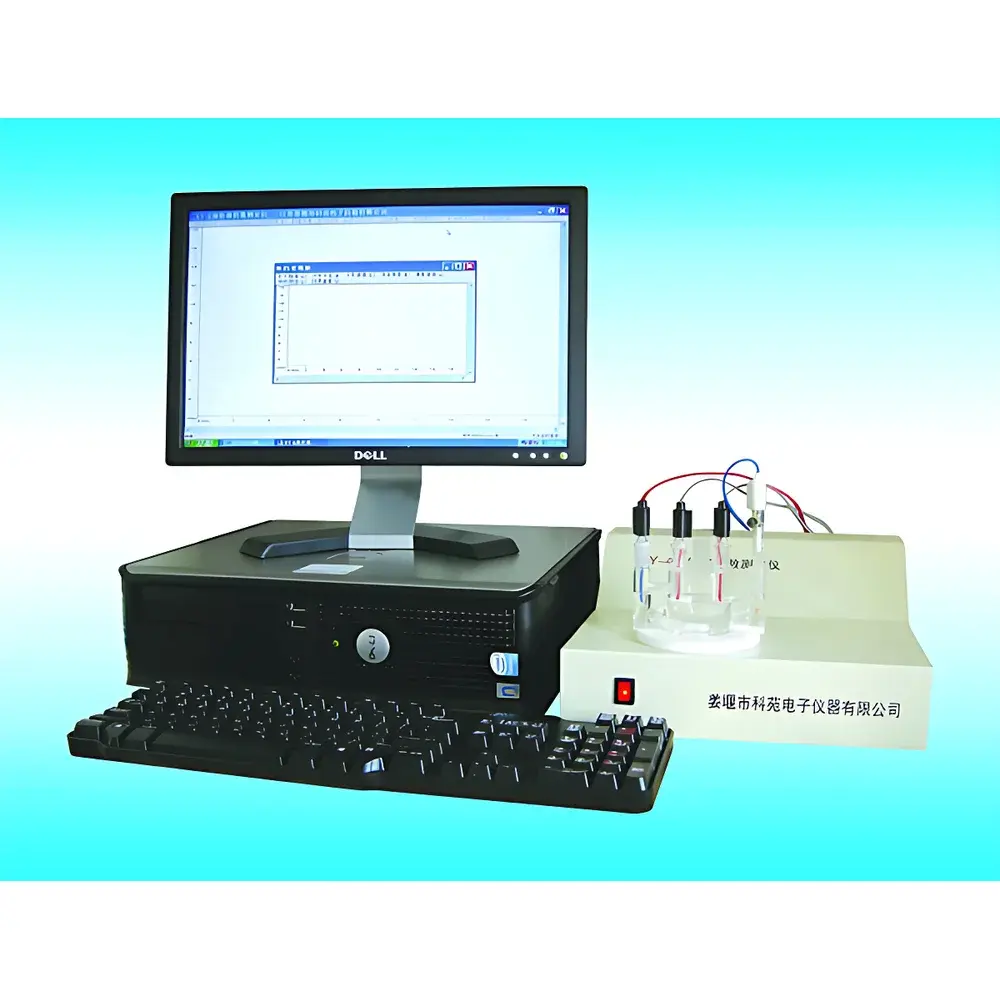
KY-4Br Bromine Number and Bromine Index Analyzer by Keyuan Instruments
| Brand | Keyuan Instruments |
|---|---|
| Origin | Jiangsu, China |
| Manufacturer Type | Direct Manufacturer |
| Instrument Type | Universal Potentiometric Titrator |
| Model | KY-4Br |
| Measurement Principle | Coulometric Titration (Microcoulometry) |
| Measurement Range | Bromine Number: 0–300 g Br/100g oil |
| Bromine Index | 1–1000 mg Br/100g oil |
| Detection Limit | 1 mg Br |
| Accuracy | ±3% ±0.2 g Br (bromine number) |
| Resolution | 0.01 mg Br |
| Bias Voltage Range | 0–500 mV |
| Sample Volume | <10 µL (bromine number) |
| Reagent Consumption | <1 mL per sample |
| Power Consumption | 20 W |
| Compliance Standards | SH/T 0630–1996, SH/T 1551–2018, GB/T 11136–1989(2004), SH/T 1767–2008(2015), GB/T 1815–1997, ASTM D1492 |
Overview
The KY-4Br Bromine Number and Bromine Index Analyzer is a dedicated coulometric titrator engineered for precise, rapid quantification of unsaturation in hydrocarbon-based samples via electrogenerated bromine consumption. Operating on the principle of microcoulometric titration—where bromine is electrolytically generated in situ within a sealed titration cell—the instrument measures the total charge required to maintain stoichiometric bromination of reactive double bonds. This method eliminates volumetric reagent delivery errors and enables direct correlation between integrated current (Coulombs) and bromine content, conforming strictly to ASTM D1492 and Chinese national standards including SH/T 0630–1996 and SH/T 1551–2018. Designed for routine QC/QA laboratories in refineries, petrochemical plants, and R&D centers, the KY-4Br delivers trace-level sensitivity (detection limit: 1 mg Br), high reproducibility (<2% RSD under controlled conditions), and full automation from sample injection to final report generation.
Key Features
- Electrolyte-free design: Uses non-benzene, low-toxicity electrolyte solution—reducing occupational health risks and disposal complexity.
- Potentiometric endpoint detection: Employs a stable dual-platinum electrode system with real-time potential monitoring, ensuring unambiguous endpoint recognition without drift or overshoot.
- Custom fritted-glass coulometric cell: Replaces conventional ion-selective membranes with a precision-engineered sintered glass frit, eliminating membrane degradation, clogging, and associated calibration drift.
- USB-integrated architecture: Fully controlled via Windows-based software; supports automated sequence execution, real-time current/voltage plotting, and synchronized data logging.
- Ultra-low sample & reagent demand: Requires ≤10 µL for bromine number analysis and ≤50 µL for bromine index determination; average reagent consumption is <1 mL per test—minimizing operational cost and waste volume.
- High-speed analysis cycle: Typical measurement duration is ≤60 seconds per sample, including electrolysis, endpoint stabilization, and calculation—enabling throughput of >50 samples per 8-hour shift.
Sample Compatibility & Compliance
The KY-4Br accepts liquid hydrocarbon matrices without pretreatment, including gasoline, kerosene, diesel, lubricating oils, naphthas, light and heavy aromatic streams (e.g., BTX fractions), and refinery intermediates. It is validated for compliance with multiple international and industry-specific regulatory frameworks: ASTM D1492 (Standard Test Method for Bromine Index of Aromatic Hydrocarbons by Coulometric Titration), SH/T 0630–1996 (Determination of Bromine Number and Bromine Index of Petroleum Products by Coulometric Method), and SH/T 1551–2018 (Determination of Bromine Index of Industrial Aromatics). All firmware and software modules support audit-trail-enabled operation, meeting GLP and GMP documentation requirements for traceability. Data files are stored in timestamped, immutable binary format with embedded metadata (operator ID, method version, calibration history), facilitating 21 CFR Part 11 readiness when deployed with appropriate IT infrastructure controls.
Software & Data Management
The proprietary Keyuan TitrSoft v3.x application provides comprehensive instrument control and data handling capabilities. It supports user-defined method templates—including configurable bias voltage (0–500 mV), integration time windows, and endpoint stability thresholds—to accommodate matrix-specific optimization. All measurements are visualized in real time as current vs. time and potential vs. time plots. Post-run processing includes automatic peak integration, baseline correction, and stoichiometric conversion using Faraday’s constant (96,485 C/mol Br₂). Export options include CSV, PDF, and XML formats compatible with LIMS integration. The software maintains full electronic records: method parameters, raw sensor outputs, intermediate calculations, and final results—all protected against unauthorized modification. Audit logs capture every user action (login, method edit, run initiation, report print), satisfying ISO/IEC 17025 clause 7.9 and CNAS-CL01:2018 data integrity requirements.
Applications
This analyzer serves critical quality control functions across upstream, midstream, and downstream petroleum operations. In refinery labs, it verifies feedstock unsaturation prior to hydrotreating or catalytic reforming—ensuring catalyst life and product specification compliance. For lubricant manufacturers, it monitors oxidation stability indicators in base oils and finished formulations. In petrochemical production, it validates aromatic purity in BTX extraction units and detects diene contamination in polymer-grade feedstocks. Research applications include kinetic studies of bromination reactions, evaluation of antioxidant efficacy, and development of novel olefin-scavenging additives. Its sub-milligram detection capability makes it suitable for high-value specialty chemicals where residual unsaturation directly impacts shelf life and thermal stability.
FAQ
What electrochemical principle does the KY-4Br employ?
It uses controlled-potential coulometric titration: bromine is generated electrolytically at the anode from bromide ions in the electrolyte, and consumed stoichiometrically by alkenes/dienes in the sample.
Is the instrument compliant with FDA 21 CFR Part 11?
Yes—when operated with validated software configuration, electronic signatures, and access-controlled user roles, it meets Part 11 requirements for electronic records and signatures.
Can the KY-4Br analyze solid or viscous samples?
No—it is designed exclusively for low-viscosity liquid hydrocarbons; samples must be fully miscible with the electrolyte and free of suspended particulates.
How often does the coulometric cell require maintenance?
Under normal usage (≤20 samples/day), the sintered glass frit requires cleaning every 100–150 runs with acetone and ultrasonic agitation; no membrane replacement is needed.
Does the system support multi-point calibration verification?
Yes—software includes built-in calibration verification routines using certified reference materials (e.g., NIST-traceable brominated hydrocarbon standards) with automatic pass/fail reporting against preset tolerance limits.




