
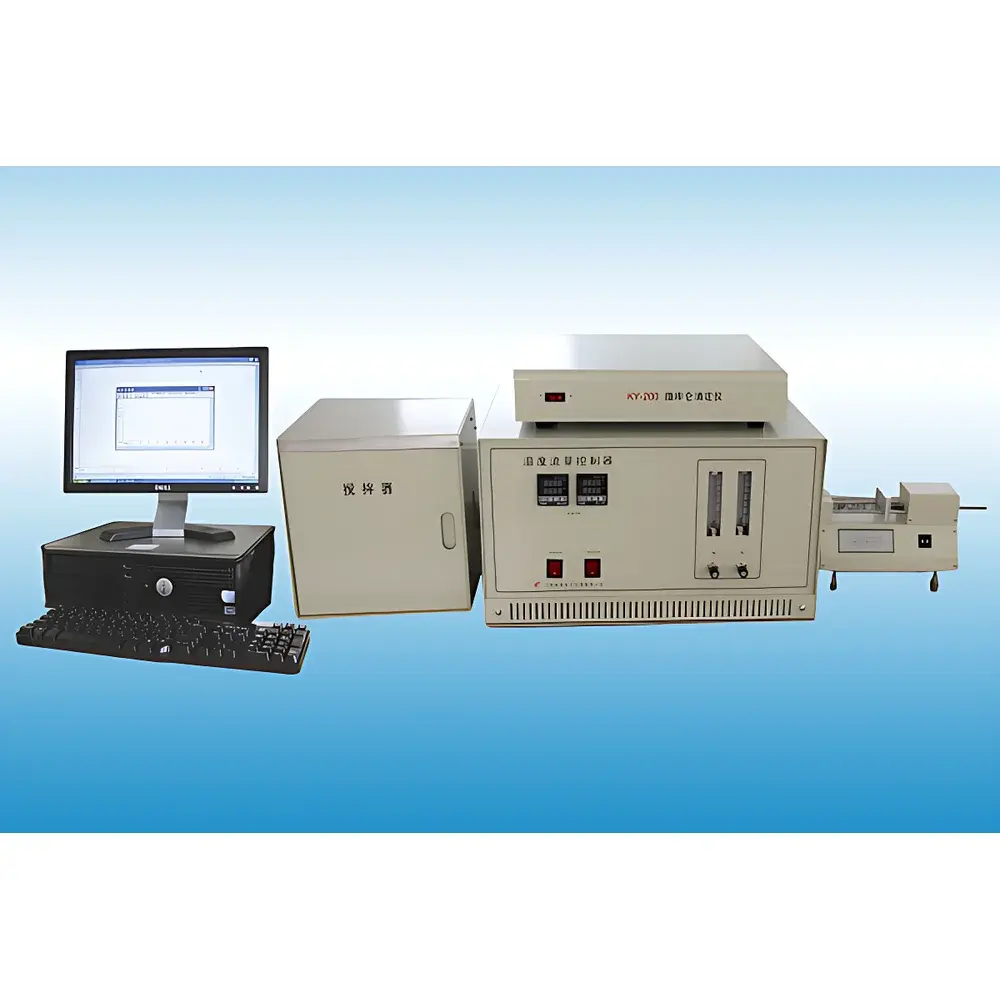
KY-210A Organic Chlorine Analyzer for Oilfield Chemicals (Microcoulometric Method A)
| Brand | Keyuan Instruments |
|---|---|
| Origin | Jiangsu, China |
| Manufacturer Type | Direct Manufacturer |
| Country of Origin | China |
| Model | KY-210A |
| Price | Upon Request |
| Measurement Range | Cl: 0.2–10,000 mg/L |
| Detection Limit | 0.1 mg/L |
| Repeatability | ≤15% (x ≤ 0.5 mg/L), ≤10% (0.5 < x ≤ 1.0 mg/L), ≤8% (1.0 < x ≤ 10 mg/L), ≤3% (x > 10 mg/L) |
| Electrolytic Cell Stability | >8 h |
| Temperature Control Range | Ambient to 1100 °C |
| Temperature Control Accuracy | ±1 °C |
| Analysis Time | 1 min per sample |
Overview
The KY-210A Organic Chlorine Analyzer for Oilfield Chemicals is a dedicated microcoulometric elemental analyzer engineered for the precise quantification of total organic chlorine in complex hydrocarbon-based formulations. It operates on the fundamental principle of controlled pyrolytic conversion followed by electrochemical detection: samples are introduced into a high-temperature combustion zone (up to 1100 °C) under a defined nitrogen/oxygen carrier gas stream, where all organochlorine compounds are quantitatively converted to hydrogen chloride (HCl). The evolved HCl is swept into a dual-electrode microcoulometric titration cell, where chloride ions react stoichiometrically with electrogenerated silver ions (Ag⁺) produced via controlled electrolysis. The instrument’s embedded microprocessor integrates the charge (coulombs) consumed during Ag⁺ generation—applying Faraday’s law—to compute chlorine concentration directly in mg/L or weight percent. This method ensures trace-level sensitivity, high specificity for covalently bound chlorine, and minimal interference from inorganic chloride when appropriate sample preparation (e.g., centrifugation) is applied.
Key Features
- Full-automation architecture integrating programmable auto-sampler, high-temperature pyrolysis furnace, and sealed microcoulometric titration cell—enabling unattended batch analysis of up to 48 samples.
- Intelligent thermal management system featuring air-cooled cracking zone with automatic fan activation/deactivation based on real-time temperature feedback—reducing thermal drift and extending component service life.
- Real-time process monitoring via dedicated software interface: simultaneous display of combustion temperature, cell voltage, electrolysis current, titration endpoint curve, and integrated coulombic charge.
- Compliance-ready design supporting audit trails, user access levels, and electronic signature functionality aligned with GLP and GMP data integrity expectations.
- Rugged, modular construction optimized for continuous operation in QC laboratories—minimal consumables, no routine calibration standards required between analyses.
Sample Compatibility & Compliance
The KY-210A is validated for liquid and semi-liquid oilfield chemical agents—including scale inhibitors, corrosion inhibitors, demulsifiers, and biocides—as well as crude oils, refined fractions, aromatic solvents, and polymer additives. Sample introduction is performed post-centrifugation to eliminate suspended particulates that could foul the combustion quartz tube or titration cell. The analyzer conforms to multiple international and industry-specific standard methods: SY/T 7329–2016 (Method A for organic chlorine in oilfield chemicals), SH/T 1757–2006 (microcoulometric determination of organic chlorine in industrial aromatics), GB/T 18612–2011 (organic chlorine in crude oil), and ASTM D5808–2009 (microcoulometric analysis of organic chlorides in aromatic hydrocarbons and related compounds). Its measurement uncertainty profile meets ISO/IEC 17025 requirements for accredited testing laboratories performing trace halogen analysis.
Software & Data Management
Control and data acquisition are executed via proprietary Windows-based software compliant with FDA 21 CFR Part 11 requirements. The platform provides full lifecycle data handling: method configuration (combustion temperature ramp profiles, integration time windows, baseline correction algorithms), raw signal visualization (current vs. time, voltage vs. time), automated report generation (PDF/CSV export), and secure database archiving with timestamped operator logs. All analytical runs are assigned unique identifiers; modifications to methods or parameters trigger mandatory electronic signatures and version-controlled change logs. Audit trail functionality records every instrument state transition, data point modification, and user action—ensuring full traceability for regulatory submissions and internal quality audits.
Applications
- Quality control of oilfield chemical formulations to verify compliance with organic chlorine specifications (<10 mg/L threshold common in pipeline-compatible additives).
- Monitoring chlorine contamination in crude oil blends prior to refining—critical for preventing catalyst poisoning in hydrotreating units.
- Research and development of low-chlorine or chlorine-free alternatives for enhanced oil recovery (EOR) chemicals.
- Environmental screening of produced water treatment chemicals to assess potential halogenated byproduct formation.
- Regulatory conformance testing for customs clearance (e.g., China Customs HS Code 9027.80 for elemental analyzers) and product registration under REACH or TSCA frameworks.
FAQ
What sample preparation is required prior to analysis?
Centrifugation at ≥3000 rpm for ≥5 minutes is mandatory to remove particulates and water droplets. Clear supernatant is transferred to autosampler vials using glass syringes—no filtration or dilution is permitted unless validated per method SOP.
Can the KY-210A distinguish between organic and inorganic chlorine species?
No—this is a total organic chlorine assay per SY/T 7329–2016 Method A. Inorganic chloride must be removed pre-analysis via solvent extraction or precipitation to avoid overestimation.
Is the instrument compatible with LIMS integration?
Yes—via configurable ODBC-compliant database export and HL7 message support for seamless bidirectional data exchange with laboratory information management systems.
What maintenance intervals are recommended for sustained accuracy?
Quartz combustion tube cleaning every 200 injections; electrolytic cell electrolyte replacement every 72 hours of cumulative operation; annual calibration verification using certified chlorinated reference standards (e.g., chlorobenzene in xylene).
Does the system support multi-element analysis?
No—the KY-210A is purpose-built exclusively for chlorine quantification via microcoulometry. For sulfur or nitrogen analysis, separate dedicated instruments (e.g., UV fluorescence or chemiluminescence detectors) are required.






