
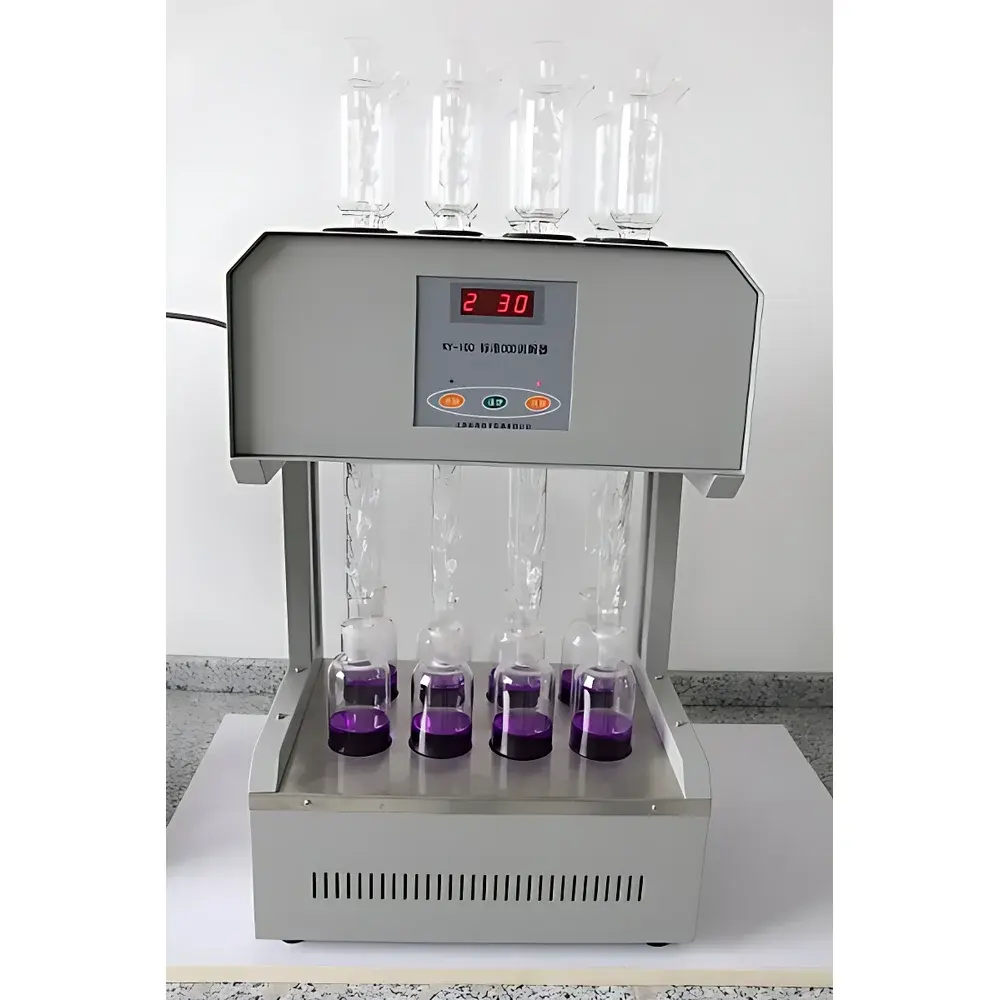
Kyoyuan KY-100(8) Standard COD Digestion System
| Brand | Kyoyuan |
|---|---|
| Origin | Jiangsu, China |
| Manufacturer Type | Direct Manufacturer |
| Country of Origin | China |
| Model | KY-100(8)js |
| Digestion Method | Reflux Digestion |
| Batch Capacity | 8 samples |
| Temperature Setting | 165 °C (per GB 11914–1989 and ISO 6060) |
| Temperature Accuracy | ±1 °C at 165 °C |
| Sample Vessel Compatibility | 250 mL conical flasks or cylindrical digestion vials |
| Timer Range | 0–999 minutes (adjustable in 1-minute increments) |
| Heating Power | 1300 W (AC 220 V ±10 %, 50 Hz) |
| Cooling Method | Forced-air convection (no tap water required) |
| Condenser Type | Glass spiky reflux condenser |
| Measuring Range | 0–1000 mg/L (direct) |
| Precision | RSD ≤5.0% for potassium hydrogen phthalate (500 mg/L) |
| Operating Ambient | 5–40 °C |
| Compliance | Fully aligned with GB 11914–1989, ISO 6060:1989, and EPA Method 410.4 |
Overview
The Kyoyuan KY-100(8) Standard COD Digestion System is a precision-engineered, microprocessor-controlled reflux digestion unit designed explicitly for compliant chemical oxygen demand (CODCr) determination in aqueous environmental samples. It implements the closed-reflux, dichromate oxidation method as defined by the Chinese national standard GB 11914–1989 and the internationally recognized ISO 6060:1989. The system maintains strict adherence to critical analytical parameters—including thermal stability at 165 °C ±1 °C, precise 120-minute reflux duration, controlled reagent addition sequence, and standardized 250 mL sample volume—ensuring metrological traceability and inter-laboratory reproducibility. Unlike open-heating or non-reflux alternatives, the KY-100(8) enforces full reflux conditions via its integrated glass spiky condenser and forced-air cooling architecture, eliminating volatile loss and minimizing operator exposure to hot acid vapors.
Key Features
- Microprocessor-based digital timer with 1-minute resolution and auto-shutdown—programmable from 0 to 999 minutes for method flexibility beyond standard 120-min reflux.
- Uniform ceramic-heating module delivering stable 165 °C surface temperature across all eight positions; verified per GB 11914–1989 thermal validation protocol.
- Spiky-glass reflux condenser (24/40 standard taper) engineered to maximize internal surface area and condensation efficiency—replacing traditional spherical condensers to reduce carryover and improve repeatability.
- Passive air-cooling system eliminates dependency on municipal water supply—reducing lab infrastructure load, conserving >95% water versus tap-cooled units, and complying with ISO 14001 water-use optimization guidelines.
- Corrosion-resistant, insulated heating block housing rated for continuous operation under aggressive sulfuric-silver sulfate media; surface temperature remains <60 °C during operation for personnel safety.
- Direct compatibility with standard 250 mL conical flasks (for classical GB method) and optional cylindrical vials (for high-throughput workflows), enabling seamless integration into existing QA/QC pipelines.
Sample Compatibility & Compliance
The KY-100(8) accommodates untreated or pre-filtered water samples—including domestic wastewater, industrial effluents, surface water, and groundwater—within the validated COD range of 0–1000 mg/L. For samples exceeding 1000 mg/L, the system supports proportional dilution protocols per Section 7.3 of GB 11914–1989, extending effective measurement to 10,000 mg/L with documented uncertainty propagation. All digestion vessels remain in-place from heating through titration, eliminating transfer errors. The instrument’s operational envelope (5–40 °C ambient, 220 V ±10 %, 50 Hz) meets IEC 61010-1 safety requirements for laboratory electrical equipment. Its procedural fidelity ensures full alignment with ISO/IEC 17025:2017 clause 7.2.2 (method validation) and supports GLP-compliant audit trails when paired with calibrated burettes and certified reference materials (e.g., potassium hydrogen phthalate CRM, NIST SRM 1012).
Software & Data Management
As a hardware-dedicated digestion platform, the KY-100(8) operates without embedded software or network connectivity—minimizing cybersecurity risk and ensuring deterministic timing performance. All time/temperature settings are retained in non-volatile memory after power cycling. While no proprietary data export is provided, the system is fully compatible with external LIMS integration via manual entry of digestion start/end timestamps, batch IDs, and operator annotations. When used alongside titration workstations supporting ASTM D1252–22 Annex A1 (titrimetric endpoint detection), full electronic records—including digital titrant consumption logs—can be archived in accordance with FDA 21 CFR Part 11 requirements for electronic signatures and audit trails.
Applications
- Regulatory compliance testing for municipal wastewater treatment plants (WWTPs) under China’s “Discharge Standard of Pollutants for Municipal Wastewater Treatment Plants” (GB 18918–2002).
- Industrial effluent monitoring for textile, pharmaceutical, food processing, and chemical manufacturing facilities subject to local environmental protection bureau (EPB) reporting.
- Environmental impact assessment (EIA) field laboratories requiring portable, low-infrastructure COD digestion capability.
- Academic and research laboratories performing method validation studies, inter-laboratory comparison exercises, or teaching fundamental redox titration principles.
- Third-party testing organizations accredited to CNAS CL01 (equivalent to ISO/IEC 17025) seeking cost-effective, standards-aligned digestion hardware.
FAQ
Does the KY-100(8) support automatic temperature ramping or multi-step heating profiles?
No. It is optimized exclusively for fixed-point reflux at 165 °C, consistent with GB 11914–1989 and ISO 6060 requirements.
Can I use 500 mL digestion vessels with this unit?
No. The heating block geometry and condenser alignment are validated only for 250 mL conical flasks or matching cylindrical vials.
Is calibration certificate included with shipment?
A factory-verified temperature uniformity report (±1 °C at 165 °C across all 8 positions) is supplied; NIST-traceable calibration requires third-party thermocouple verification per ISO/IEC 17025.
What maintenance is required for the spiky condenser?
Rinse with deionized water after each use; inspect for silica deposition quarterly and clean with warm 10% nitric acid if opacity develops.
How does the air-cooling system perform in ambient temperatures above 35 °C?
For reliable condensation efficiency, ambient must remain ≤40 °C; above 35 °C, confirm reflux rate visually (1–2 drops/sec at condenser tip) before initiating analysis.
Related Products







