
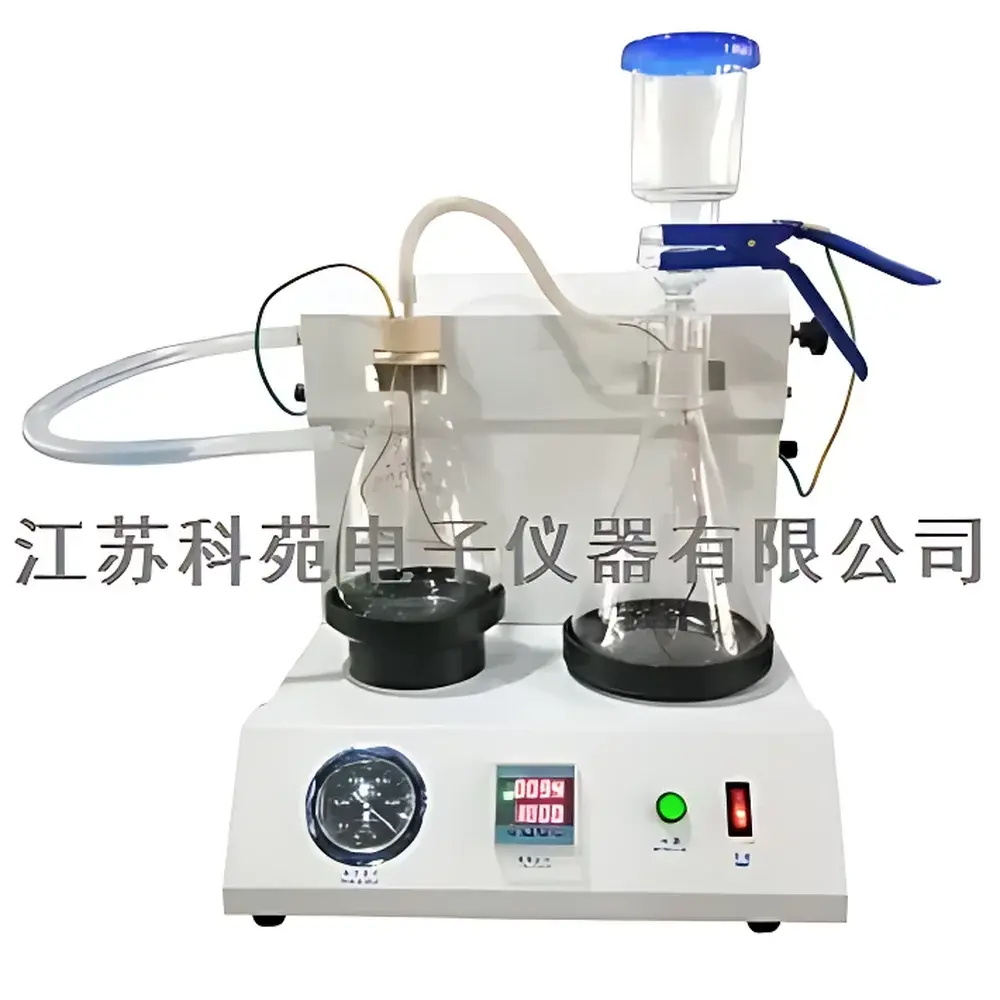
KY-33400 Total Contaminants Content Analyzer
| Brand | Keyuan Instruments |
|---|---|
| Origin | Jiangsu, China |
| Manufacturer Type | Direct Manufacturer |
| Country of Origin | China |
| Model | KY-33400 |
| Price Range | USD 2,800 – 7,000 |
| Vacuum Pump | Single-stage rotary vane pump |
| Vacuum Regulation | Stainless steel needle valve |
| Filtration Control | Solenoid valve actuated negative pressure control |
| Vacuum Gauge Range | 0 to –0.1 MPa |
| Power Consumption | 180 W |
| Dimensions (L×W×H) | 380 × 400 × 400 mm |
| Power Supply | AC 220 V ±10%, 50 Hz |
| Operating Environment | Temperature 0–45 °C, Relative Humidity ≤80% |
| Sample Viscosity Limit | ≤8 mm²/s at 20 °C or ≤5 mm²/s at 40 °C |
| Measurable Contaminant Range | 12–30 mg/kg |
| Applicable Fuels | Diesel with >30% FAME content, and other hydrocarbon-based fuels beyond standard viscosity limits |
Overview
The KY-33400 Total Contaminants Content Analyzer is a precision laboratory instrument engineered for the quantitative determination of total insoluble contaminants in middle distillate fuels—primarily diesel, biodiesel blends (including FAME-rich formulations), and related petroleum products. It operates in strict accordance with GB/T 33400–2016, the Chinese national standard equivalent to ASTM D7845 and ISO 10307-2 for gravimetric measurement of particulate contamination. The instrument employs vacuum-assisted membrane filtration under controlled negative pressure, followed by gravimetric analysis of retained residues on certified glass-frit filters. This method delivers high reproducibility and traceable mass quantification without reliance on optical or spectroscopic proxies—ensuring compliance with quality assurance protocols in refinery QC labs, fuel distribution centers, and third-party testing facilities.
Key Features
- Integrated modular architecture: Separated functional zones—lower compartment houses power supply, solenoid driver circuitry, and thermal management; upper zone accommodates filtration manifold, vacuum regulation, and operator interface—minimizing electromagnetic interference and optimizing thermal stability.
- Electrostatic mitigation design: Integrated brass grounding terminal ensures reliable charge dissipation during filtration of low-conductivity hydrocarbon samples, eliminating particle repulsion artifacts and improving filter capture efficiency.
- Precision vacuum control: Stainless steel needle valve enables fine-tuned adjustment across the full –0.1 MPa range; calibrated medical-grade vacuum gauge provides stable, linear analog readout with <±1.5% full-scale accuracy—critical for maintaining consistent filtration flux and minimizing filter clogging.
- High-integrity filtration assembly: Borosilicate glass frit discs (pore size: 10–16 µm, compliant with ASTM E128) are mounted in chemically inert stainless steel holders, ensuring mechanical robustness and resistance to solvent swelling or thermal deformation during repeated use.
- Low-noise, fail-safe actuation: Solid-state solenoid valves replace mechanical switches—offering millisecond response time, zero contact wear, and silent operation over >100,000 cycles, supporting unattended batch processing in GLP-compliant environments.
Sample Compatibility & Compliance
The KY-33400 accepts liquid fuel samples meeting the physical criteria defined in GB/T 33400: kinematic viscosity ≤8 mm²/s at 20 °C or ≤5 mm²/s at 40 °C. It extends applicability to high-FAME biodiesel blends (>30% v/v) where conventional filtration methods may suffer from wax precipitation or emulsion formation. All wetted materials—including glass frits, stainless steel manifolds, and fluoropolymer gaskets—are compatible with hydrocarbons, alcohols, and ester-based fuels. The system supports audit-ready documentation per ISO/IEC 17025 requirements, and its gravimetric workflow aligns with USP , ASTM D2276, and EN 14214 Annex C for contaminant verification in fuel certification.
Software & Data Management
While the KY-33400 is a hardware-centric gravimetric analyzer with no embedded microprocessor or touchscreen interface, it is fully compatible with external laboratory information management systems (LIMS) via standardized weighing protocol integration. Users employ certified analytical balances (e.g., METTLER TOLEDO XP series) connected via RS232 or USB to record pre- and post-filtration masses. Data export follows ASTM E1382-compliant CSV templates, enabling traceable audit trails, calibration history logging, and automated uncertainty propagation per GUM (JCGM 100:2008). Optional digital vacuum logger modules (sold separately) provide time-stamped pressure profiles for process validation under FDA 21 CFR Part 11–aligned electronic records.
Applications
- Refinery final product release testing for diesel and renewable diesel (HVO) batches prior to pipeline injection or marine bunkering.
- Verification of fuel cleanliness in aviation turbine fuel (Jet A-1) storage tanks per DEF STAN 91-91 Annex B requirements.
- Biodiesel quality surveillance in FAME-dominant blends where oxidation-induced polymerization increases particulate load.
- Root cause analysis of injector fouling in heavy-duty engines through correlation of measured contaminant mass with engine oil degradation markers.
- Contract laboratory accreditation support for ISO/IEC 17025 scope expansion in petrochemical testing categories.
FAQ
What standards does the KY-33400 comply with?
It conforms to GB/T 33400–2016, which references ASTM D7845 and ISO 10307-2 methodologies for total insolubles quantification.
Can it analyze ultra-low-sulfur diesel (ULSD) with additives?
Yes—provided additive packages do not introduce non-filterable micelles or colloidal stabilizers that compromise gravimetric recovery; method validation per ASTM D7845 Annex A is recommended.
Is calibration required before each test?
No routine calibration is needed for the vacuum or filtration subsystems; however, the analytical balance used for mass measurement must be calibrated daily per ISO 9001 Clause 7.6 and verified with NIST-traceable weights.
What maintenance intervals are recommended?
Vacuum pump oil replacement every 500 operating hours; stainless steel needle valve lubrication with fluorinated grease annually; glass frit cleaning via ultrasonic bath in acetone followed by oven drying at 105 °C.
Does the instrument support automated data reporting?
Not natively—but seamless integration with LIMS or Excel-based QA templates is achieved using standard COM port communication and configurable ASCII output protocols.







