
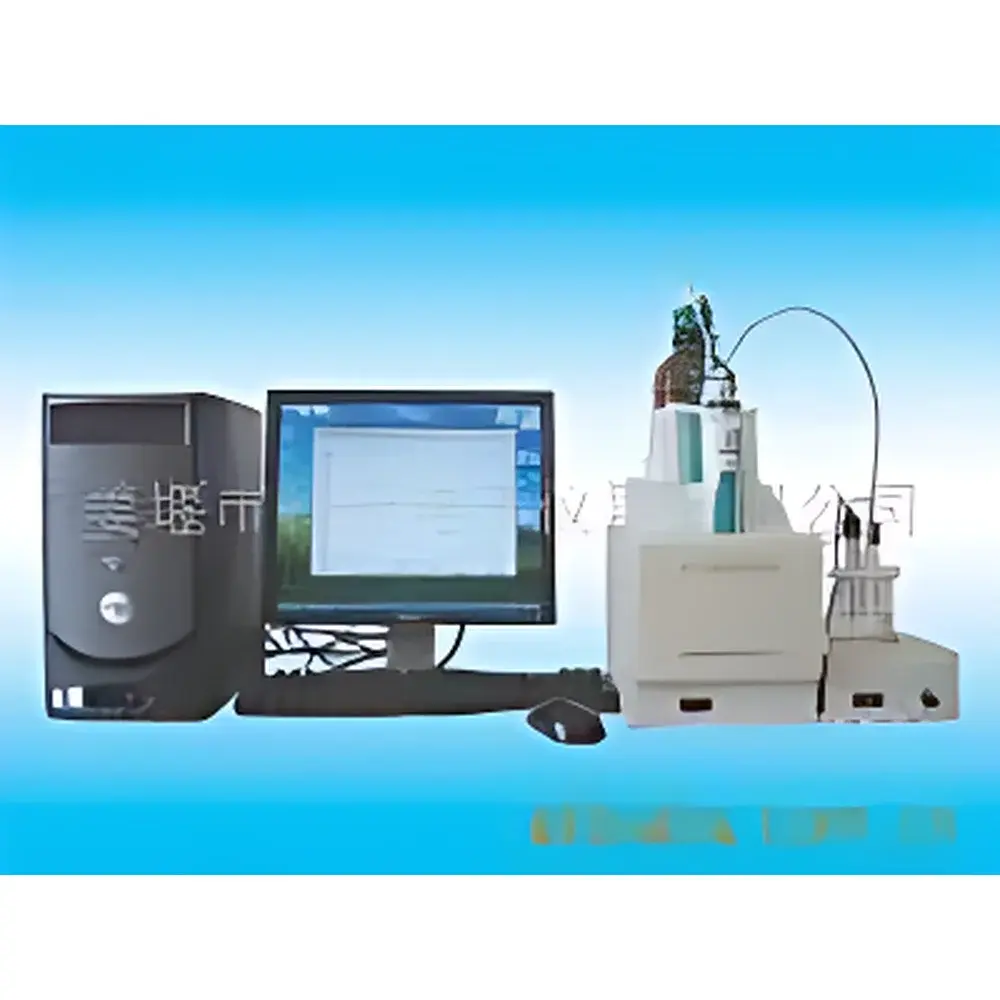
KY-4 D Microcomputer-Controlled Potentiometric Titration Analyzer for Basic Nitrogen in Petroleum Products
| Brand | Keyuan Instruments |
|---|---|
| Origin | Jiangsu, China |
| Manufacturer Type | Direct Manufacturer |
| Country of Origin | China |
| Model | KY-4 D |
| Pricing | Available Upon Request |
| Standard Compliance | GB/T 1792–1988 |
| Sample Form | Liquid |
| Measurement Range | ≥3 µg/g |
| Titration Method | Potentiometric Titration |
| Minimum Titration Volume | 0.01 mL |
| Potential Measurement Range | –1999.5 to +1999.5 mV |
| Burette Accuracy | ±0.1% F·S |
| Electrode Potential Resolution | 0.1 mV |
| Basic Error of Potential Unit | ±0.5 mV or ±0.1% of full scale |
| Relative Standard Deviation (RSD) | ≤5% |
Overview
The KY-4 D Microcomputer-Controlled Potentiometric Titration Analyzer is a dedicated instrument engineered for the precise quantification of basic nitrogen compounds in petroleum distillates, lubricating oils, and related hydrocarbon matrices. It operates on the fundamental principle of potentiometric titration—monitoring the potential shift across a high-impedance indicator electrode (typically a glass/reference combination) as a standardized perchloric acid titrant is incrementally delivered into the sample dissolved in glacial acetic acid. The inflection point of the resulting E–V curve corresponds to the stoichiometric endpoint of protonation of basic nitrogen species (e.g., pyridinic, quinolinic, and alkyl-substituted heterocyclic amines). Designed in strict accordance with GB/T 1792–1988 (“Determination of Basic Nitrogen in Petroleum Products — Potentiometric Titration Method”), the KY-4 D delivers trace-level sensitivity down to 3 µg/g, making it suitable for quality control in refinery laboratories, R&D facilities evaluating catalyst deactivation mechanisms, and regulatory compliance testing under ISO 8217 and ASTM D3228 frameworks.
Key Features
- Microprocessor-based control architecture with real-time curve acquisition and dynamic endpoint recognition via second-derivative analysis
- Imported precision burette assembly with volumetric accuracy of ±0.1% F·S and programmable dispensing resolution of 0.01 mL
- Dual high-input-impedance (>1012 Ω) analog front-end ensuring stable electrode potential measurement across the full ±1999.5 mV range
- Automated liquid handling sequence: solvent addition, sample dissolution, titrant delivery, endpoint confirmation, and post-titration rinse
- Onboard calibration routines for both electrode potential offset and burette volume verification using certified reference standards
- Robust mechanical design optimized for continuous operation in industrial laboratory environments with ambient temperature fluctuations
Sample Compatibility & Compliance
The KY-4 D accepts homogeneous liquid samples—including naphthas, kerosenes, diesel fuels, vacuum gas oils, and synthetic lubricants—provided they are fully soluble in glacial acetic acid and free of suspended particulates or water immiscibles that could foul the electrode surface or interfere with potential stability. Sample introduction is performed manually via calibrated syringe or automated sampler (optional add-on). All measurement protocols adhere to the metrological requirements defined in GB/T 1792–1988, which aligns closely with the technical scope of ASTM D3228 (Standard Test Method for Basic Nitrogen in Aviation Turbine Fuels) and serves as a validated surrogate for ISO 8217 Annex A. Data integrity meets GLP documentation standards, supporting audit-ready reporting with timestamped raw curves, endpoint coordinates, and operator identification logs.
Software & Data Management
The embedded Windows-compatible software provides full method development, execution, and post-processing capabilities. Users define titration parameters—including initial delay, incremental step size, stopping criteria (dE/dV threshold), and smoothing algorithm (Savitzky-Golay filter order 2, window width 5)—via an intuitive GUI. Raw potential vs. volume data is stored in .CSV and proprietary binary formats; curve interpolation, baseline correction, and multi-point endpoint refinement are supported. Audit trail functionality records all parameter modifications, calibration events, and result exports in accordance with ALCOA+ principles. Export options include PDF analytical reports compliant with internal QA templates and direct integration into LIMS via ODBC drivers.
Applications
- Refinery QC: Monitoring basic nitrogen content in crude assay fractions to assess catalyst poisoning risk in hydrotreating units
- Fuel specification compliance: Verification of aviation turbine fuel (Jet A-1) against maximum allowable basic nitrogen per DEF STAN 91-91 and MIL-DTL-83133E
- Lubricant formulation R&D: Correlating nitrogen-containing additive concentration with oxidation stability and sludge formation propensity
- Research on nitrogen speciation: Coupling with GC-MS or FTIR for compound-class identification following selective extraction protocols
- Educational laboratories: Teaching quantitative electroanalytical techniques including electrode kinetics, junction potential effects, and titration curve modeling
FAQ
What electrode configuration is recommended for optimal performance?
A combination glass/reference electrode with double-junction design and LiCl-saturated KCl filling solution is strongly recommended to minimize liquid junction potential drift during prolonged titrations in low-conductivity acetic acid media.
Can the KY-4 D be used for non-petroleum matrices such as biodiesel or bio-oils?
Yes—provided the sample is pre-treated to remove glycerides and free fatty acids that may coat the electrode surface; method validation per ASTM D6445 is advised prior to routine use.
Is the system compliant with FDA 21 CFR Part 11 requirements?
While the base configuration supports electronic signatures and audit trails, full Part 11 compliance requires optional validation packages, role-based access control modules, and encrypted database storage—available through authorized Keyuan Instruments service partners.
How often should the titration system be recalibrated?
Burette volumetric calibration is recommended before each analytical batch or at least daily when operating continuously; electrode potential calibration using standard buffer solutions (pH 4.01 and 7.00 in aqueous acetate matrix) should occur prior to each session.
Does the instrument support remote diagnostics or firmware updates?
Yes—via secure Ethernet connection and authenticated web interface; updates are distributed as digitally signed binaries with SHA-256 checksum verification.
Related Products







