
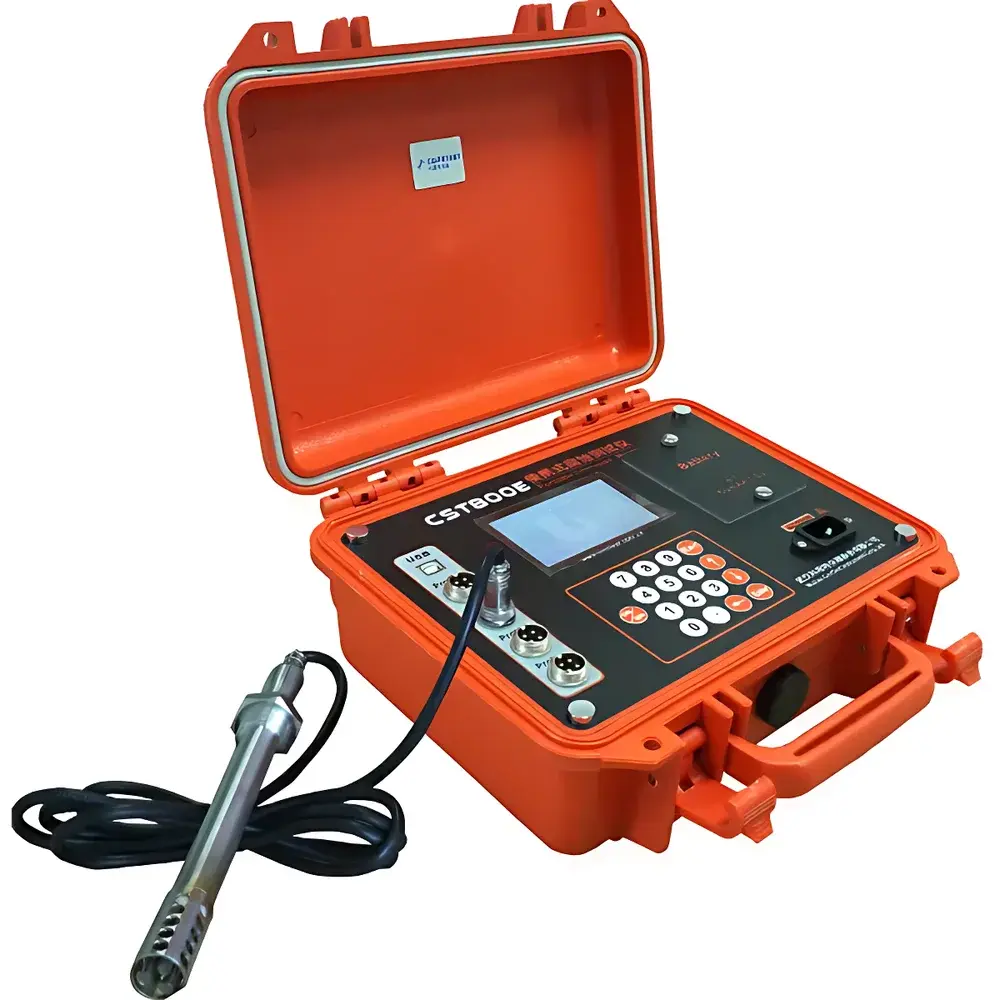
CorrTest CST800E Portable Electrochemical Impedance Spectroscopy (EIS) Corrosion Monitor
| Brand | CorrTest |
|---|---|
| Origin | Hubei, China |
| Manufacturer Type | Authorized Distributor |
| Country of Origin | China |
| Model | CST800E |
| Pricing | Upon Request |
| Measurement Principle | Electrochemical Impedance Spectroscopy (EIS) |
| Channels | 4 independent corrosion monitoring channels |
| Corrosion Rate Range | 0.1 μm/a to 10 mm/a |
| Absolute Accuracy | ±1% of reading |
| Input Impedance | 1 × 10¹¹ Ω |
| Corrosion Potential Range | −2.5 V to +2.5 V |
| Potential Resolution | 0.1 mV |
| Solution Resistance (Rs) Range | 10 Ω to 500 kΩ |
| Polarization Resistance (Rp) Range | 5 Ω to 10 MΩ |
| AC Excitation Signal | Sine wave, amplitude 1–100 mV, frequency 0.001 Hz–10 kHz |
| Timing Interval | 1–255 hours |
| Real-Time Clock Drift | <1 min/month |
| Onboard Memory | 16 MB non-volatile flash (20,000 data sets) |
| Communication Interfaces | USB 2.0, RS-485 |
| Power Supply | AC 220 V ±10% / 4 × AA rechargeable batteries (60 h continuous operation) |
| Dimensions | 280 mm × 250 mm × 110 mm |
| Weight | 3.5 kg |
| Operating Temperature | −30 °C to +60 °C |
| Relative Humidity | ≤80% RH (non-condensing) |
| Enclosure Material | Industrial-grade ABS polymer |
| Ingress Protection | IP65 |
| Included Accessories | CP-81 corrosion probe, electrode polishing kit, simulated electrolytic cell, power/USB/electrode/probe cables, EISTools software suite |
Overview
The CorrTest CST800E is a field-deployable, four-channel electrochemical impedance spectroscopy (EIS)-based corrosion monitor engineered for quantitative, non-destructive assessment of metallic degradation in complex, high-resistivity environments. Unlike conventional linear polarization resistance (LPR) instruments, the CST800E applies low-amplitude sinusoidal excitation (1–100 mV, 0.001 Hz–10 kHz) to the working electrode and resolves both solution resistance (Rs) and polarization resistance (Rp) at dual-frequency endpoints—enabling robust separation of ohmic drop and charge-transfer contributions. This dual-frequency EIS methodology ensures metrological traceability in media where Rs dominates (e.g., oil-contaminated wastewater, unsaturated soils, and chloride-diffused concrete), where traditional DC techniques suffer from unstable baseline drift and erroneous current integration. The instrument operates under ASTM G102 and ISO 16773-2 principles for corrosion rate derivation via Stern–Geary approximation, with built-in validation against open-circuit potential (OCP) stability thresholds prior to measurement initiation.
Key Features
- Four independent, galvanically isolated measurement channels for concurrent multi-location monitoring or redundant sensor validation
- True dual-frequency EIS architecture delivering simultaneous Rs and Rp quantification without manual calibration or compensation loops
- IP65-rated ruggedized enclosure with thermal-stabilized internal reference electronics for operation across −30 °C to +60 °C
- Hybrid power system supporting seamless transition between AC mains and 4×AA rechargeable battery pack (60 h runtime, field-swappable)
- Real-time clock with <1 min/month drift, enabling time-synchronized long-term trend analysis across distributed deployments
- 16 MB non-volatile flash memory storing full timestamped datasets—including OCP, Rs, Rp, icorr, and calculated corrosion rate—with automatic overwrite protection
- Integrated RS-485 interface for Modbus RTU integration into SCADA or PLC-based asset integrity management systems
Sample Compatibility & Compliance
The CST800E is validated for use with standard three-electrode corrosion probes (e.g., CP-81 stainless steel/Ag|AgCl configuration) in heterogeneous electrolytes including produced water (TDS up to 250,000 ppm), aerated and deaerated cooling tower fluids, saturated and partially saturated soils (resistivity >1 kΩ·m), and carbonated or chloride-impregnated concrete (pH 9–13). Its high-input-impedance front-end (1 × 10¹¹ Ω) prevents loading errors during high-Rs measurements. The device conforms to IEC 61326-1 (EMC for industrial environments), IEC 61000-4-2/4/5/6 (ESD/surge/conducted immunity), and meets mechanical shock/vibration requirements per MIL-STD-810G Method 516.6. Data acquisition workflows support GLP-compliant audit trails when used with EISTools software under 21 CFR Part 11–enabled configurations.
Software & Data Management
EISTools is a Windows-based corrosion data management platform certified for direct communication with CST800E and CST810E instruments via USB or RS-485. It ingests raw OCP, Rs, Rp, and derived icorr values into a local SQLite database with immutable timestamps and instrument serial-number tagging. Users generate time-series plots of corrosion rate vs. environmental parameters (e.g., temperature, pH, Cl⁻), perform cross-probe correlation analysis, and apply grey system theory (GST)-based predictive modeling to forecast remaining service life based on historical Rp decay trends. All reports export to PDF or CSV; graphical outputs include dual-Y axis charts overlaying Rp and corrosion rate, with configurable confidence intervals. Software update logs, user login history, and electronic signature fields are retained for regulatory review.
Applications
- Real-time corrosion rate mapping of downhole tubing, pipeline coupons, and heat exchanger tubes in oilfield produced water systems
- Long-term monitoring of buried pipeline coatings and cathodic protection efficiency in soil resistivity gradients
- Quantitative evaluation of inhibitor performance in recirculating cooling water circuits under dynamic biocide dosing regimes
- In-situ assessment of reinforcement depassivation kinetics in reinforced concrete infrastructure exposed to marine or de-icing salt environments
- Field validation of accelerated laboratory corrosion tests (e.g., ASTM G109, G155) against actual service conditions
FAQ
Can the CST800E operate unattended for extended periods?
Yes—the device supports autonomous scheduled measurements at user-defined intervals (1–255 hours) and wakes from ultra-low-power sleep mode using its onboard RTC. Data is stored locally until retrieval.
Is the CP-81 probe compatible with aggressive sour environments (H₂S, CO₂)?
The CP-81 uses 316L stainless steel working electrodes and Ag/AgCl reference elements rated for continuous immersion in pH 3–11 media containing up to 500 ppm H₂S. Optional Hastelloy C-276 variants are available for severe service.
Does EISTools support automated report generation for regulatory submissions?
Yes—templates comply with ISO 21809-3 Annex D and NACE SP0106 reporting structures. Audit logs record all data modifications, and digital signatures meet ALCOA+ data integrity criteria.
How is measurement accuracy verified in the field?
Each unit ships with a traceable NIST-calibrated simulated electrolytic cell. Users perform daily verification using this cell to confirm Rs and Rp response linearity before deployment.
Can multiple CST800E units be synchronized across a wide area network?
Via RS-485 daisy-chaining or optional Ethernet gateway, up to 32 units can share a common time base and upload data to a central server using Modbus TCP or MQTT protocols.
Related Products






