
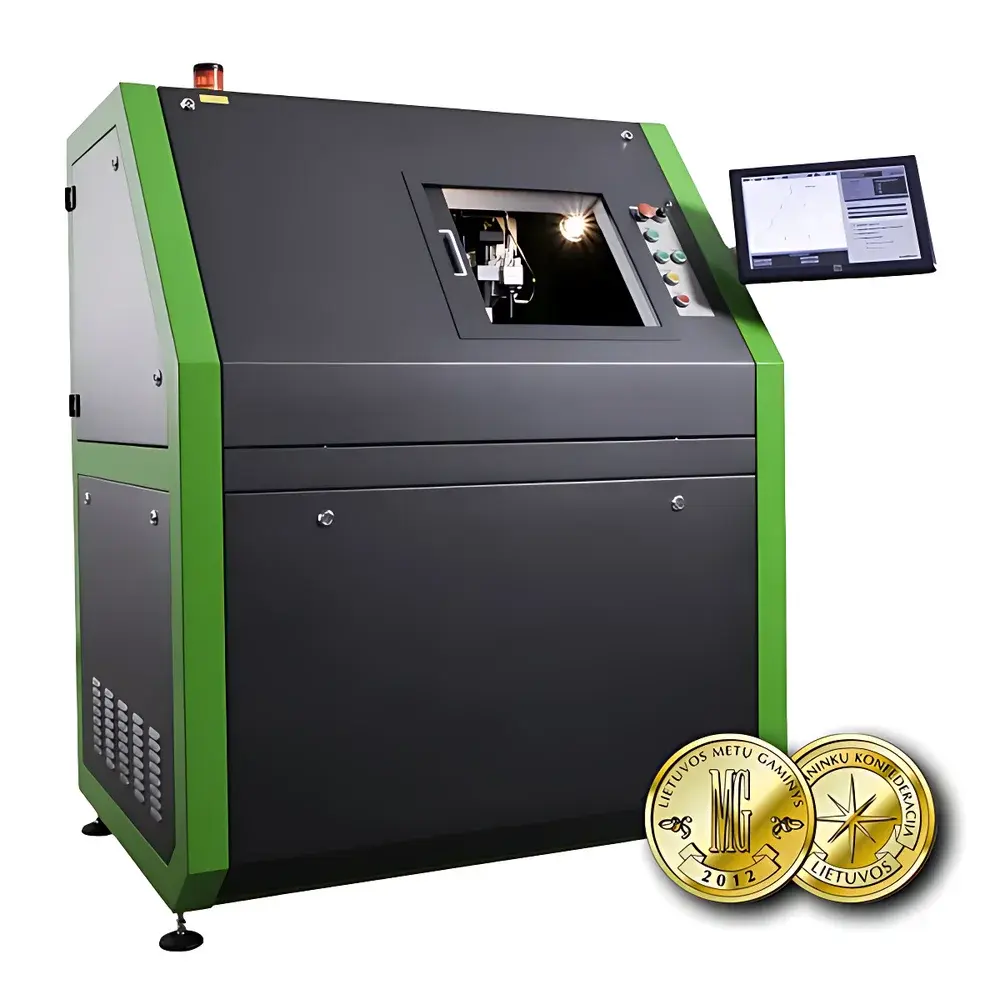
ELAS Ventu FNP1064 Industrial Nanosecond Fiber Laser Micromachining Workstation
| Brand | ELAS |
|---|---|
| Model | Ventu FNP1064 |
| Laser Type | MOPFA Q-switched Yb-doped fiber laser |
| Wavelength | 1064 nm (nominal, 1060–1070 nm range) |
| Avg. Output Power | 20 W |
| Pulse Duration | 120 ns |
| Repetition Rate | 20–100 kHz |
| Beam Diameter | ~6 mm |
| Beam Quality (M²) | < 1.6 |
| Positioning System | 3-phase ironless linear motor stage |
| Travel Range | 300 × 300 mm |
| Bidirectional Repeatability | 0.7 µm |
| On-Axis Accuracy | 5 µm |
| Max Speed | 500 mm/s |
| Max Acceleration (no load) | 20 mm/s² |
| Dimensions | 1500 × 1500 × 900 mm |
| Weight | ~350 kg |
| Input Voltage | 220 V AC |
| Max Power Consumption | < 3 kW |
| Operating Temp | 18–27 °C |
| RH | 10–80 % (non-condensing) |
Overview
The ELAS Ventu FNP1064 is an industrial-grade nanosecond pulsed fiber laser micromachining workstation engineered for high-precision, high-reproducibility material processing in demanding production and R&D environments. Built upon a MOPFA (Master Oscillator Power Amplifier) Q-switched ytterbium-doped fiber laser platform, it delivers stable 1064 nm radiation with tightly controlled pulse parameters—120 ns pulse width and adjustable repetition rates from 20 to 100 kHz—optimized for non-thermal ablation, minimal heat-affected zone (HAZ), and high-fidelity feature definition in brittle and thermally sensitive substrates. Its core architecture integrates a high-stiffness linear motor-driven XY positioning system with sub-micron repeatability (0.7 µm bidirectional), enabling robust long-run operation across silicon wafers, refractory metal alloys (e.g., Inconel, titanium), and advanced ceramics (Al₂O₃, SiC, ZrO₂). Designed for integration into ISO 14644-compliant cleanrooms or controlled manufacturing cells, the FNP1064 meets essential safety requirements per IEC 60825-1:2014 (Class 4 laser product) and supports optional interlock interfaces compliant with EN ISO 13857.
Key Features
- Nanosecond-pulsed Yb-doped fiber laser (1064 nm) with M² < 1.6 beam quality for diffraction-limited focusing and consistent energy density distribution
- Automated Z-axis focus control with integrated distance sensor for real-time focal plane compensation during multi-layer or warped substrate processing
- Machine vision subsystem (optional) featuring high-resolution CMOS imaging and AI-assisted pattern recognition for automatic fiducial alignment, defect-based ROI selection, and in-process verification
- Modular gas delivery interface supporting N₂, O₂, Ar, or compressed air for assist gas-assisted cutting, oxidation suppression, or plasma plume mitigation
- Open-architecture control software with Python API and native support for G-code, DXF, and Gerber file import—enabling seamless integration with CAD/CAM workflows and MES systems
- Low consumables footprint: no flashlamps, no mirrors requiring periodic replacement, and sealed optical path design minimizing maintenance intervals
Sample Compatibility & Compliance
The Ventu FNP1064 is validated for direct-write processing of semiconductor-grade monocrystalline and polycrystalline silicon, sapphire substrates, copper-clad laminates (FR-4, polyimide), stainless steel 304/316, nickel-titanium shape-memory alloys, and technical ceramics including alumina, silicon carbide, and lithium niobate. It supports process qualification per ASTM F3048 (standard guide for laser micromachining of medical devices) and enables traceable parameter logging required under ISO 13485 and FDA 21 CFR Part 11 when configured with audit-trail-enabled software. All mechanical and electrical subsystems conform to CE marking directives (EMC Directive 2014/30/EU, Machinery Directive 2006/42/EC), and laser safety enclosures meet EN 60825-1 Class 1 requirements when interlocked.
Software & Data Management
The workstation runs ELAS ControlSuite™ v4.x—a deterministic real-time OS-based platform with dual-mode operation: guided wizard mode for rapid process setup by technicians, and expert scripting mode for advanced users implementing custom scan strategies (e.g., vector-synchronized pulse-on-demand, hatch pattern optimization, or multi-pass depth control). Process logs include timestamped laser parameters (pulse energy, peak power, overlap ratio), stage position trajectories, environmental sensor readings (temperature, humidity), and machine vision metadata. Data export conforms to HDF5 and CSV standards; raw log files are digitally signed and cryptographically hashed to satisfy GLP/GMP data integrity requirements. Optional cloud synchronization enables remote diagnostics and fleet-wide performance benchmarking across distributed manufacturing sites.
Applications
- High-aspect-ratio micro-milling of cooling channels in turbine blade molds (aspect ratios up to 25:1 in Inconel 718)
- Drilling of <50 µm vias in silicon interposers for 2.5D/3D IC packaging
- Cutting of thin-film photovoltaic layers (CIGS, perovskite) without delamination or thermal cracking
- Surface texturing of biomedical implants for enhanced osseointegration (Ra control ±0.05 µm)
- Trimming of thick-film resistors on hybrid ceramic substrates with <±0.1% resistance tolerance
- Marking and serialization of aerospace components compliant with AS9132 and SAE AMS2750E
FAQ
What laser class does the Ventu FNP1064 operate under, and what safety measures are integrated?
The system is certified as a Class 4 laser product per IEC 60825-1:2014. It includes interlocked safety enclosures, emergency stop circuitry compliant with EN ISO 13850, and integrated laser emission indicators synchronized with shutter status.
Can the FNP1064 be integrated into an automated production line?
Yes—it provides Ethernet/IP and PROFINET communication protocols, hardware I/O triggers (TTL/24 V), and full PLC handshake support for seamless integration with conveyor systems, robotic loaders, and MES platforms.
Is vacuum processing supported out-of-the-box?
Vacuum capability is available via optional vacuum generator module with chamber interface flange (KF40 or CF35), enabling ablation in low-pressure inert environments for reduced plasma shielding and improved surface finish.
What level of calibration traceability is provided with the system?
Positioning accuracy is verified using laser interferometry traceable to NIST standards; laser power and pulse energy calibration certificates are issued annually by an ISO/IEC 17025-accredited metrology lab.
Does ELAS provide application engineering support for process development?
Yes—customers receive 20 hours of remote application consulting and one on-site process validation day as part of standard commissioning, with extended support packages available under SLA terms.



