
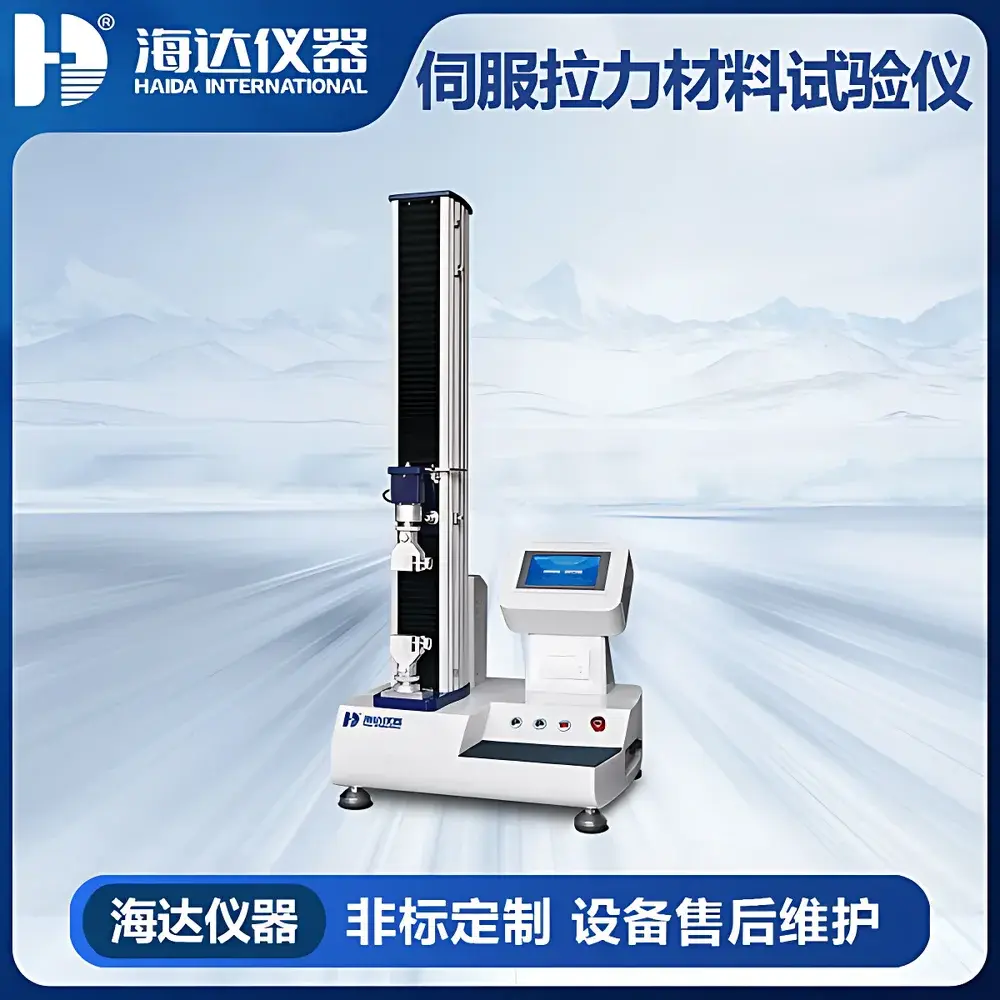
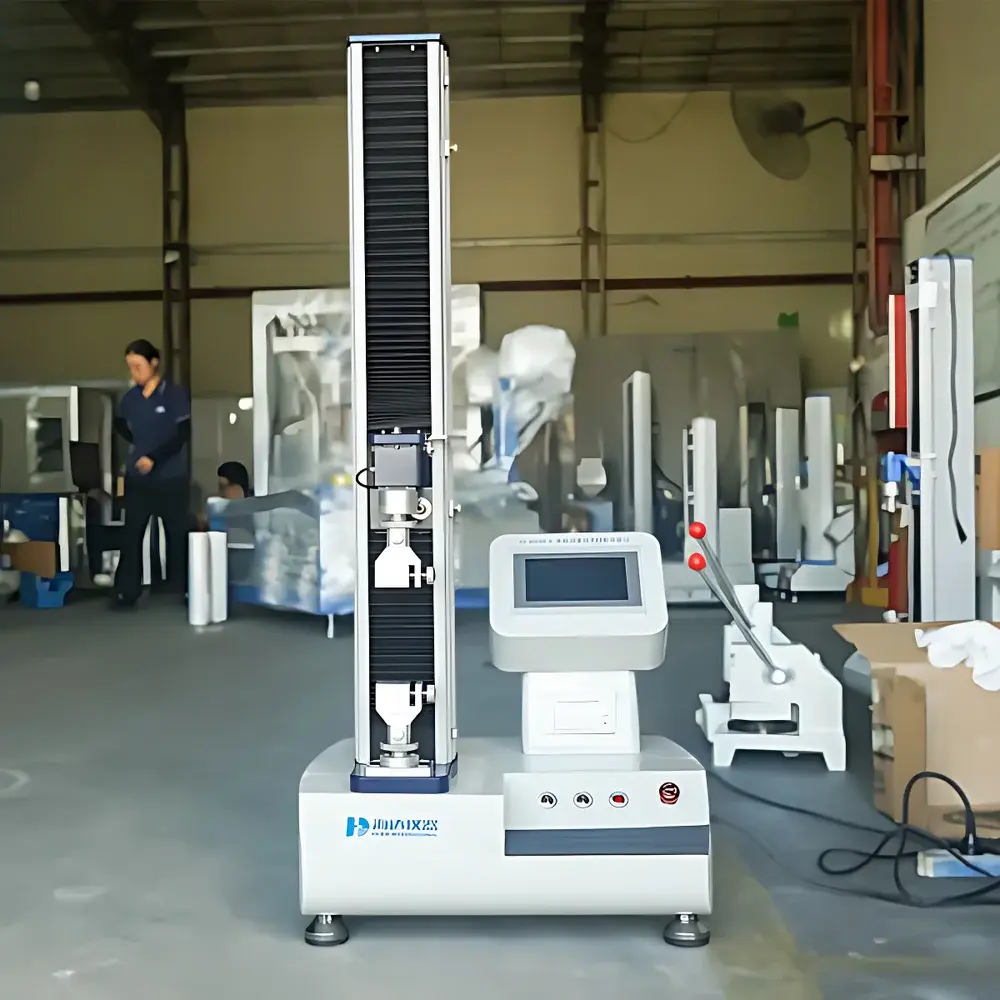
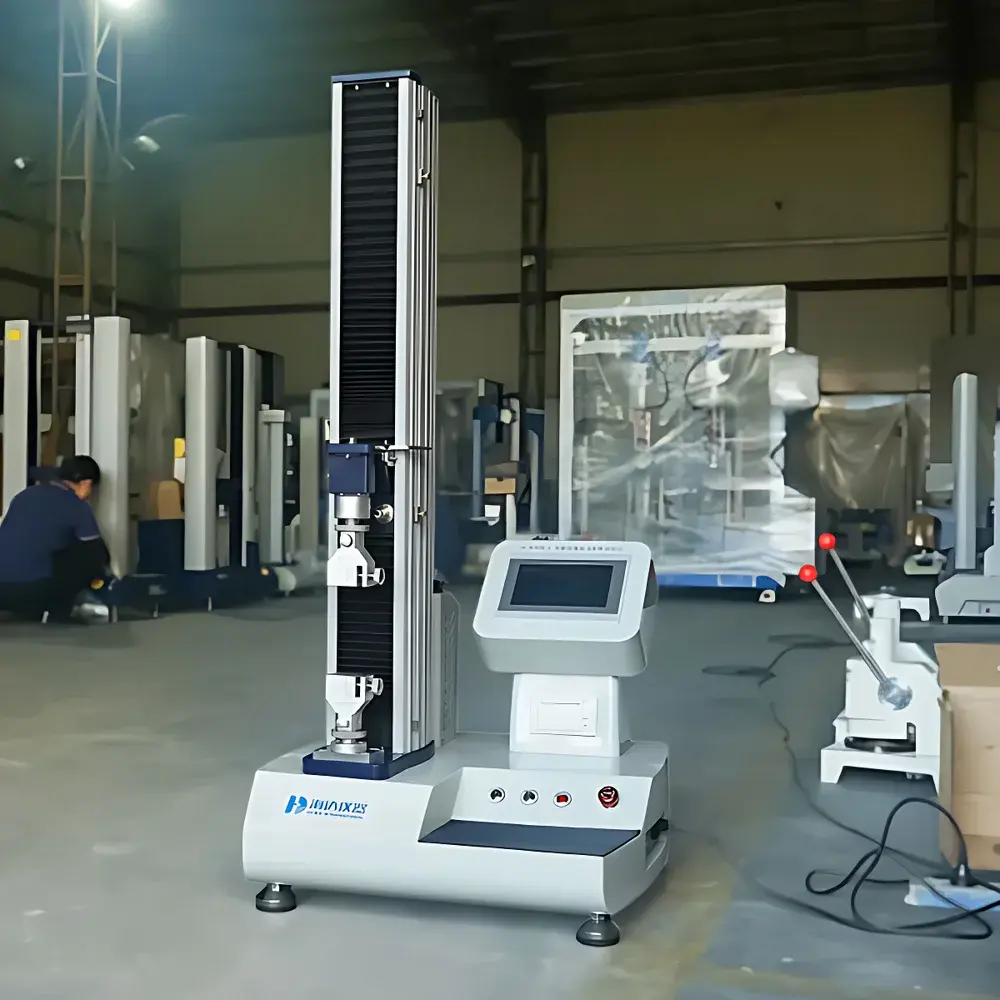
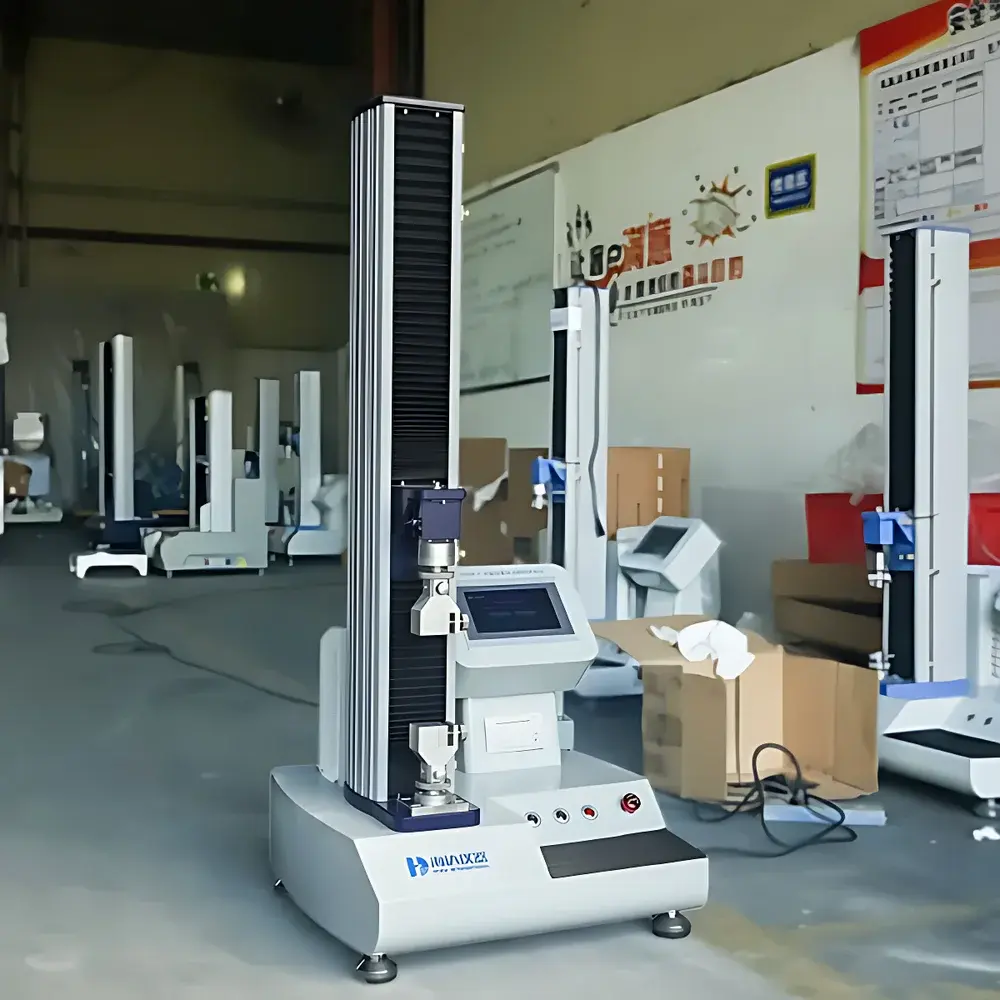
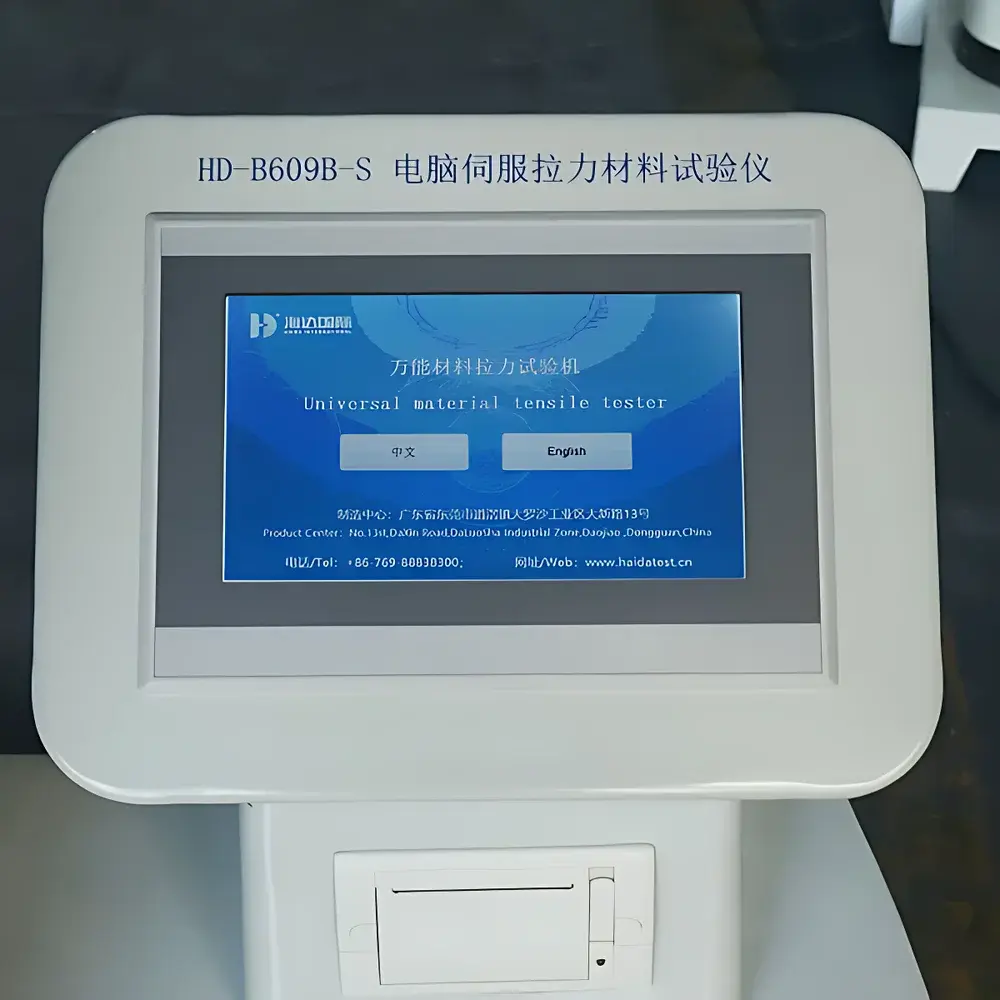
HAIDA HD-B609B-S Computer-Controlled Servo-Powered Tensile Testing Machine
| Brand | HAIDA INTERNATIONAL |
|---|---|
| Origin | Guangdong, China |
| Manufacturer Type | Direct Manufacturer |
| Product Category | Domestic (China-Made) |
| Model | HAIDA HD-B609B-S Computer-Controlled Servo-Powered Tensile Testing Machine |
| Instrument Type | Electromechanical Tensile Tester |
| Maximum Test Load | 50 N / 1 kN / 2 kN (selectable load cell) |
| Force Measurement Range | 0.05 N to 2 kN (full scale) |
| Force Accuracy | ≤ ±0.5% FS |
| Crosshead Speed Range | 0.1–500 mm/min |
| Effective Stroke | 900 mm (excluding grips) |
| Load Resolution | 1/250,000 of full scale |
| Horizontal Clearance (grip center to dust cover) | 60 mm |
| Dimensions (L×W×H) | ≈ 580 × 550 × 1250 mm |
| Weight | ≈ 70 kg |
| Power Supply | 1Ø AC 220 V, ~500 W |
Overview
The HAIDA HD-B609B-S is a precision-engineered, computer-controlled electromechanical tensile testing machine designed for static mechanical property evaluation of materials across R&D, quality control, and production environments. It operates on the principle of controlled uniaxial force application—measuring load response (via high-resolution load cells) and displacement (via calibrated encoder feedback on a preloaded滚珠丝杆—ball screw actuation system)—to determine fundamental mechanical parameters including tensile strength, yield point, elongation at break, modulus of elasticity, compressive strength, peel adhesion, tear resistance, puncture force, and seal integrity. Its dual-control architecture—supporting both Windows-based PC operation and integrated touchscreen interface—enables seamless test setup, real-time monitoring, and post-test analysis without external software dependencies. The system conforms to core structural and metrological requirements defined in ISO 7500-1 (static calibration of testing machines), ASTM E4 (load verification), and ISO 5893 (tensile testing instrumentation), forming a foundational platform for compliant physical property assessment.
Key Features
- High-fidelity force measurement using interchangeable load cells (50 N, 1 kN, or 2 kN), each certified to ≤ ±0.5% full-scale accuracy per ISO 7500-1 Class 0.5
- 400 W servo motor coupled with a precision ground ball screw drive, delivering smooth, low-noise motion and exceptional positional repeatability over the full 900 mm stroke
- Dual-mode control architecture: simultaneous operation via industrial-grade 7-inch capacitive touchscreen (with embedded firmware) and Windows PC (via USB or optional Ethernet)
- Multi-mode closed-loop control: constant rate of crosshead displacement, constant strain rate, constant stress rate, constant force ramp, and displacement-limited hold modes—all switchable within a single test sequence
- Comprehensive hardware protection: electronic overload cutoff, mechanical end-stop limit switches, and programmable travel limits prevent damage during abnormal conditions
- Real-time data acquisition at ≥1 kHz sampling rate, supporting dynamic event capture such as brittle fracture initiation or adhesive debonding onset
Sample Compatibility & Compliance
The HD-B609B-S accommodates specimens ranging from thin polymer films (e.g., PET, PE, BOPP) and elastomeric seals to rigid plastics, metallic foils, composites, paperboard, textiles, and wood-based panels. Standardized grip configurations—including pneumatic, wedge, roller, and peel-specific fixtures—are compatible with ISO 6892-1, ASTM D638, ASTM D882, ASTM D1876 (T-peel), ASTM D903 (180° peel), ISO 11339 (adhesive bond strength), ISO 1421 (rubber tear), and GB/T 228.1–2021. Calibration traceability follows JJG 475–2018 (Chinese national verification regulation for universal testing machines) and GB/T 16825.1–2008 (verification of force measurement systems). For regulated environments, audit trails, user access controls, and electronic signature support can be implemented via optional GLP/GMP-compliant software modules aligned with FDA 21 CFR Part 11 requirements.
Software & Data Management
The embedded HAIDA TestSuite software provides ISO/ASTM-compliant test method templates for tensile, compression, bend, peel, tear, puncture, and shear protocols. All raw data—including time-stamped load, displacement, and calculated engineering stress/strain—is stored in open CSV and XML formats for third-party statistical analysis. USB export supports direct transfer to Microsoft Excel, MATLAB, or Minitab; optional thermal printer integration produces ISO 17025-compliant hardcopy reports with embedded test curves, metadata, and calibration certificates. Multi-user permission levels (operator, supervisor, administrator) ensure procedural integrity, while batch testing mode enables automated sequential execution of up to 99 samples with pass/fail criteria based on user-defined upper/lower limits.
Applications
- Plastics & Polymers: Determination of tensile modulus, yield strength, and elongation per ISO 527 and ASTM D638
- Packaging Materials: Seal strength validation (ASTM F88), peel adhesion of laminates (ASTM D903), and puncture resistance of flexible pouches (ASTM F1306)
- Medical Devices: Testing of suture tensile strength (ISO 10555), catheter burst pressure (ISO 10555-1), and adhesive tape performance (ISO 29862)
- Automotive Components: Evaluation of gasket compression set (ISO 188), rubber bushing stiffness (ISO 4664), and composite panel flexural rigidity (ASTM D7264)
- Electronics: Bond strength of wire bonds and solder joints under shear or pull-off loading (JEDEC JESD22-B116)
FAQ
What load cell options are available, and how are they selected?
The HD-B609B-S supports three factory-calibrated load cells: 50 N (for thin films and micro-specimens), 1 kN (general-purpose plastics and composites), and 2 kN (metals, reinforced polymers, and structural components). Selection is based on expected maximum load—ideally operating between 10% and 90% of full scale for optimal resolution and accuracy.
Is the system compliant with ISO/IEC 17025 requirements for accredited labs?
Yes—the base system meets mechanical and metrological prerequisites. Full accreditation readiness requires documented calibration records (traceable to NIM or equivalent NMIs), uncertainty budgets, environmental monitoring logs, and implementation of a validated software configuration management process, all supported by HAIDA’s Quality Assurance Documentation Package.
Can test methods be exported or imported between instruments?
Yes—test configurations (including control parameters, calculation formulas, and reporting templates) are saved as portable .hdt files and can be deployed across identical HD-B609B-S units without reconfiguration.
What safety certifications does the unit carry?
The instrument complies with IEC 61000-6-2 (EMC immunity) and IEC 61000-6-4 (EMC emissions), and carries CE marking per Machinery Directive 2006/42/EC and Low Voltage Directive 2014/35/EU. UL/cUL listing is available upon request for North American deployment.
How is thermal drift compensated during long-duration tests?
Load cells feature temperature-compensated semiconductor strain gauges; real-time ambient temperature monitoring triggers automatic zero-drift correction algorithms during idle periods and low-speed testing phases, maintaining stability within ±0.1% FS over 8-hour continuous operation.



